Sat 06 December 2025:
Three decades on from the day Hindu mobs razed the historic Babri Masjid to the ground, India’s Muslims still refuse to forget its legacy. In a nation increasingly dominated by Hindutva nationalism, that unyielding memory has become the a powerful act of resistance,” writes journalist Rushda Fathima Khan.
Despite the construction of the new Ram Temple and the extensive national media coverage surrounding its completion, the memory of Babri has not faded from the community’s collective consciousness. That endurance itself reflects a form of resistance.
Across societies, when communities are pushed aside or denied justice, their collective memory becomes sharper. Moments of rupture become reference points that organise political understanding. Memory evolves into a source of clarity in situations where the institutional environment does not deliver fairness.
ARCHEOLOGIST WHO OBSERVED DIG SAYS NO EVIDENCE OF TEMPLE UNDER BABRI MASJID
This is the dynamic visible in the Indian Muslim relationship to Babri. The event has become more than a historical episode. It has become a marker against which subsequent political developments are measured.
The relationship between erasure and remembrance has parallels elsewhere. In Bosnia during the 1990s, the destruction of mosques and cultural infrastructure formed part of a broader political project to reorder identity and belonging. Reports from western China have described the steady removal of Islamic architecture in regions inhabited by Uyghur Muslims. Each context differs, but the underlying dynamic is comparable. Once a state or dominant political movement defines a minority identity as a problem, religious and cultural spaces become sites of contestation.
BABRI MASJID-RAM MANDIR: ALL YOU NEED TO KNOW ABOUT THE LONG-STANDING DISPUTE
To understand the significance of 6 December, it is necessary to revisit the decades that preceded the demolition. Anti-Muslim violence in places such as Moradabad, Nellie, Hashimpura and Bhagalpur had already created a sense that state institutions were unwilling or unable to protect Muslims.
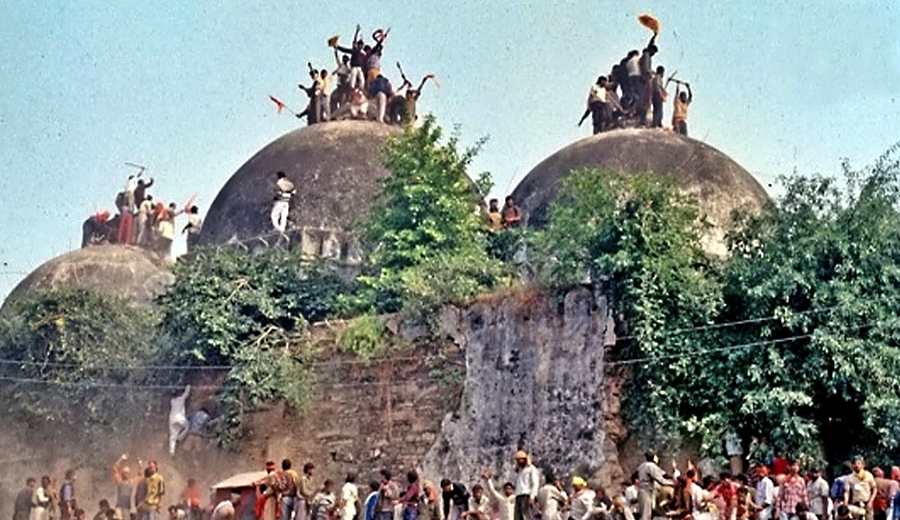
Babri confirmed these fears in an unmistakable way. On 6 December 1992, tens of thousands of Hindu extremists spent hours bringing the 16th-century mosque down with hammers and makeshift tools. Senior political leaders of the right-wing Bharatiya Janata Party (BJP) and other Hindu extremist groups were present in the area and police units did not intervene. The demolition was followed by one of the deadliest outbreaks of communal violence in India, with nearly two thousand people killed in riots across several states.
Investigative commissions produced extensive documentation but limited accountability. Several far-right political actors implicated in the mobilisation were not held responsible. Cases dragged on for decades before ending in acquittals. Most significantly, in 2019, the Supreme Court described the demolition as a serious violation of the rule of law yet awarded the disputed land for the construction of a Ram templet.
JUDGEMENT IS UNJUST: MUSLIM BOARD LAWYER REACTS TO BABRI MASJID VERDICT (WATCH)
This outcome signalled a deeper problem. Every institutional pathway that should have constrained majoritarian mobilisation had failed to do so. Opposition parties offered rhetorical criticism but no sustained political challenge. Babri thus exposed a structural reality: the solution to the vulnerability of Indian Muslims could not be found within the system as it operates today. The institutions that were created to act as checks have increasingly converged with the political logic of Hindutva.
The developments of the past decade underline this assessment. Human rights organisations, including Amnesty International, have documented punitive demolitions targeting Muslim homes, businesses and religious structures across several states. These actions are often justified through allegations of illegal construction, yet many demolitions follow protests by Hindu extremist outfits or communal tensions rather than due legal process.
The bulldozer has become an unofficial symbol of administrative power, conveying retribution instead of procedural justice. The pattern extends to religious sites.
In 2024, the government’s attempt to survey the Shahi Jama Masjid in Uttar Pradesh’s Sambhal triggered protests that ended with at least five Muslim men killed in police firing. These contemporary developments link the past to the present. The Ram Temple spectacle, choreographed by the ruling BJP and fronted by India’s Hindu nationalist Prime Minister Narendra Modi, who positioned himself at the centre of a religious event in full view of the nation’s cameras, was celebrated by large sections of the Hindu masses as a moment of pride.
For Indian Muslims, the exclusion revealed by Babri is now reinforced by the wider public whose celebrations have normalised a tragedy that Muslims continue to grieve.
__________________________________________________________________________

https://whatsapp.com/channel/0029VaAtNxX8fewmiFmN7N22
__________________________________________________________________________
Thirty-three years after Babri, the central lesson remains unchanged. The demolition exposed the limitations of every institution that was expected to safeguard minority rights, and the decades since have confirmed how deeply that alignment has taken root. The memory endures because it reflects a truth that Indian Muslims encounter repeatedly in contemporary India: the existing system offers no meaningful route to redress or protection.
Remembering Babri is therefore not an act of looking backward. It is a clear understanding of the political reality they continue to face.

__________________________________________________________________________
FOLLOW INDEPENDENT PRESS:
WhatsApp CHANNEL
https://whatsapp.com/channel/0029VaAtNxX8fewmiFmN7N22

TWITTER (CLICK HERE)
https://twitter.com/IpIndependent

FACEBOOK (CLICK HERE)
https://web.facebook.com/ipindependent

YOUTUBE (CLICK HERE)
https://www.youtube.com/@ipindependent

Think your friends would be interested? Share this story!