Wed 22 October 2025:
When Donald Trump sent a last-minute invitation to Benjamin Netanyahu to attend the Sharm el-Sheikh ceasefire summit, President Recep Tayyip Erdoğan stopped his private plane from landing in Egypt. While the Turkish presidential plane circled above, officials say Erdoğan pushed Cairo hard, threatened to boycott the event, and rallied other Muslim nations to do the same. Netanyahu ultimately stayed away (his office cited a Jewish holiday). Multiple outlets note Turkey’s opposition as a factor, even if the narratives differ at the edges. The outcome was clear: Netanyahu did not land, and Egypt–Qatar–Türkiye–U.S. issued a joint statement backing a ceasefire framework. That sequence shows where real leverage moved—in Ankara’s diplomacy, not in a pipeline valve.
But set that against the recurring demand to “shut the tap” at Ceyhan? Ceyhan is the seaward end of the Baku–Tbilisi–Ceyhan (BTC) pipeline, a 1,700-km corridor built as much in treaty text as in steel. Under the Intergovernmental Agreement and Host Government Agreements, the states promised not to “interrupt or impede” the freedom of transit “through the Facilities,” which is a defined term that reaches the terminal and jetties—and route disputes into binding state-to-state arbitration and investor arbitration (ICC/ICSID-type). A destination-specific order at the loading docks (“no liftings that could end up in Israel”) is exactly the kind of interference the trade regime is designed to punish with damages. That is why Ankara has leaned on a full trade freeze, port restrictions, and airspace limits rather than a terminal-level BTC ban.
Those “everything-but-BTC” steps may seem hypocritical. Yet Türkiye halted all bilateral trade with Israel on 2–3 May 2024 and later barred Israeli ships from Turkish ports while restricting airspace to Israeli government flights and flights carrying arms. On this mix of trade, port, and airspace measures, Türkiye stands almost alone among major economies.
There is also the system reality: even if Türkiye could lawfully stop a particular Ceyhan lifting, it would not “turn off Israel’s energy.” Israel’s power system runs mostly on natural gas; in 2024 gas supplied the dominant share of electricity, with coal and renewables making up most of the rest. Crude flows matter chiefly for refining (jet/diesel/gasoline), not for baseload power. That does not make crude irrelevant to military fuels, but it does mean BTC is not a singular “energy lifeline.” Moreover, the BTC is not a simple, direct line to Israel but carries fuel to the rest of the Mediterranean and the EU. Israel could piggyback off other fuel shiploads leaving Ceyhan making the punitive process difficult to enforce.
South Africa
Now pivot to South Africa—the place with a lever the government can pull. Since late 2023, Israeli utilities have continued to receive coal at Hadera/Orot Rabin. S&P’s vessel tracking shows that in early 2024 Colombia provided the bulk of Israel’s coal imports (≈60%), with South Africa a smaller but notable share that later had room to rise after Bogotá announced a ban. The legal point is cleaner than the tonnage: South African coal exports are regulated by domestic South African law, not a corridor treaty. Pretoria can put “coal to Israel” behind export permits (and refuse them), for which there is precedent, or issue a time-bound prohibition via Government Gazette under the International Trade Administration Act and Export Control Regulations. That is an administratively straightforward, domestically lawful switch.
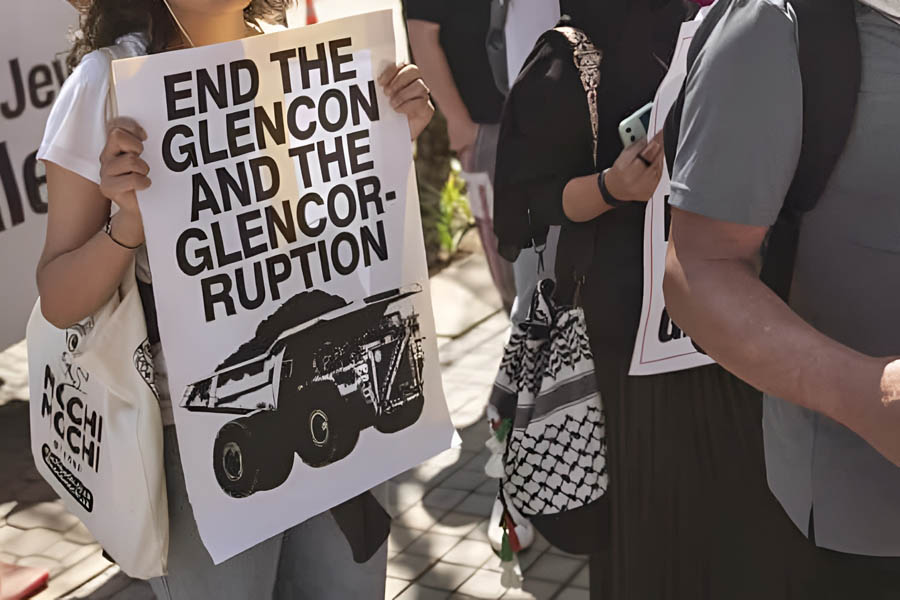
Glencore
Where does Glencore fit? Two ways. First, Glencore is one of South Africa’s leading producers and exporters of thermal coal, with multiple complexes in Mpumalanga and a long-standing marketing operation that sells seaborne thermal coal globally. Second, Glencore’s South African footprint includes joint ventures with African Rainbow Minerals (ARM), notably the Goedgevonden (GGV) mine, where Glencore holds 74% and ARM 26%. That coal is produced for both domestic Eskom and export through RBCT—i.e., the very logistics chain that can feed Hadera when traders and utilities bid for tons. It is therefore accurate to say that some South African coal with Glencore involvement is technically capable of reaching Israel when market signals and shipping windows align, tying a specific Hadera discharge to a specific Glencore-origin parcel, however, requires bill-of-lading-level proof.
There is also the Colombia precedent underscoring Glencore’s role as a global coal actor. In 2024–2025, Colombia (historically Israel’s main supplier) oved to halt coal exports to Israel, and President Gustavo Petro publicly pressed Glencore over shipments and later claimed Cerrejón had ceased sales to Israel in line with the decree.
That dispute illustrates the obvious that large miners/traders like Glencore are often the commercial hinge in any country-to-Israel coal flow, and that they respond to binding government measures when those measures exist.
This is where investor–state dispute settlement (ISDS) reframes what counts as “punitive.” Pipeline treaties and HGAs attach cash liability to state interference at the terminal; a targeted Ceyhan block would invite both state-to-state and investor claims that will carry significant damages. By contrast, if South Africa gates “coal to Israel,” the legal fight tracks through the WTO: Israel could bring a GATT Article XI complaint; South Africa could defend under national-security (Article XXI) and public-morals (Article XX(a)) if the measure is narrow and evidence-based. WTO remedies are prospective (change the measure or accept retaliation), not investor-style damages that would happen in the case of the BTC challenge. In short, BTC’s treaty box makes a cutoff legally expensive while coal export controls are legally manageable, even if politically loud.
__________________________________________________________________________

https://whatsapp.com/channel/0029VaAtNxX8fewmiFmN7N22
__________________________________________________________________________
Türkiye has combined a trade freeze with port and airspace limits while respecting BTC’s legal architecture, and it used political leverage not the pipleline to prevent Netenyahu from attending. Meanwhile South Africa has a domestic legal switch it can flip on coal, and the corporate infrastructure (miners and traders including Glencore-linked ventures) ensures that a Gazette notice would bite in practice.
In Türkiye, the law around BTC is designed to keep oil moving and to punish terminal-level interference. Ankara has therefore applied pressure everywhere else and, when it mattered, and used diplomacy to move events. In South Africa, coal exports are a matter of domestic licensing. If Pretoria wants policy to match principle, it can gate or pause coal to Israel and then litigate the WTO questions on security or public morals. If your aim is pressure that holds up in court as well as in headlines, follow not just the ships but the rules they sail under but the companies, too. In this case Glencore’s South African coal sits right at the hinge between policy choices in Pretoria and electricity margins in Israel.
The statements, views and opinions expressed in this column are solely those of the authors and do not necessarily represent those of Independent Press.

By Mariam Jooma Çarikci
Mariam Jooma Çarikci is an Independent researcher, focused on the politics of Africa, Zionism in Africa, and Türkiye’s evolving role in the Middle East and Africa.
__________________________________________________________________________
FOLLOW INDEPENDENT PRESS:
WhatsApp CHANNEL
https://whatsapp.com/channel/0029VaAtNxX8fewmiFmN7N22

TWITTER (CLICK HERE)
https://twitter.com/IpIndependent

FACEBOOK (CLICK HERE)
https://web.facebook.com/ipindependent

YOUTUBE (CLICK HERE)
https://www.youtube.com/@ipindependent

Think your friends would be interested? Share this story!