Tue 25 November 2025:
The report, titled “From Risk to Resilience: Helping People and Firms Adapt in South Asia,” based on case studies from Bangladesh, India and Pakistan, said South Asia is one of the world’s most climate-vulnerable regions due to its dense population, rising temperatures and exposed geography.
The study said the region is expected to face “more frequent and more severe weather” shocks over the coming decade.
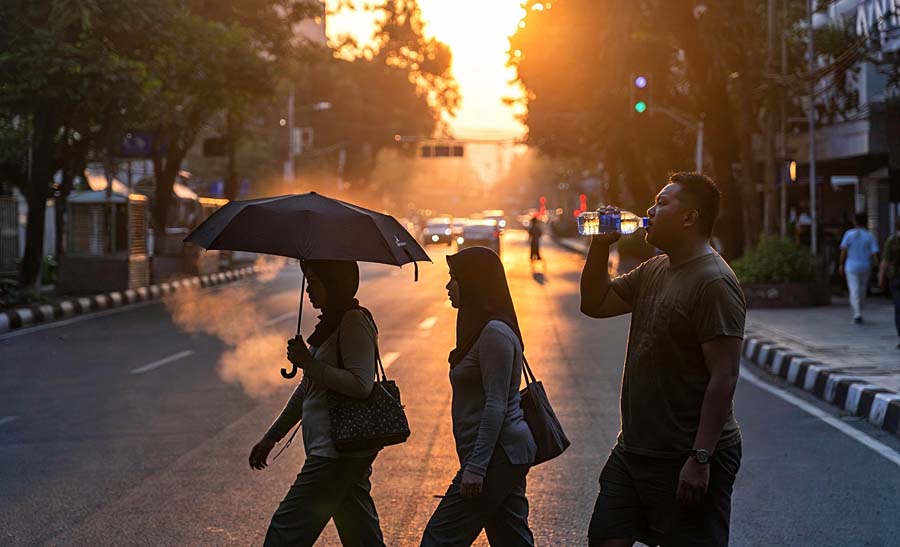
By 2030, 1.8 billion people — 89% of the population — are projected to be exposed to extreme heat, while 462 million people may face severe flooding.
The report called for stronger early warning systems, targeted programs to assist vulnerable households, and policies to help people adapt to the growing risks.
While most households in coastal and riverine areas have access to cyclone warnings, fewer than half receive alerts for floods or other hazards, it noted.
The findings also showed that well-targeted social assistance programs, supported by updated information, can be rapidly scaled up during climate shocks to protect poor and vulnerable communities.
But the report cautioned that governments’ fiscal limitations mean private-sector adaptation, backed by a comprehensive policy framework, will also be critical.
__________________________________________________________________________

https://whatsapp.com/channel/0029VaAtNxX8fewmiFmN7N22
__________________________________________________________________________
Fossil fuels and deforestation have pushed global warming past 1.2°C, and every additional fraction of a degree roughly doubles heatwave severity.
The people hit hardest — outdoor laborers, the elderly, and those without air conditioning — are usually the ones who contributed the least to the problem.There is still a narrow window. Cutting emissions in half by 2030 would spare billions from the worst outcomes.
Cities can fight back today with cool roofs, urban forests, and heat-warning systems. But the clock is ticking faster than the thermometer is rising.
Extreme heat has quietly become the deadliest climate hazard on Earth. If we don’t act urgently, large swaths of the planet will spend future summers on the edge of uninhabitable.
SOURCE: INDEPENDENT PRESS AND NEWS AGENCIES
__________________________________________________________________________
FOLLOW INDEPENDENT PRESS:
WhatsApp CHANNEL
https://whatsapp.com/channel/0029VaAtNxX8fewmiFmN7N22

TWITTER (CLICK HERE)
https://twitter.com/IpIndependent

FACEBOOK (CLICK HERE)
https://web.facebook.com/ipindependent

YOUTUBE (CLICK HERE)
https://www.youtube.com/@ipindependent

Think your friends would be interested? Share this story!