Tue 12 August 2025:
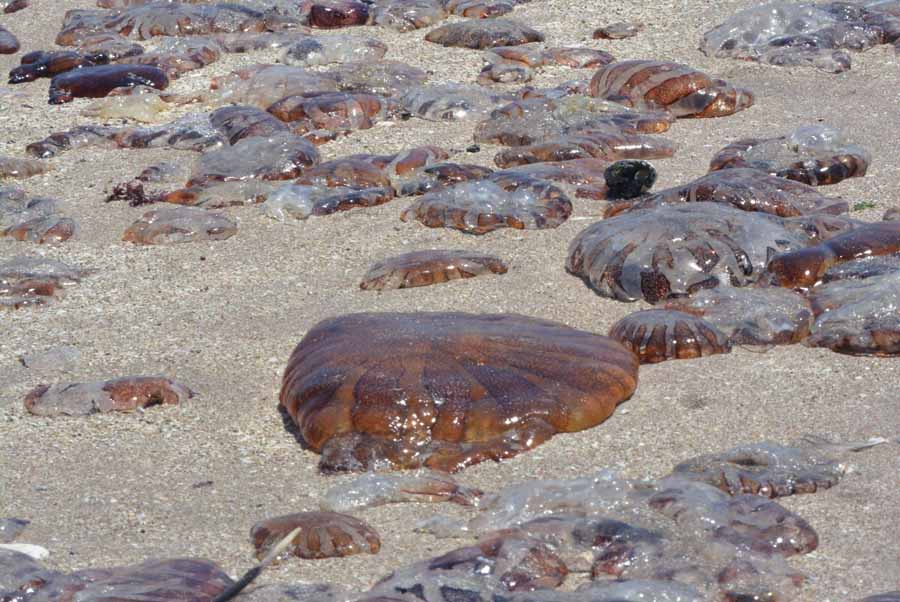
On Sunday evening, three reactor units at the Gravelines nuclear power station, located on the English Channel, were automatically shut down due to a large influx of jellyfish clogging the plant’s water pumping systems, according to France’s energy company, Electricite de France (EDF).
A fourth reactor was taken offline early Monday morning. EDF assured that the plant’s safety, its workers, and the surrounding environment remain unaffected.
“These shutdowns are the result of the massive and unpredictable presence of jellyfish in the filter drums of the pumping stations,” EDF said in a statement.
The plant in northern France is one of the largest in the country and is cooled from a canal connected to the North Sea.
Teams were carrying out inspections to restart the site “in complete safety”, EDF said, adding the reactors that were shut down are expected to restart on Thursday.
🇫🇷 A #French nuclear plant temporarily shut down Monday due to a “massive and unpredictable presence of jellyfish” in its filters, its operator said.
The swarm clogged up the cooling system, causing four units at the Gravelines plant to automatically switch off.
📹 @lottie_lam pic.twitter.com/UyPwNleGms
— FRANCE 24 English (@France24_en) August 12, 2025
The beaches around Gravelines, between the major cities of Dunkirk and Calais, have seen an increase in jellyfish in recent years due to warming waters and the introduction of invasive species.
The Bulletin of the Atomic Scientists wrote in 2021 that jellyfish swarms incapacitating nuclear power plants is “neither new nor unknown” and there was substantial economic cost due to the forced closure of power plants.
Scientists are currently exploring ways to avert closures due to sea swarms, including using drones to map the movement of jellyfish, which would allow early intervention.
__________________________________________________________________________

https://whatsapp.com/channel/0029VaAtNxX8fewmiFmN7N22
__________________________________________________________________________
“Jellyfish breed faster when water is warmer, and because areas like the North Sea are becoming warmer, the reproductive window is getting wider and wider,” Derek Wright, marine biology consultant with the United States National Oceanic and Atmospheric Administration, told the Reuters news agency.
“Jellyfish can also hitch rides on tanker ships, entering the ships’ ballast tank in one port and often getting pumped out into waters halfway across the globe,” he said.
An invasive species known as the Asian Moon jellyfish, native to the Pacific Northwest, was first sighted in the North Sea in 2020. The species, which prefers still water with high levels of animal plankton, such as that in ports and canals, has caused similar problems before in ports and at nuclear plants in China, Japan, and India.
EDF said it did not know the species of jellyfish involved in the shutdown, but this is not the first time jellyfish have shut down a nuclear facility, though such incidents were “quite rare” – the last effect on EDF operations was in the 1990s.
There have been cases of plants in other countries shutting down due to jellyfish invasions, notably a three-day closure in Sweden in 2013 and a 1999 incident in Japan that caused a major drop in power output.
Experts say overfishing, plastic pollution and climate change have created conditions for jellyfish to thrive and reproduce.
EDF said there was no risk of a power shortage due to the shutdown, saying other energy sources, including solar power, were operational.
SOURCE: INDEPENDENT PRESS AND NEWS AGENCIES
__________________________________________________________________________
FOLLOW INDEPENDENT PRESS:
WhatsApp CHANNEL
https://whatsapp.com/channel/0029VaAtNxX8fewmiFmN7N22

TWITTER (CLICK HERE)
https://twitter.com/IpIndependent

FACEBOOK (CLICK HERE)
https://web.facebook.com/ipindependent

YOUTUBE (CLICK HERE)
https://www.youtube.com/@ipindependent

Think your friends would be interested? Share this story!