Thu 14 August 2025:
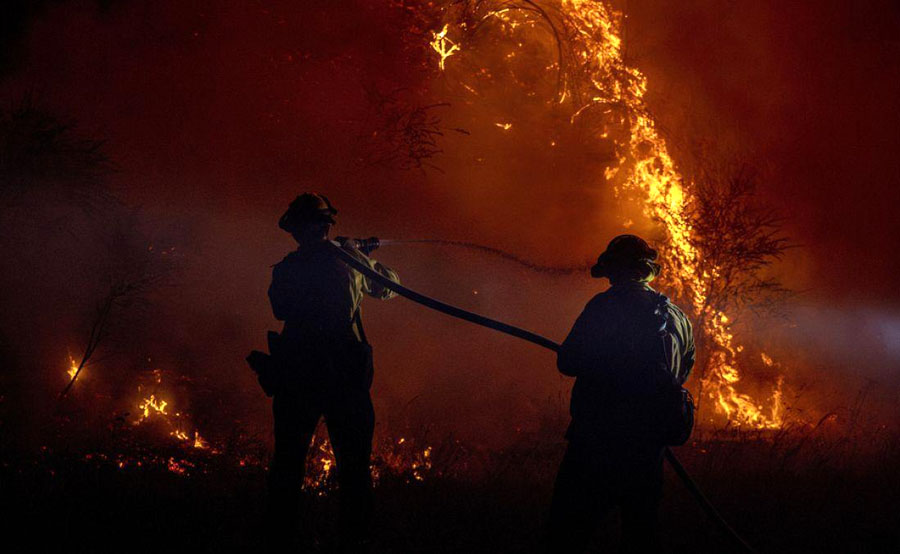
A new heatwave has gripped parts of Europe, sending temperatures up to 43 degrees Celsius (109.4 degrees Fahrenheit), with wildfires wreaking havoc and forcing evacuations as the impact of global warming is keenly felt on the continent.
Heat alerts were issued in Italy, France, Spain, Portugal and the Balkans on Tuesday, with temperatures expected to soar above 40C (104F) in some regions.
Europe has been battling wildfires for weeks now, with smoke and greenhouse gas emissions related to forest fires since the beginning of summer in the Northern Hemisphere among the highest ever recorded, according to the EU climate monitor Copernicus.
In Spain, an employee of a Spanish equestrian centre died from his injuries in Tres Cantos, a wealthy suburb north of Madrid, officials said on Tuesday. Later, officials in Castile and Leon in northwestern Spain confirmed another man was killed while fighting fires.
Flames and dark smoke billowed after a wildfire swept through olive groves and forests and disrupted rail traffic on the outskirts of the Greek city of Patras, west of Athens https://t.co/QG4Acu2I84 pic.twitter.com/DetHnr829C
— Reuters (@Reuters) August 14, 2025
About 2,000 people were evacuated from hotels and homes near the popular beaches of Tarifa in Andalusia, southern Spain after a wildfire broke out.
In the Castile and Leon region, dozens of blazes were reported, including one threatening Las Medulas, a UNESCO World Heritage site known for its ancient Roman gold mines.
The head of the regional government Alfonso Fernandez Manueco pledged “to act quickly and generously” once the fire is over to restore the site “to its full glory as soon as possible”.
Spanish Prime Minister Pedro Sanchez said on X that rescue services were “working tirelessly to extinguish the fires” and warned: “We are at extreme risk of forest fires. Please be very cautious.”
In Spain’s region of Galicia, low rainfall and strong winds have made firefighting efforts more difficult, said Al Jazeera’s Felix Nyawara.
“I’m so sorry because there are lots of animals up … that will also get burned [if] no one … finds them,” Mari Carmen, a Spanish resident of Galicia, told Al Jazeera.
__________________________________________________________________________

https://whatsapp.com/channel/0029VaAtNxX8fewmiFmN7N22
__________________________________________________________________________
Heat grips the Balkans
In Bulgaria nearly 200 fires have been reported. Most have been brought under control, localised and extinguished, but the situation remains “very challenging”, said Alexander Dzhartov, head of Bulgaria’s national fire safety unit.
Hungary on Sunday recorded a new national high of 39.9C (104F) in the southeast, breaking a record set in 1948. Budapest also recorded a city record at 38.7C (101.6F).
Wildfires destroyed several homes in Albania as firefighters battled blazes in sweltering conditions on Monday. According to Albania’s Ministry of Defence, firefighters and soldiers subdued most of the close to 40 fires that flared up within 24 hours but more than a dozen were still active.
In Croatia, about 150 firefighters spent the night defending homes from a blaze near the port city of Split.
In Montenegro, a soldier died and another was seriously injured when their water tanker overturned while fighting wildfires in the hills north of the capital, Podgorica.
Police in Albania said an 80-year-old man died from smoke inhalation on Tuesday after he lit a blaze in his yard that spread out of control to nearby villages in Elbasan district’s Gramsh area.
In Italy, a child died of heatstroke on Monday.
Eleven Italian cities, including Rome, Milan and Florence, were also placed on red alert on Tuesday due to the heat.
In southern France, temperature records were broken at four weather stations on Monday, and three-quarters of the country was under heat alerts on Tuesday.
In Portugal, firefighters battled three large wildfires, with the most serious near Trancoso in the centre of the country.
What is causing the heatwaves?
The persistent heat is being driven by a high-pressure system over Western Europe known as a heat dome.
It acts like a lid that traps hot air under it. The pressure from the weather system pushes air down into a hot, dome-shaped mass and prevents milder weather systems from moving through.
As a result, it creates prolonged periods of excessively high temperatures.
The heat in turn prevents clouds from building up, reducing the chances of rain.
This June was the warmest on record for Western Europe
Due to the weather phenomenon, Western Europe saw its warmest June on record with an average temperature of 20.49C (68.88F), surpassing the previous record for the month from 2003 by 0.06C (0.11F), according to the Copernicus Climate Change Service.
On June 30, temperatures averaged 24.9C (76.8F) over Western Europe, setting a new daily temperature record for June. The same average temperature was recorded on July 1.
Europe is the fastest warming continent and has warmed by 0.53C (0.95F) per decade since the mid-1990s, according to the ERA5 dataset from the Copernicus Climate Change Service.
Several factors are causing this effect in Europe, including shifts in atmospheric circulation, leading to more frequent and intense heatwaves. Additionally, reduced air pollution means that more solar radiation is reaching the Earth’s surface and reducing cloud cover. Certain areas of Europe also extend into the Arctic, which is the fastest warming region on the planet.
SOURCE: INDEPENDENT PRESS AND NEWS AGENCIES
__________________________________________________________________________
FOLLOW INDEPENDENT PRESS:
WhatsApp CHANNEL
https://whatsapp.com/channel/0029VaAtNxX8fewmiFmN7N22

TWITTER (CLICK HERE)
https://twitter.com/IpIndependent

FACEBOOK (CLICK HERE)
https://web.facebook.com/ipindependent

YOUTUBE (CLICK HERE)
https://www.youtube.com/@ipindependent

Think your friends would be interested? Share this story!