Sun 22 February 2026:
A significant portion of dates offered for sale in Europe allegedly enters the market through third countries while concealing their true origin, Anadolu reports.
The rapid expansion of the global date trade and the complexity of supply chains have fueled debate over traceability and labeling transparency.
Israel, currently facing boycott campaigns particularly in the Muslim world, has reportedly adopted labeling strategies to mitigate the impact of consumer boycotts in Europe.
The global date market, valued at $32.7 billion in 2025, is projected to grow to $34.5 billion in 2026, with a compound annual growth rate of 6.14%. The market is forecast to reach $55.58 billion by 2034.
The Middle East and Africa region maintains a dominant position, with annual harvest capacity exceeding nine million tons. The region accounted for 85.28% of the global market in 2025. Its market size increased from $27.89 billion in 2025 to $29.43 billion in 2026.
Key producers and consumers in the region include Tunisia, Iran, Israel, Saudi Arabia, the UAE, Iraq, and Egypt.
Egypt ranks as the world’s leading producer, exceeding 1.7 million tons annually. Saudi Arabia follows with more than 1.5 million tons, Iran with over 1.3 million tons, and Algeria with more than 1.1 million tons.
While Israel trails Egypt and Saudi Arabia in overall production volume, it remains a significant player in high value-added date exports, particularly premium Medjool varieties.
However, discrepancies between production and export figures have raised questions regarding supply chain traceability.
Various industry reports, media investigations, and consumer watchdog groups in Europe suggest that dates produced in Israeli settlements in the occupied West Bank may be marketed with concealed origin labels to bypass boycott measures and regulatory scrutiny.
__________________________________________________________________________

https://whatsapp.com/channel/0029VaAtNxX8fewmiFmN7N22
__________________________________________________________________________
Transparency debate in supply chain
Claims center on settlement-produced dates being shipped to Europe via intermediary countries or indirect logistics channels rather than through direct export.
Products originating in the West Bank are allegedly labeled simply as “Israeli product” or presented as originating from neighboring countries when entering the European Union market.
Some exporters are said to repackage goods in free trade zones or route them through intermediary countries, obscuring their place of production.
With growing sensitivity in Europe toward ethical sourcing and fair trade, concerns have been raised that concealed origin labeling may mislead consumers and potentially violate trade regulations.
Experts say such practices may intensify during Ramadan, when demand peaks. Increased demand could strain inspection mechanisms and distort competition, they add.
According to World Bank data, roughly half of dates sold in the Netherlands and more than one-third in France are of Israeli origin.
Experts note that both countries function as packaging and re-export hubs within Europe, with products distributed onward to other EU states, including Germany.
Israel-linked products are estimated to account for approximately 25% of Germany’s total date supply.
Date laundering claims
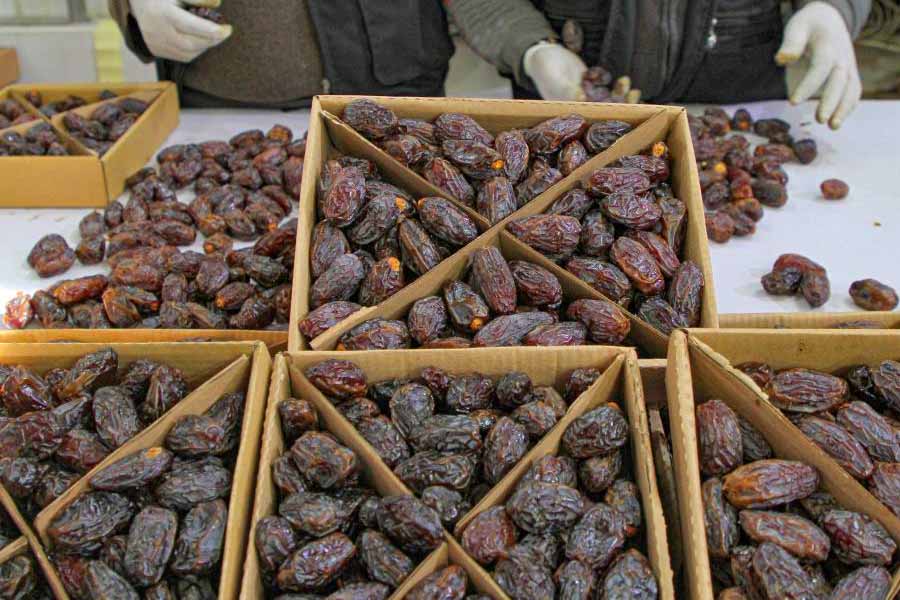
Premium Medjool dates are at the center of origin-related debates.
According to the Centre for the Promotion of Imports from developing countries (CBI), about 50% of Medjool dates exported to Europe originate from Israel. International food trade publications suggest the figure could reach 75%.
Critics argue that a portion of these exports may derive from settlement plantations in the West Bank, with origin labeling lacking clarity.
Israel exports approximately 35,000 tons of dates annually. However, sector data indicate that only about 8,800 tons are produced within Israel’s internationally recognized borders, primarily in the Arava Valley, according to figures published by the Israeli agriculture magazine Lahaklai.
If accurate, this would imply that roughly 75% of exported volume may originate from West Bank settlements, which are widely considered illegal under international law.
Some Israeli-linked companies are alleged to obscure production locations when exporting these dates.
The term “date laundering” is used by critics to describe practices in which settlement-produced dates are marketed under alternative origin labels, including the Netherlands, Morocco, the UAE, or Palestine.
Some sector representatives allege that settlement products are mixed into Palestinian supply chains through intermediaries. Others claim that discrepancies between official declarations and actual supply volumes enable settlement-origin products to be exported under Palestinian branding.
Palestinian authorities have previously conducted enforcement actions. In 2014, the Palestinian Ministry of National Economy reportedly seized 20 tons of Israeli dates intended to be sold under a “Palestinian product” label. Similar investigations have been reported in subsequent years.
EU labeling rules
The European Union applies specific labeling requirements to products originating from Israeli settlements.
Under a 2019 ruling by the EU Court of Justice, labeling settlement goods solely as “Israeli product” is considered insufficient; the settlement origin must be clearly indicated to avoid misleading consumers.
Experts urge European consumers to carefully review origin information when purchasing dates and call for greater transparency regarding products routed through intermediary countries or bearing vague regional labels.
Meanwhile, Israel’s agricultural sector is reported to be facing significant strain amid boycott campaigns and logistical disruptions linked to the Gaza conflict.
Israeli producers have warned that the sector is nearing collapse, according to reports in the Israeli press.
Consumer activism and grassroots pressure in European markets, historically among Israel’s largest export destinations, have prompted some retailers to reassess sourcing policies.
The UK-based Co-op has halted sourcing from Israel, while boycott campaigns have gained traction in countries such as Belgium and Ireland.
-MEMO
__________________________________________________________________________
FOLLOW INDEPENDENT PRESS:
WhatsApp CHANNEL
https://whatsapp.com/channel/0029VaAtNxX8fewmiFmN7N22

TWITTER (CLICK HERE)
https://twitter.com/IpIndependent

FACEBOOK (CLICK HERE)
https://web.facebook.com/ipindependent

YOUTUBE (CLICK HERE)
https://www.youtube.com/@ipindependent

Think your friends would be interested? Share this story!