Fri 21 November 2025:
Chinese scientists have found signs of iron rust caused by meteorite impacts in rock and soil samples collected by the “Chang’e 6” rover from the Moon’s far side.
Researchers from Shandong University, the Institute of Geochemistry at the Chinese Academy of Sciences, and Yunnan University reported in Science Advances that the rover discovered microscopic hematite (α-Fe2O3) and maghemite crystals in samples taken from the Moon’s South Pole-Aitken Basin.
They noted that these crystals formed not through the usual iron-oxygen interaction on Earth, but via contact with volatile oxygen released from iron sulfide in meteorites upon impact.
The presence of these magnetically active crystals could help explain magnetic anomalies in the lunar polar region and provide a scientific basis for future Moon studies.
Previously, the Chang’e 6 mission had also identified carbonaceous chondrite elements in its samples, which are rich in water and organic materials and originate from outside the Solar System.
The researchers further investigated several possible formation mechanisms for ferric iron on the moon and systematically ruled out some alternatives.
__________________________________________________________________________

https://whatsapp.com/channel/0029VaAtNxX8fewmiFmN7N22
__________________________________________________________________________
They observed that minerals containing oxidised iron were found primarily in lunar soil breccias – rocks composed of various fragments cemented together by the intense heat and pressure of meteorite impacts. These minerals were not found in pristine fragments of ancient volcanic rock.
The team proposed instead that the hematite grains were generated by large-scale impact events, such as those that formed the South Pole–Aitken basin and the Apollo crater on the far side of the moon.
Shock heating from such impacts could cause thermal decomposition of oxygen-rich minerals such as troilite and other sulphides. During these high-energy events, minerals release oxygen into the surrounding environment. The sudden burst of free oxygen then reacts with other iron-rich minerals in the soil, causing them to “rust” and form iron oxide minerals.
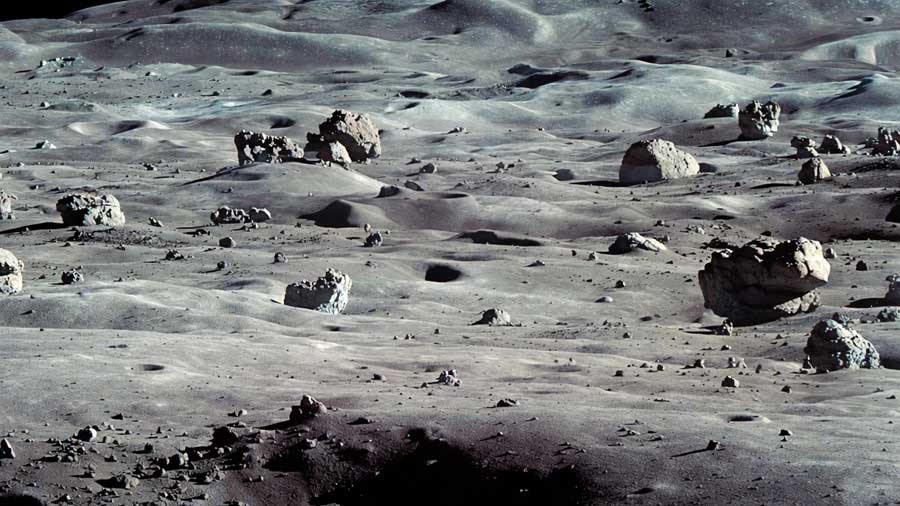
The Chang’e-6 landing site is located within the South Pole–Aitken basin, one of the oldest and largest impact basins in the solar system. This region has experienced multiple major impacts and has not been covered by later volcanic lava flows, making it ideal for preserving products of ancient impacts.
The discovery of hematite confirms the presence of localised oxidising environments on the lunar surface. This opens new pathways for exploring the mechanisms that have shaped the moon’s transformation over billions of years.
Launched on May 3, 2024, Chang’e 6 landed in the Apollo Crater of the South Pole-Aitken Basin on June 2, 2024, and returned to Earth with lunar samples on June 25, 2024. This made China the first country to collect samples from the Moon’s far side.
SOURCE: INDEPENDENT PRESS AND NEWS AGENCIES
__________________________________________________________________________
FOLLOW INDEPENDENT PRESS:
WhatsApp CHANNEL
https://whatsapp.com/channel/0029VaAtNxX8fewmiFmN7N22

TWITTER (CLICK HERE)
https://twitter.com/IpIndependent

FACEBOOK (CLICK HERE)
https://web.facebook.com/ipindependent

YOUTUBE (CLICK HERE)
https://www.youtube.com/@ipindependent

Think your friends would be interested? Share this story!