Fri 01 August 2025:
A groundbreaking report by an British-Indian advocacy organisation will lay bare the causes and consequences of the city’s 2022 riots, pointing to the sectarian Hindutva ideology as the key instigator.
The report titled, Community Tensions, Hindutva, & Islamophobia, is due for release next week and was researched and released by the United Kingdom-Indian Muslim Council (UKIMC).
5Pillars has seen the report which is based on analysis and conclusions drawn from a survey of almost 500 members of Leicester’s Muslim community that was conducted during 2023-2024.
It concludes that the Leicester riots were primarily driven by the sectarian Hindutva ideology, exacerbated by institutional failures, biased media narratives, and a Hindutva-driven digital ecosystem, leading to distrust, psychological harm, and the need for a comprehensive roadmap to rebuild community trust and prevent future unrest.
The research explores the community’s experiences prior to, during, and since the riots, as well as their perceptions regarding its origins, the responsible instigators, responses from the local authorities, and how it was represented in public, political and media narratives.
It also exposes institutional failures by the authorities and community leadership and proposes a roadmap to rebuild trust and prevent future unrest across the UK.
A UKIMC spokesperson said: “This report is a wake-up call. Leicester’s story shows how quickly harmony can unravel when divisive ideologies take root. But with bold action, locally and nationally. We can rebuild trust and ensure no community feels targeted or abandoned.”
Hindutva roots of the riots
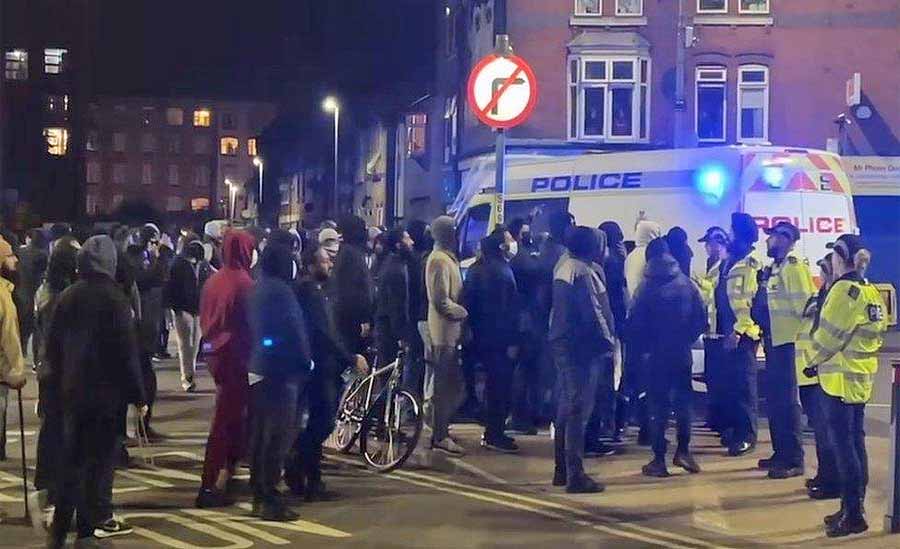
In 2022, riots in Leicester shocked the UK as sectarian street battles erupted between mostly Muslim and Hindu men following rising tensions between the two communities.
Muslims in Leicester had been dealing with a growing campaign of harassment and intimidation against their communities by thugs appearing to be inspired by a political ideology from India known as Hindutva.
Police attempted to separate rival groups each night as Muslims, angered by constant attacks on their community, began mobilising to patrol Muslim-populated areas.
At the time of the trouble, 5Pillars reported on several cases of assaults with Muslim youth claiming they had been violently attacked by Hindu men.

Leicester unrest 2022
The new survey has researched and documented accounts from locals who described a steady rise in anti-social behaviour — public alcohol consumption, loud music, fireworks, targeted littering and sexual harassment —alongside physical attacks, arson, and organised marches where Hindutva slogans were chanted.
These acts, often laced with ethno-religious ideologies, were perceived as deliberate attempts to intimidate and assert dominance over Muslim communities.
The report distinguishes Hindutva, a political ideology rooted in ethno-nationalism, from Hinduism. Hindutva, it explains, promotes an exclusivist vision of India as a Hindu nation, marginalising minorities like Muslims and Christians as “outsiders.”
Its hallmarks include homogenising India’s diverse traditions and fostering antagonism toward non-Hindus.
Respondents attributed the riots to a minority of extremists adhering to this ideology, often imported through immigration and amplified by outsiders who descended on Leicester to stoke division.
Failures by state and media
The report sharply criticises media and political narratives that misrepresented the unrest.
It argues that many news outlets and politicians either framed Muslims as aggressors from the get-go or portrayed the violence as a clash between equal sides, ignoring evidence of targeted victimisation.
Right-wing news channels like GB News focused the story on anti-multiculturalism angles, using the troubles to argue that multiculturalism is bad without exploring the real cause of the tensions.
Conservative Government Minister Michael Gove announced an independent enquiry into the unrest, however his reputation as an Islamophobe created a heavy sense of distrust in the government’s effort, further deepened by the appointment of the Zionist peer, Lord Ian Austin, as chair of the enquiry.
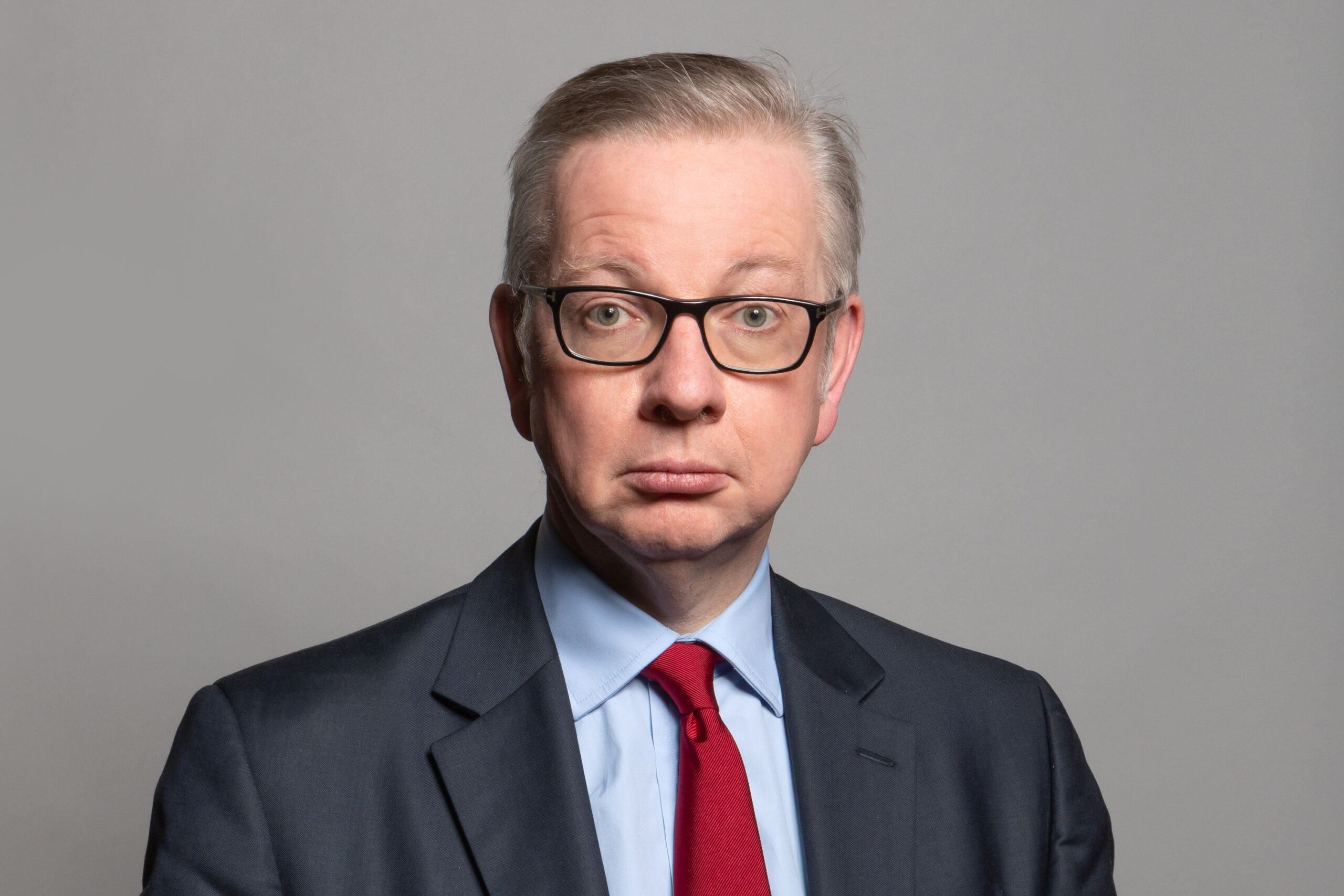
Michael Gove MP. Pic: UK Parliament
Both Gove and Austin are passionate Zionists who have long been criticised for expressing Islamophobic or anti-Palestine views.
Media and Hindu preachers in India also began commentating on events in the English Midlands and were accused of spreading propaganda.
A “Hindutva-driven digital ecosystem,” spanning social media and organisations in the UK and India, was found to have fuelled Islamophobia, exacerbating tensions.
The former government’s perceived inaction on Islamophobia and failure to address the riots objectively left Muslim communities feeling abandoned and frustrated, empowering the idea that locals themselves had to mobilise to protect themselves.
A recurring theme in the report is the deep distrust in local authorities, particularly the police, due to perceived bias and inadequate responses.
The riots’ psychological impact was profound, with survey participants reporting anxiety, fear, depression, and grief over the breakdown of once-warm Hindu-Muslim relations.
These feelings were compounded by frustration at outsiders inciting tensions and systemic barriers to mental health access, such as language issues and culturally insensitive services.
__________________________________________________________________________

https://whatsapp.com/channel/0029VaAtNxX8fewmiFmN7N22
__________________________________________________________________________
A roadmap for reconciliation
The report’s most ambitious contribution is its roadmap for change, offering nearly 40 recommendations distilled into ten key policy pledges to heal divisions and prevent similar unrest elsewhere in the UK.
Recommendations include to:
- Scrap the PREVENT counter-extremism strategy and enact a “new holistic, rights-based approach.”
- Amend the focus of counter-extremism efforts to appropriately recognise and address diverse threats, including far-right and Hindutva ideologies.
- Establish local interfaith dialogue forums
- Establish a National Youth Inclusion Fund to support youth-led initiatives.
- Increase funding to support community infrastructure and welfare.
- Support new migrants and refugees in community life.
- Expand local support and funding for language support, cultural orientation, and community participation pathways for newly arrived immigrants.
- Reform policing to promote trust, representation and fairness.
- Legislate mandatory unconscious bias, Islamophobia awareness, and historical context training for police officers.
- Enact legislative reform to tackle Islamophobia and properly define the term.
- Reform media and online regulation to combat disinformation and hate.
This article is republished from 5Pillars. Read the original article.

__________________________________________________________________________
FOLLOW INDEPENDENT PRESS:
WhatsApp CHANNEL
https://whatsapp.com/channel/0029VaAtNxX8fewmiFmN7N22

TWITTER (CLICK HERE)
https://twitter.com/IpIndependent

FACEBOOK (CLICK HERE)
https://web.facebook.com/ipindependent

YOUTUBE (CLICK HERE)
https://www.youtube.com/@ipindependent

Think your friends would be interested? Share this story!