Wed 11 February 2026:
Anyone in this region who has experienced occupation firsthand cannot welcome the occupation of Iran. The memory of Iraq alone is enough to make talk of foreign tanks crossing the border a recurring nightmare. The occupation of Iraq and the destruction of its state were not a passing incident in the region’s history, but an open wound in the contemporary world’s memory, and a political and moral scandal in the record of the powers that claimed to have come to liberate the Iraqis, only to unleash chaos. This should have taught the region’s governments, especially the Arab governments that contributed to the 2003 aggression through silence, facilitation or collusion, an unforgettable lesson.
The people were not involved; there were no Arab streets applauding the occupation. Instead, regimes were calculating their profits and losses behind closed doors, leaving the people to foot the bill alone.
Therefore, it is futile to search for an Arab ‘public opinion’ that welcomes the occupation of Iran, even if Tehran’s regime is a political opponent or declared enemy. Occupation is one thing and the fall of the regime is quite another.
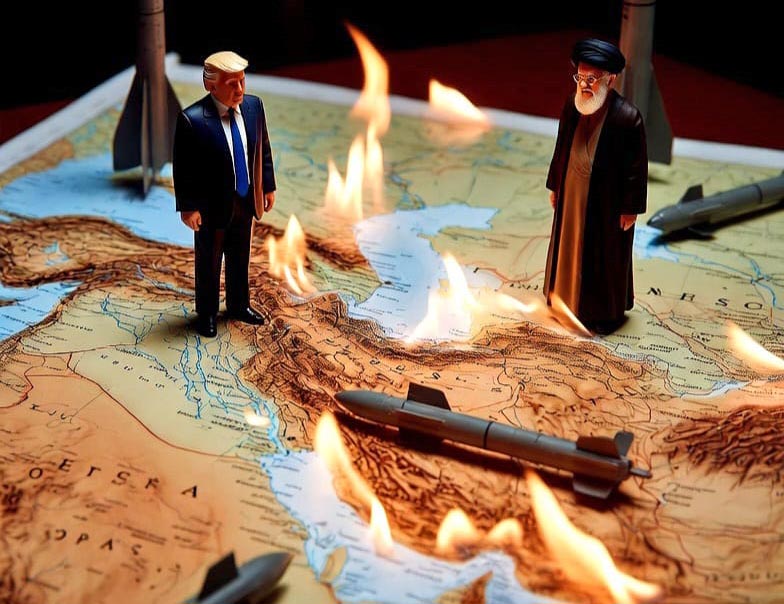
The United States is no longer in a position to repeat the Iraq adventure, politically, morally or militarily. US President Donald Trump described the occupation of Iraq as ‘the biggest mistake’ and ‘a war built on lies’, admitting belatedly that the venture brought nothing but costly failure.
This realisation is no longer limited to traditional opponents of the war; it has also become part of the narrative of the US establishment, which is now seeking alternative ways to manage its conflicts other than direct occupation. Therefore, there are currently no serious US claims about the intention to occupy Iran, nor is there an international environment that would allow such a project to be realised.
The world has changed, as has the United States, and the region scarred by the Iraq war will not easily accept being drawn into a similar conflict.
However, the question that needs to be asked here is: if occupation is unacceptable, does that mean the regime in Tehran is untouchable? Does any talk of its downfall constitute collusion with an ‘external project’?
It is precisely here that we must distinguish between the regime falling from within and the country being occupied from outside.
What has been happening in Iran for years is not a ‘conspiracy’ orchestrated in faraway intelligence rooms, but rather an accumulated social and political movement for which tens of thousands of people have paid the price in the form of death, detention and persecution. Iranians themselves are demanding the fall of the regime, taking to the streets and facing bullets, prisons and revolutionary courts. Repeated protests, from the ‘Green Movement’ to fuel uprisings and the wave of anger sparked by the killing of Mahsa Amini, reveal that the regime can no longer reproduce its former legitimacy. The ‘Islamic Revolution’ born in 1979 has become a closed theocratic authority that thrives on repression at home and adventurism abroad.
Today, many Western analyses argue that the Tehran regime is experiencing a ‘structural crisis of legitimacy’, and that its traditional intimidation tactics are less effective against a new generation unafraid of the streets or prison.
Senior Iranian officials have never hidden their ambition for regional hegemony. From the slogan of ‘exporting the revolution’ to explicit talk of controlling ‘four Arab capitals’, official rhetoric has boasted of what it considers ‘strategic achievements’ in Baghdad, Damascus, Beirut and Sana’a. This was not just rhetoric, but a comprehensive policy based on building networks of militias and cross-border loyalties that combined arms, ideology, and economics.
In his analysis of Qassem Soleimani and Iran’s regional strategy, Ali Soufan — executive director of the Qatar International Academy for Security Studies — describes how Tehran succeeded in ‘combining militia power with official state power’ to create a model of influence extending from Lebanon to Iraq and Yemen. This model has transformed Arab capitals into arenas of direct or indirect influence.
Today, no one on the Arab street sees a repressive theocratic regime that sends militias to Arab capitals as a model of liberation or a ‘stronghold of resistance’. In fact, many in the West are now saying that the Iranian regime has lost its ‘most dangerous weapon’: the ability to intimidate at home and abroad. They argue that the regime is experiencing a strategic crisis that goes beyond sanctions to the core of its political structure.
Therefore, we can conclude that rejecting occupation does not mean defending the regime, and rejecting US policies does not mean accepting Tehran’s policies. Like the Iranian people, the Arab peoples want something much simpler: a normal state, neither revolutionary nor theocratic, that is not run from embassies or Revolutionary Guard chambers.
__________________________________________________________________________

https://whatsapp.com/channel/0029VaAtNxX8fewmiFmN7N22
__________________________________________________________________________
If the Tehran regime falls as a result of internal dynamics, this will primarily be an opportunity for Iranians to regain the normal lives that were confiscated in the name of revolution, religion, and national security. It would provide an opportunity for an economy suffocated by sanctions and proxy wars, as well as for young people who want to live in the 21st century rather than in a propaganda discourse frozen in 1979. At the same time, it would be an opportunity for the peoples of the region to rebuild their balances away from the logic of axes and militias. While not all crises would be resolved by the fall of the Iranian regime, one of the biggest sources of tension and sectarian division would lose its ideological and military backing.
It is important to put the comparison in context:
What happened in Iraq in 2003 was not the ‘fall of a regime’, but rather the forced replacement of one regime with another, hastily created by the United States and characterised by sectarianism.
This regime opened the gates of hell on the country, destroying its institutions, displacing its scientific elite and squandering its wealth. The fall of the Tehran regime, if it occurs organically, will be an entirely different matter. Iranians will govern themselves, not through an authority imposed from outside nor through political engineering by foreign armies.
It would be a moment of restoration, not replacement; a moment to correct the historical course that has been deviating since 1979, not a moment to reproduce the catastrophe that occurred in Baghdad. The difference between these two scenarios is the difference between a country being reshaped by an invading force and a country being reclaimed by its own people. This alone would make the fall of the Tehran regime, if it were to be decided by the Iranians, a new beginning for the entire region, rather than a repetition of past mistakes.
The statements, views and opinions expressed in this column are solely those of the author and do not necessarily represent those of Independent Press.
Author:

Karam Nama is British-Iraqi writer. He has published several books, including An Unlicensed Weapon: Donald Trump, a Media Power Without Responsibility and Sick Market: Journalism in the Digital Age.
__________________________________________________________________________
FOLLOW INDEPENDENT PRESS:
WhatsApp CHANNEL
https://whatsapp.com/channel/0029VaAtNxX8fewmiFmN7N22

TWITTER (CLICK HERE)
https://twitter.com/IpIndependent

FACEBOOK (CLICK HERE)
https://web.facebook.com/ipindependent

YOUTUBE (CLICK HERE)
https://www.youtube.com/@ipindependent

Think your friends would be interested? Share this story!