Tue 02 December 2025:
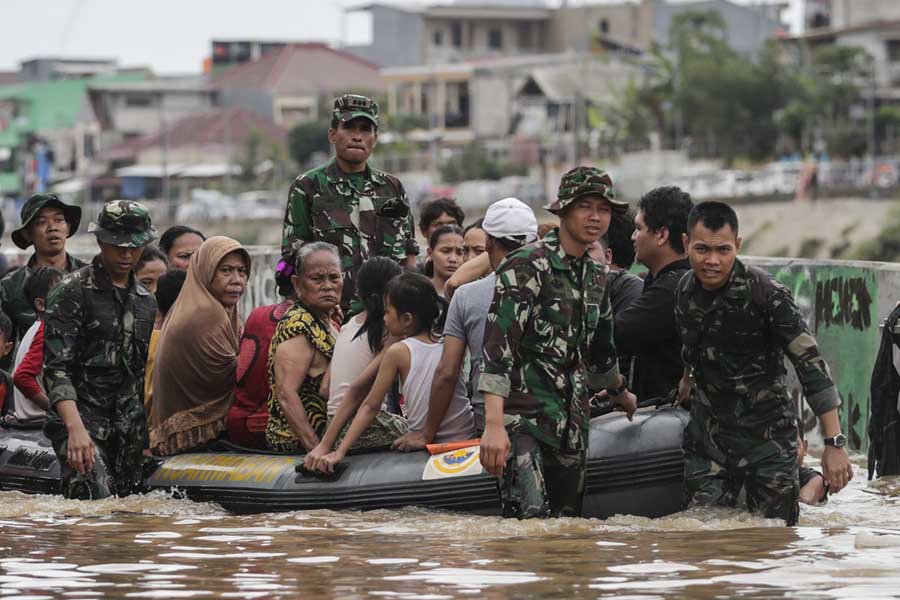
The death toll from the ongoing floods and landslides in four countries in South and Southeast Asia climbed to over 1,400, as hundreds are still missing amid continued search and rescue operations, according to data shared by local governments.
Unprecedented floods, landslides, storms, and cyclones have wreaked havoc across Indonesia, Malaysia, Sri Lanka, and Thailand, and authorities are racing against time to rescue stranded communities, provide emergency aid, and assess the widespread destruction.
Arriving in North Sumatra on Monday, Indonesian President Prabowo Subianto said the government’s priority was “how to immediately send the necessary aid”.
“There are several isolated villages that, God willing, we can reach,” Prabowo said, adding that the government was deploying helicopters and aircraft to aid the relief effort.
While he said “the worst has passed”, the state weather agency is forecasting further moderate to heavy rain, lightning and strong winds around Jakarta, and thunderstorms across West Nusa Tenggara, West Java and South Kalimantan.
In Sungai Nyalo village, about 100km (62 miles) from West Sumatra’s capital Padang, floodwaters had mostly receded on Sunday, leaving homes, vehicles and crops coated in thick grey mud.
“Most villagers chose to stay; they didn’t want to leave their houses behind,” Idris, 55, who, like many Indonesians, goes by one name, told the AFP news agency.
__________________________________________________________________________

https://whatsapp.com/channel/0029VaAtNxX8fewmiFmN7N22
__________________________________________________________________________
Sri Lanka seeks aid
Meanwhile, in Sri Lanka, the government has called for international aid and is using military helicopters to reach people stranded by flooding and landslides triggered by Cyclone Ditwah.
At least 366 people have been killed, according to authorities, with another 367 people missing.
A helicopter pilot “tragically lost his life” while making an emergency landing “during a mission to support flood-affected communities in Lunuwila,” north of Colombo, Sri Lanka’s Air Force said in a post on Facebook on Monday.
Officials said the extent of damage in the worst-affected central region was only just being revealed as relief workers cleared roads blocked by fallen trees and mudslides.
President Anura Kumara Dissanayake, who declared a state of emergency to deal with the disaster, pledged to build back. “We are facing the largest and most challenging natural disaster in our history,” Dissanayake said in an address to the nation.
“This is a humanitarian crisis of historic proportions,” Sampath Kotuwegoda, director-general of the disaster management centre, told Al Jazeera, adding that all 25 districts of the country have been affected.
Death toll rises in southern Thailand
Thai authorities on Monday said the death toll from ongoing flooding in the south of the country had risen to at least 176 people.
The government has rolled out relief measures, but there has been growing public criticism of the flood response, and two local officials have been suspended over their alleged failures, according to AFP.
Save the Children estimates 76,000 children are currently unable to return to school. Services are slowly recovering in Songkhla province – where 131 people have died.
Meanwhile, 80 percent of tap water was restored and full service is expected by midweek, according to the Thai Enquirer.
Across the border in Malaysia, where heavy rains also inundated large stretches of land in Perlis state, at least three people were killed.
Climate change is increasing the intensity and frequency of storms and producing more heavy rain events because a warmer atmosphere holds more moisture.
Alexander Matheou, the International Federation of Red Cross and Red Crescent Societies’ Asia-Pacific director, said countries urgently need “better early warning systems, shelter for people to go to in times of flooding, more nature-based solutions … [and] social protection systems in disaster”.
“These floods are a stark reminder that climate-driven disasters are becoming the new normal,” he said in a statement. “Investment in resilience and preparedness is critical.”
SOURCE: INDEPENDENT PRESS AND NEWS AGENCIES
__________________________________________________________________________
FOLLOW INDEPENDENT PRESS:
WhatsApp CHANNEL
https://whatsapp.com/channel/0029VaAtNxX8fewmiFmN7N22

TWITTER (CLICK HERE)
https://twitter.com/IpIndependent

FACEBOOK (CLICK HERE)
https://web.facebook.com/ipindependent

YOUTUBE (CLICK HERE)
https://www.youtube.com/@ipindependent

Think your friends would be interested? Share this story!