Sun 28 September 2025:
In Gaza, the toll of occupation is brutally visible: families live amid ruins, hospitals strain under bombardment, and children grow up amid the echoes of conflict. Behind this visible devastation, there is a less visible but equally consequential story—one that links Indian corporations and capital to Israel’s machinery of occupation and control. While political rhetoric in India emphasizes human rights and development, the reality of corporate investments tells a different story, where economic interests intersect with systems that perpetuate suffering. As the humanitarian crisis intensifies, Indian capital continues to flow into sectors that directly support military campaigns, settlements, and the everyday mechanisms of oppression experienced by Palestinians.
Indian corporations, both public and private, are embedded in Israel’s economy of occupation. In defence, Adani Enterprises has been involved in projects producing drones like the Hermes 900, which Israel deploys in Gaza. These technologies are not neutral commodities; they are tools actively used in operations that result in civilian casualties and displacement. Beyond drone production, Indian procurement of armoured vehicles and advanced military technology further links Indian capital to operations that sustain Israel’s control over Gaza and the West Bank.
Technology companies are similarly implicated. TCS, Infosys, and Reliance provide software and IT solutions that underpin surveillance systems throughout the occupied territories. These digital infrastructures enable the monitoring, restriction, and control of Palestinian communities, effectively consolidating a network of administration that international observers have compared to apartheid. Through these systems, Indian technological expertise becomes a component of occupation, facilitating everyday mechanisms of control and surveillance that affect the lives of millions.
Water and agriculture investments deepen this entanglement. Jain Irrigation and Adani Ventures have partnered with Mekorot, Israel’s national water company, which governs the distribution of water in the West Bank and settlements. By financing and collaborating with Mekorot, Indian companies profit from systems that deny Palestinians access to basic resources. Water—a necessity for life—is weaponized, and Indian investment becomes inseparable from the deprivation and structural inequities faced by Palestinian communities.
Infrastructure development compounds the issue. Indian firms have participated in constructing roads, pipelines, and other projects that directly support settlements. While these projects are framed as ordinary commercial ventures, they frequently involve expropriating Palestinian land, embedding economic resources into the machinery of occupation. Through defence, technology, water, and infrastructure, Indian corporate interests are not mere bystanders; they are integral to sustaining a system of oppression.
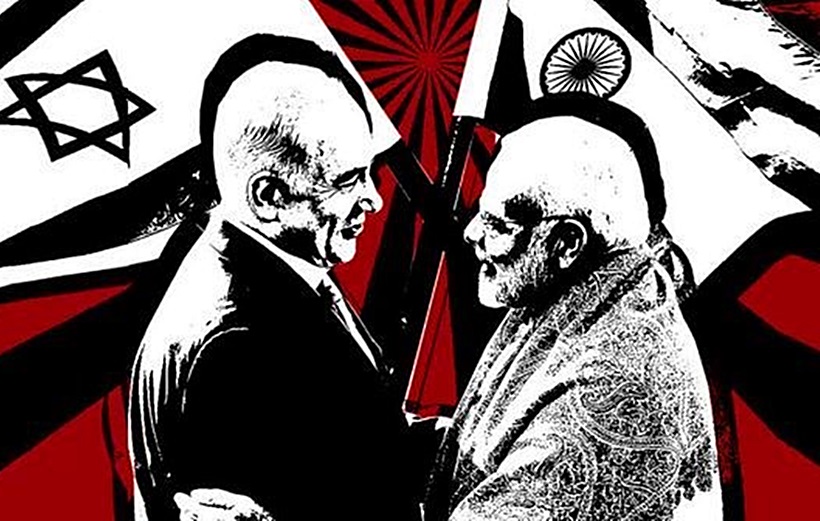
India’s political trajectory mirrors these corporate entanglements. Historically, the country supported Palestinian self-determination in international forums. In recent years, however, India has deepened its political and economic relationship with Israel, even as Gaza suffers escalating humanitarian crises. Bilateral trade has reached billions of dollars annually, with new investment treaties reinforcing this growing alignment. This shift exposes a troubling duality: India publicly promotes human rights and democracy, while simultaneously strengthening economic ties with a state engaged in systematic violations of international law.
CenFA emphasises that “Indian capital—both state and private—is enmeshed in the financial ecosystem that sustains occupation and war crimes.” The convergence of Indian government policy and corporate investment illustrates a prioritisation of profit and strategic advantage over ethical responsibility, raising critical questions about complicity in sustained human rights abuses.
The consequences of these corporate and governmental choices are painfully concrete. Gaza has endured continuous military operations, a blockade that restricts access to food, water, and medical aid, and the destruction of schools and hospitals. UN agencies report that tens of thousands of Palestinians have been displaced in recent escalations, while essential services remain critically limited. Indian investments, whether direct or indirect, contribute to this cycle. Surveillance systems, military technologies, and infrastructure financed by Indian capital enable the occupation to persist. CenFA notes that “investments in water and technology, while seemingly benign, are inseparable from the systemic oppression of Palestinian communities.” These are not abstract financial transactions; they materially sustain human suffering.
Adani Enterprises’ involvement in defence projects, Jain Irrigation’s water partnerships with Mekorot, and the technological services provided by Reliance, TCS, and Infosys together form a network through which Indian capital reinforces occupation. Trade between India and Israel has surged to billions of dollars annually, with investment treaties further facilitating economic alignment. Each partnership, each transaction, becomes part of a broader ecosystem that sustains settlements, militarized control, and systemic deprivation.
International law provides a clear framework: the transfer of resources for settlement expansion or occupation-related projects is prohibited. By financing projects that enable occupation, Indian companies risk legal and ethical violations. Beyond legal risk, the moral imperative is unavoidable. As one human rights expert cited in the report observes, “Financial and technological support to occupations is not neutral. It sustains the very structures that violate the basic rights of a population under siege.” Even if the primary motive is profit, the ethical stakes cannot be ignored.
__________________________________________________________________________

https://whatsapp.com/channel/0029VaAtNxX8fewmiFmN7N22
__________________________________________________________________________
CenFA urges Indian corporations to reconsider their involvement in occupation-linked projects and calls on the government to align trade and investment policies with human rights norms. Citizens and civil society also bear responsibility: holding corporate and state actors accountable for complicity in oppression is critical to ensuring ethical practice and transparency. Public awareness, advocacy, and policy reform are essential steps toward disentangling profit from oppression.
The story of Gaza is thus not only one of survival and resistance but also of complicity through capital. Indian corporations, through defence, technology, water, and infrastructure investments, materially support occupation. The Modi government’s deepening ties with Israel, despite the ongoing humanitarian crisis, reflect alignment with the Zionist state at the expense of human rights. Recognising these financial entanglements is crucial. Profit cannot, and must not, outweigh human life, dignity, and justice.
“Every investment carries a moral choice; in Gaza, the choice is stark and undeniable.” (CenFA Report, 2025) CenFA’s findings serve as a reminder that financial decisions are never neutral in contexts of occupation and conflict. Ethical scrutiny, corporate accountability, and adherence to international human rights principles are urgent imperatives. Only by disentangling profit from oppression can India reconcile its historical anti-colonial values with contemporary responsibilities, ensuring that economic engagement never comes at the cost of human suffering.
“Where profit flows unchecked, human suffering becomes a currency, and Gaza bears the cost of this calculus.”
Author:

__________________________________________________________________________
FOLLOW INDEPENDENT PRESS:
WhatsApp CHANNEL
https://whatsapp.com/channel/0029VaAtNxX8fewmiFmN7N22

TWITTER (CLICK HERE)
https://twitter.com/IpIndependent

FACEBOOK (CLICK HERE)
https://web.facebook.com/ipindependent

YOUTUBE (CLICK HERE)
https://www.youtube.com/@ipindependent

Think your friends would be interested? Share this story!