

 SOUTH AFRICA ELECTIONS 2024 (31/05/2024)

The ruling African National Congress party in the lead with just under 60 percent of the votes counted. However, it is falling short of a majority. The Democratic Alliance sits second while former President Zuma’s uMkhonto weSizwe (MK) party currently third. If the ANC does not receive more than 50 percent, it will need to make a deal with other parties to form a coalition government. Officials results are not expected to be announced before Sunday.
It will ‘take years’ for ANC to recover losses: journalist
“I think the next 48 hours [are key], the final results coming out, with KZN the biggest shock. But if you were on the ground this is [reflective of] what voters have told you. I think the ANC has just refused to listen. It’s going to take years for the ANC to ever regain the upper hand.
“A spectacular fall for Africa’s oldest liberation movement,” she added.
————————————————-
About 50 people arrested this week, police minister says
Of more than 23,000 polling stations around the country, he said around 632 of them were known to be “troublesome”.
Cele was speaking at the Electoral Commission’s results centre in Midrand.
————————————————-
A ‘reality-check election’ for many parties
“It’s a reality-check election for many of these political parties, including the ANC,” she told Al Jazeera from the election results headquarters.
“I think the idea of when the talks around working together, coalition politics or coalition governing will be starting to happen, some parties like the DA … have indicated that they are not going to dismiss any talks with the ANC,” she noted, saying that that was a promising sign.
Naidu said that going forward, she would be monitoring the “maturity of the political parties that are going to go into coalition talks and how they are going to navigate those discussions”, as well as “what are going to be some of those complexities, how are they going to work together, and what are going to be some of the non-negotiable spaces and the issues that they are going to have.”
————————————————-
More than 70 percent of votes completed
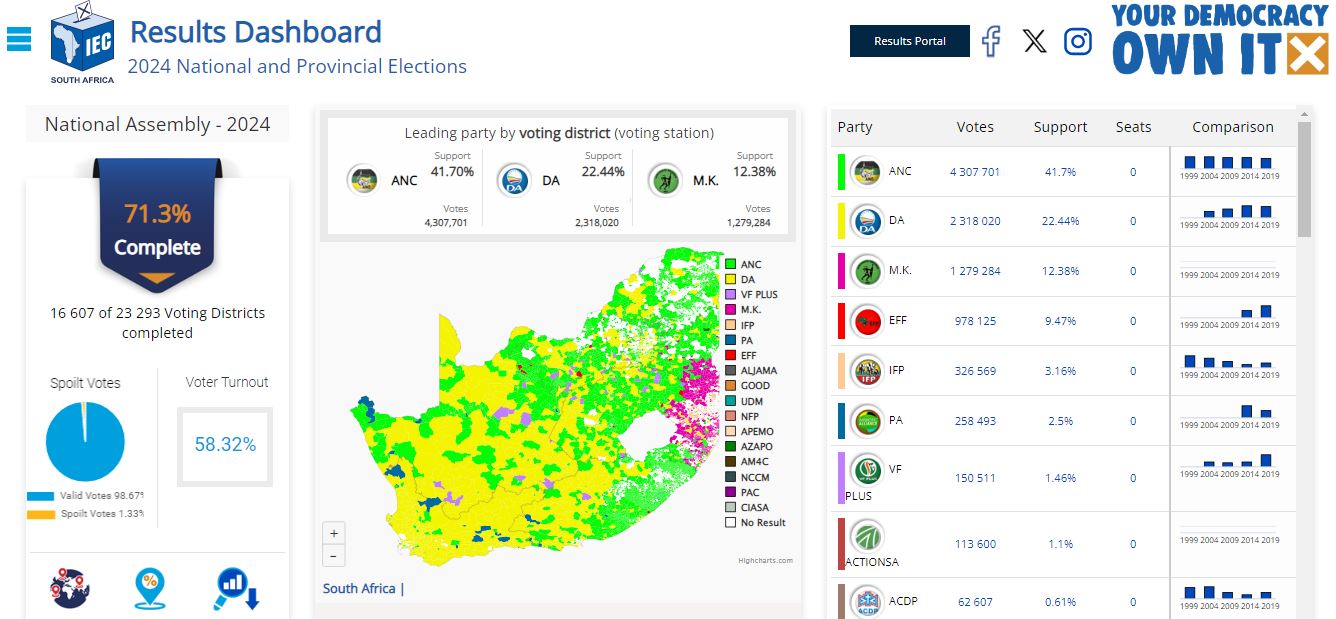
————————————————-
ANC will likely remain ‘largest party in the country’: analyst
“So far, it seems to have been in denial about the option that it might have to enter into a coalition,” Bax told Al Jazeera.
The choices for the party are “quite clear”, she said.
There are “three opposition parties that did well … the ANC did not do well, but still has a very large chunk of the vote.
“The options are quite clear … and what type of alliance the ANC would form, there is not much guesswork there,” she said, adding that the party will likely remain “at the helm”.
“President Cyril Ramaphosa might keep his job … it’s likely,” Bax said. “So the ANC will still be the largest party in the country.”
————————————————-
Early results left investors ‘swinging between anxiety’
It reported that ahead of the vote, it seemed that the governing party would be much closer to the 50-percent mark that would have enabled it to join hands with a small party.
However, after half of the votes counted, ANC’s tally is hovering just under the 41-percent mark.
“We remain in something of a no-man’s-land at present, with the still-sizable uncertainty over the ANC’s final tally keeping most options for the next government on the table,” Ivailo Vesselinov, chief strategist at Emso Asset Management, was quoted as saying by Bloomberg.
Validation of results ongoing
“The Election Commission is in the process of validating the results that’s why they are slow coming in,” Fahmida Miller, our correspondent in South Africa, says.
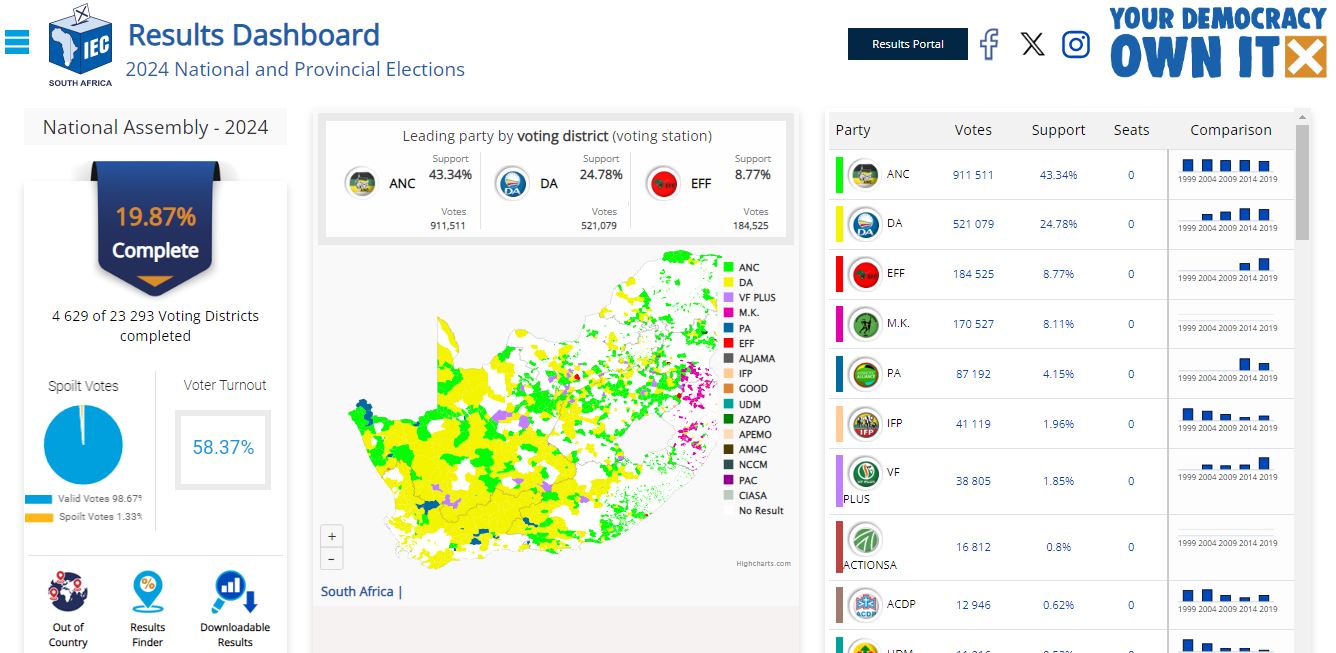
“The Election Commission said earlier that the final results should be announced by Sunday and that hasn’t changed yet. It appears that the turnout was around 58 percent.”
————————————————-
Who are the potential coalition partners?
The price of a deal with either of those would likely be significant policy concessions by the ANC, as well as the offer of some senior government positions for its partner.
Investors and the business community would prefer a deal with the DA, which has received 23 percent of votes so far, and is seen as more market-friendly.
However, the ideological divide between the ANC and the leading opposition party is so wide as to make such a deal difficult.
Led by Julius Malema, a former leader of the ANC’s youth wing, the EFF may be a more natural fit for the ANC, but relations are tense between Malema and some ANC factions.
The EFF, on 9.5 percent of the vote, said in April it would partner with the ANC if it got the powerful post of finance minister.
————————————————-
Election results will be ‘sobering’ for ruling party
“Current predictions show the ANC likely to come in between 40 and 45 percent of the vote, which would be a significant reduction in their support, having obtained 57 percent in the previous election,” he told Al Jazeera. “So it’s a sobering election for the African National Congress.
“It seems that the primary beneficiary of the ANC’s drop in support has been Jacob Zuma’s new MK party. The official opposition, the Democratic Alliance, seems to be staying relatively stable in the low 20 percents.”
————————————————-
Nobody is going to resign, says ANC official
“Nobody is going to resign. Collectively, all of us, we still are confident that he [Ramaphosa] has to remain the president of the ANC,” she told reporters at the results centre. “The leadership of the ANC will meet, structures of the ANC will be consulted. For now we are not talking to anybody.”
The ANC had won every previous national election since the historic 1994 vote that ended white minority rule, but over the last decade, South Africans have watched the economy stagnate, unemployment and poverty climb and infrastructure crumble, leading to regular power outages.
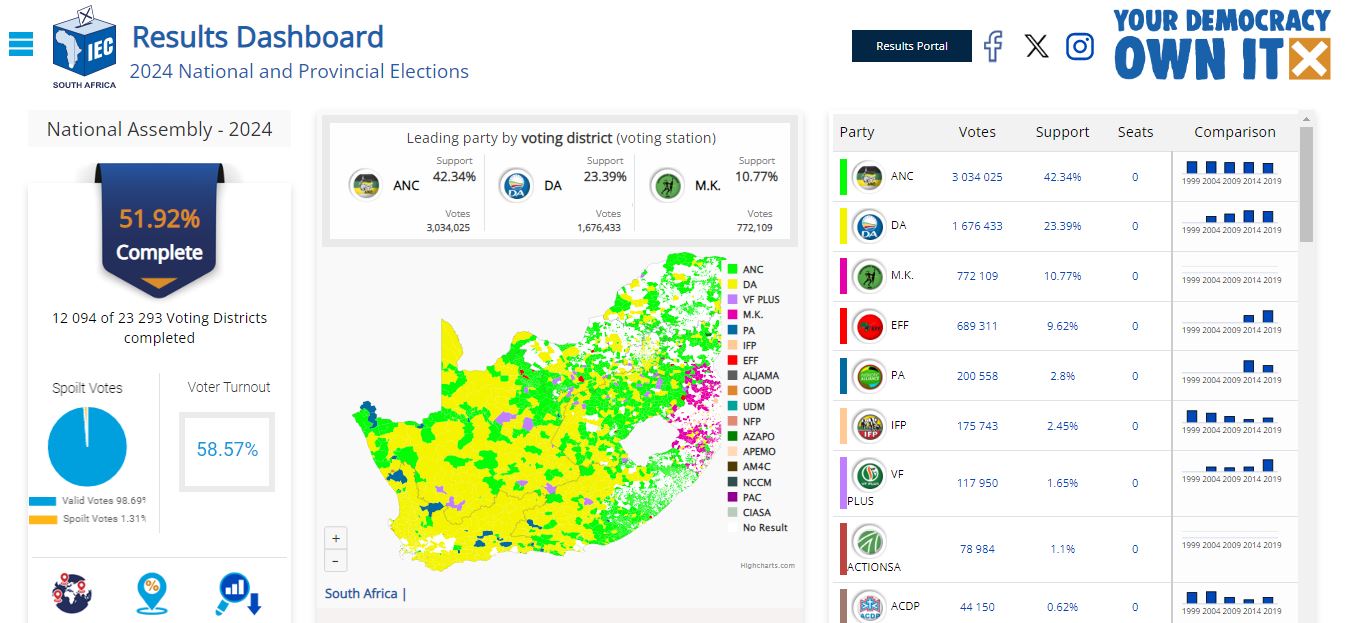
With over 60 percent of votes declared, ANC sits at the top but just under the 42 percent mark, followed by the DA at 23 percent.
The current result is about 15 percentage points lower than the ANC’s last election win.
————————————————-
What is the DA party in South Africa?
In the last National Assembly, the DA had 84 seats.
Steenhuisen, 48, is the head of the DA and is eager to sell his party as one that will “rescue South Africa” from the ANC.
Many view the DA as a party that champions only the interests of the middle class, specifically those in its support base in the Western Cape, despite campaigning in a country where working-class Black people make up the bulk of the population.
While the DA remains the second-largest party after the ANC, it has struggled to rally support from Black voters. It opposes policies such as workplace race quotas introduced by Ramaphosa’s government to close economic gaps that have seen Black people perpetually disadvantaged.
This is why some voters and rivals criticise Steenhuisen and the DA for being unaware of the conditions of the majority of South Africans.
Steenhuisen himself has deflected accusations of representing an advantaged minority by saying South Africans are looking for competence.
————————————————-
How is the president elected?
Instead, they elect 400 members of the National Assembly, which then selects the president by a simple majority – 201 or more votes.
If the ANC secures more than 50 percent of the vote, President Ramaphosa will most likely be re-elected as president to serve a second and final five-year term.
————————————————-
How many people have voted in this election?
According to the IEC, turnout was 58.58 percent which means about 16.2 million turned up to vote.
In 2019, 17.6 million people turned out to vote.
————————————————-
EFF slams outage of IEC results dashboard
“This incompetence was first witnessed on the voting day when the VMD [voter management device] machines were not fully functional in many voting stations across the country,” a statement on X by the party said. “This resulted in long lines and a longer voting process which were not properly managed by the institution.
“The crash of the results dashboard for such a historical election is concerning and warrants a thorough investigation to ensure transparency and integrity in the electoral process.”
————————————————-
How does the electoral system work in South Africa?
Voters cast ballots for a party with associated candidates’ list determined before the election.
Voting is under a proportional system in which parties and candidates are competing for 400 seats in the National Assembly.
Parties on the national ballot will contest 200 of those seats while the other 200 are divided among the nine regions and contested by parties and independent candidates.
For the first time, voters received three ballots instead of two in this election. On each ballot, they had to choose one party or one candidate.
Two ballots will be used to elect the National Assembly, and the third one will be for the election of members of the provincial legislature in each province.
————————————————-
When was the last election and what were the results?
In 1994, the ANC won 62.5 percent of the vote. In 1999, it won 66.4 percent. In 2004, it reached its highest levels, clinching almost 70 percent of the vote. In 2009, it won nearly 66 percent, and in 2014, it won 62 percent.
In the last election in 2019, the ANC achieved its lowest margin of victory, winning 57.5 percent of the vote.
The official opposition DA has come second in the past five elections.
————————————————-
Research group predicts National Assembly seat allocations
The CSIR said it predicts that the ANC is likely to lose its majority in the National Assembly and the DA will have a slight increase in its seats.
“For ANC, it is likely that they will end up with around 160 seats,” CSIR official Pravesh Debba was quoted as saying by SABC.
“DA is looking as if they will end up with about 87 and MK 58, and EFF 38.”
————————————————-
Could the MK be a significant player in South Africa’s political landscape?
Now he’s fielding a stand-in and testing a new role as kingmaker.
Zuma is determined to be a thorn in the side of the ANC, with which he has since fallen out. With the MK, Zuma is looking to wrest power from his old party – if not nationally, then at least to split the ANC’s votes in his home province of KwaZulu-Natal.
With just over 58 percent of the votes announced, MK sits third on the list with 11.3 percent.
————————————————-
Western Cape votes expected to be finalised on Friday
The statement comes despite the glitches experienced on IEC’s systems across the country on Friday morning.
The Western Cape is governed by the opposition Democratic Alliance (DA) since 2009 and this is not expected to change in the latest elections.
————————————————-
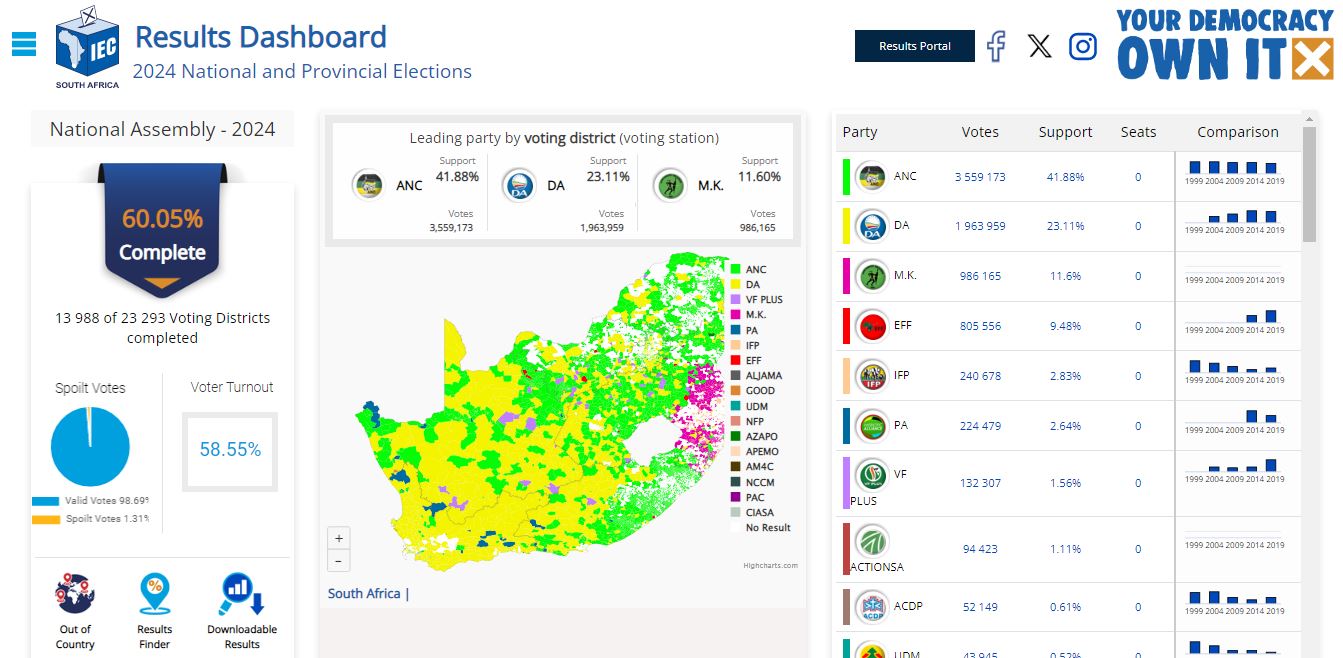
South Africa Elections Results 2024 ( 31/05/2024 12:04pm)
————————————————-
Could the MK be a significant player in South Africa’s political landscape?
Now he’s fielding a stand-in and testing a new role as kingmaker.
Zuma is determined to be a thorn in the side of the ANC, with which he has since fallen out. With the MK, Zuma is looking to wrest power from his old party – if not nationally, then at least to split the ANC’s votes in his home province of KwaZulu-Natal.
With just over 58 percent of the votes announced, MK sits third on the list with 11.3 percent.
————————————————-
Western Cape votes expected to be finalised on Friday
The statement comes despite the glitches experienced on IEC’s systems across the country on Friday morning.
The Western Cape is governed by the opposition Democratic Alliance (DA) since 2009 and this is not expected to change in the latest elections.
With almost 56 percent of the results announced, the DA currently sits second with 24 percent. The ruling ANC currently tops the table with just under 42 percent and will require the help of other parties to form a government.
————————————————-
What does Zuma want?
“I think what Zuma wants is two things. He’s not interested in being anywhere close to government. What he wants is a presidential pardon, so he is going to look for a coalition with a governing party at the national level that can give him a presidential pardon. He has got multiple corruption, racketeering charges, and has been trying for years to get out of it.
“He has run out of legal runway, has to face corruption charges, and is very likely to go to jail in his old age. What he wants to do is prevent that from happening. And the only way to prevent that from happening is to get a presidential pardon. So everything he does is based on that. He wants to get the high numbers [for the MK party] so he can get into a national coalition, where whoever is elected president gives him that pardon.”
————————————————-
ANC likely to ‘accommodate’ left-wing parties for a coalition
“So they lost 15 percentage points of the votes compared with the last election – down from 57 percent to give and take 42 percent,” he told Al Jazeera from Krugersdorp. “Hence losing majority in South Africa and overall control of the country.”
According to Swana, for a coalition, the ANC would have to accommodate the left-wing parties, which are the MK Party, the Economic Freedom Fighters, and the African Transformation Movement, among others.
“In the absence of that, you will have perpetual protests. Big businesses in South Africa are calling for the ANC to form a coalition with smaller parties and exclude other big parties… So the most likely scenario is where the ANC accommodates the left.”
————————————————-
What happened on Thursday?
- Polls officially closed at 9pm (19:00 GMT) on Wednesday, but long voter queues and delays kept many polling stations open until about 3am (01:00 GMT) on Thursday.
- Vote counting began shortly after polls closed and continued throughout the day.
- By 4pm (14:00 GMT), results were concluded for 22.6 percent of all voting districts, the country’s Electoral Commission said.
- Just before 11pm (21:00 GMT), more than 40 percent of the vote was tallied. Counting continues into Friday.
- Zuma’s MK party gained ground in KwaZulu-Natal, and the main opposition DA took an early lead in the Western Cape. Meanwhile, the ANC struggled more than it did in previous elections.
- Analysts say it is unlikely the ANC will get a 50 percent majority, which means the party will have to seek coalition partners to govern.
Final results are expected to be announced by Sunday.
————————————————-
Man arrested for election fraud in Cape Town
Western Cape provincial Police Commissioner Thembisile Patekile said the 64-year-old was arrested at Hoërskool Jan Van Riebeeck in the suburb of Gardens.
Patekile added the man first voted at Jan Van Riebeeck Primary, adding that he will be charged with election fraud.
All votes have been counted
“The Election Commission is in the process of validating the results that’s why they are slow coming in,” Miller said, reporting from Midrand.
“The Election Commission said earlier that the final results should be announced by Sunday and that hasn’t changed yet. It appears that the turnout was around 58 percent.”
————————————————-
Is the ANC heading for a coalition?
With nearly half of the votes counted, the ANC is hovering closer to the 40-percent mark than 50, making it very likely it will need the help of the bigger parties for a coalition.
If the ANC performs much worse than expected, there is a slim chance it could be completely removed from government.
Early results left investors ‘swinging between anxiety’
It reported that ahead of the vote, it seemed that the governing party would be much closer to the 50-percent mark that would have enabled it to join hands with a small party.
However, after half of the votes counted, ANC’s tally is hovering around the 42-percent mark.
“We remain in something of a no-man’s-land at present, with the still-sizable uncertainty over the ANC’s final tally keeping most options for the next government on the table,” Ivailo Vesselinov, chief strategist at Emso Asset Management, was quoted as saying by Bloomberg.
South Africa election results page back on
However, it still seems to be missing data from areas where it had previously announced votes had been counted in.
We will bring you all the latest on this as well as the results as soon as we can.
————————————————-
When will we find out the results?
Ahead of the polls, the IEC said it will announce final results on Sunday, June 2.
————————————————-
Urban vote count may help ANC, but likely won’t be enough
“Big cities are the ANC’s domain historically, they’ve always done very well in the major urban centres. But what we’ve seen in the rural areas is definitely a bleeding of support. If that is repeated in the urban areas, the ANC is going to do even worse than we predict at the moment,” Al Jazeera’s Mike Hanna said, reporting from the election result centre in Midrand.
“But it is a very tricky situation, because you do have a somewhat regional bias to things as well,” he added, noting that the MK has benefitted from strong results in KwaZulu-Natal, a historic hub of ANC support but also the home province of MK leader Jacob Zuma.
————————————————-
Glitch in Election Commission website
In a post on X, the IEC said they are working on restoring the service.
————————————————-
What if no party wins a majority?
If this happens, the ANC will need to try to make a deal with other parties to form a coalition government. The choice of coalition partners depends on their d
————————————————-
istance from the 50 percent mark.
If the ANC performs much worse than expected, there is a slim chance it could be completely removed from government.
————————————————-
South Africa Elections Results 2024 (05:13am | 31/05/2024)
Here’s what happened yesterday
- Polls officially closed at 9pm (19:00 GMT) on Wednesday, but long voter queues and delays kept many polling stations open until about 3am (01:00 GMT) on Thursday.
- Vote counting began shortly after polls closed and continued throughout the day.
- By 4pm (14:00 GMT), results were concluded for 22.6 percent of all voting districts, the country’s Electoral Commission said.
- Just before 11pm (21:00 GMT), more than 40 percent of the vote was tallied. Counting will continue into Friday.
- Jacob Zuma’s MK party gained ground in KwaZulu-Natal, and the main opposition DA took an early lead in the Western Cape. Meanwhile, the ANC struggled more than it did in previous elections.
- Analysts say it is unlikely the ANC will get a 50 percent majority, which means the party will have to seek coalition partners to govern.
- Final results are expected to be announced by Sunday.
————————————————-
South Africa Elections Results 2024 (10:59 pm)
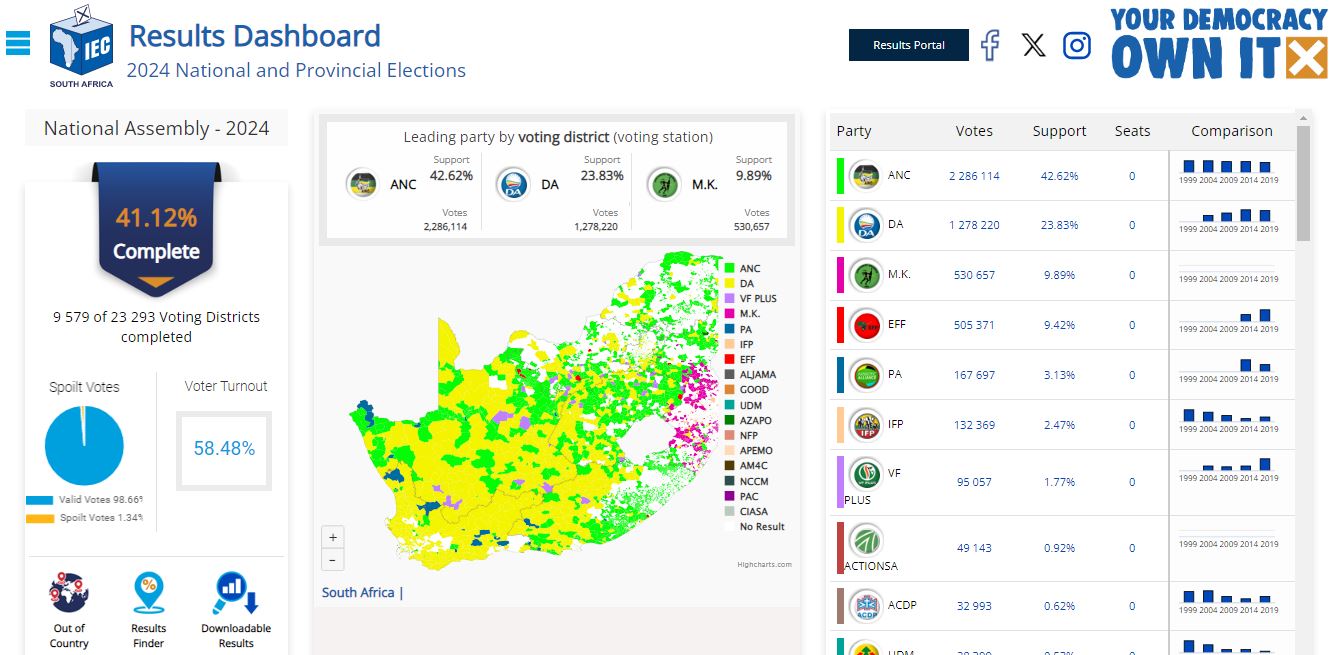
40 percent of the vote counted
The ANC was in the lead nationally with 42.6 percent, but early results and projections suggested it would likely lose its outright majority.
In second place was the DA with 23.8 percent, followed by the MK with 9.8 percent, and the EFF with 9.4 percent.
The ANC had so far won the most votes in all provinces besides the Western Cape – where the DA was in the lead – and KwaZulu-Natal, where the MK was making gains.
————————————————-
Urban vote count may help ANC, but likely won’t be enough
“Big cities are the ANC’s domain historically, they’ve always done very well in the major urban centres. But what we’ve seen in the rural areas is definitely a bleeding of support. If that is repeated in the urban areas, the ANC is going to do even worse than we predict at the moment,” Al Jazeera’s Mike Hanna said, reporting from the election result centre in Midrand.
“But it is a very tricky situation, because you do have a somewhat regional bias to things as well,” he added, noting that the MK has benefitted from strong results in KwaZulu-Natal, a historic hub of ANC support but also the home province of MK leader Jacob Zuma.
————————————————-
Voter turnout currently trending lower than 2019
That is lower than the 66 percent figures from 2019 – which undermines earlier predictions from the commission that said turnout would likely exceed the previous election.
“Analysts have told Daily Maverick that the long voting queues seen countrywide on Wednesday are not necessarily an indication of high voter turnout, but may be an indication of what’s happening inside voting stations. If you take into account the reports of delayed ballots, tech glitches and three ballot papers, it’s not rational to assume the long queues were the result solely of a high voter turnout,” the outlet said.
————————————————-
Former ANC activist: Election results will be ‘sobering’ for ruling party
“Current predictions show the ANC likely to come in between 40 and 45 percent of the vote, which would be a significant reduction in their support, having obtained 57 percent in the previous election,” he told Al Jazeera. “So it’s a sobering election for the African National Congress.
“It seems that the primary beneficiary of the ANC’s drop in support has been Jacob Zuma’s new MK party. The official opposition, the Democratic Alliance, seems to be staying relatively stable in the low 20 percents.”
————————————————-
Results thus far ‘very encouraging’: Opposition
“Certainly, it’s a political future that could be very, very different from the decades of the past,” said Hanna.
“We are very satisfied with the picture that is starting to emerge with the results that are out now. It’s very encouraging for our prospects in this election,” Solly Malatsi, a spokesperson for the Multi-Party Charter (MPC) opposition coalition told Hanna.
“The truth of the matter right now is that the future of governance in South Africa is coalitions,” he added.
————————————————-
IEC asks for help locating missing ballot box
“The Electoral Commission appeals to citizens in and around Ward 14 uMhlathuze, in KwaZulu-Natal, to be on the lookout for an IEC branded ballot box that went missing in transit from the voting station … to the municipal electoral office for storage,” the body said on X, stating that the ballots in the box had already been “counted, reconciled and validated”.
“The IEC appeals to anyone who finds the ballot box to return it to us. Citizens are reminded that anyone found to be in possession of ballots is liable to criminal prosecution,” the post added.
The Electoral Commission appeals to citizens in and around Ward 14 uMhlathuze, in KwaZulu-Natal, to be on the lookout for an IEC branded ballot box that went missing in transit from the voting station Matamzana Dube School in VD 43412767, KZN282, uMhlathuze, to the municipal… pic.twitter.com/lTA8FXpDaB
— IEC South Africa (@IECSouthAfrica) May 30, 2024
————————————————-
Many South Africans feel let down by ANC: Analyst
He says many Zulus – the country’s largest ethnic group, to which Jacob Zuma belongs – are also enthused about the candidacy of the former president.
“A lot of people who are either disgruntled or fed up with the ANC feel that the ANC has let them down,” he said.
“So they see this new political party [MK] as the alternative. And then you have a lot of Zulu speakers, Zulu people who support him [Zuma] just because in him they see themselves.”
————————————————-
ANC faces uncertain coalition possibilities if it falls short of a majority
“The other option is for the ANC to cobble together a whole lot of the smaller parties who may demand less to become part of the coalition,” Al Jazeera’s Mike Hanna reported from the election result centre in Johannesburg.
“The problem with that, in terms of the arithmetic, is that the ANC would have to get at least 46 percent or more of the votes to form a coalition with a number of parties.
“But as the results are coming in, that appears to be a target that may be very hard for the organisation to reach.”
————————————————-
MK becoming ‘permanent fixture’ in national politics: Party member
Hanna spoke to Duduzile Zuma-Sambudla, an MK member and former President Jacob Zuma’s daughter.
“I think [the MK is becoming] a permanent fixture in South African politics. It’s one that’s needed and one that’s obviously wanted as we can see by the numbers,” she said, reiterating that there would be no coalition talks with the ANC.
“It’s what democracy is: People have the right to choose who they want to choose, and the bulk of our voters this year were young people,” she added.
————————————————-
‘The race is not over’: ANC deputy secretary-general
“It is still early, the race is not yet over,” she said, noting that vote tallies from the KwaZulu-Natal province have been a “surprise”.
Some young voters hope MK will boost their economic prospects
“I’m sure the [MK] party will give us great job opportunities, especially us youngsters,” voter Pindile Mkhize told Al Jazeera.
“I finished school in 2010 and I still don’t have a job. The other party is promising us the jobs, but still nothing. I think the MK is going to give us a change.”
————————————————-
ANC projected to lose Gauteng: Local media
The outlet, using a forecasting tool it developed during the last elections, projected that the ANC would get 35 percent of the vote in Gauteng, the economic heart of South Africa, which is home to Johannesburg and Pretoria.
The party narrowly held on to the province in the 2019 elections with 50.1 percent of the vote.
News24 said the ANC and EFF are already working together in key metro areas and, if the ruling party loses Gauteng, that working arrangement may be extended. However, it added that the two parties would still need other smaller parties to surpass 50 percent.
————————————————-
South Africa Elections Results 2024 (07:48 pm)
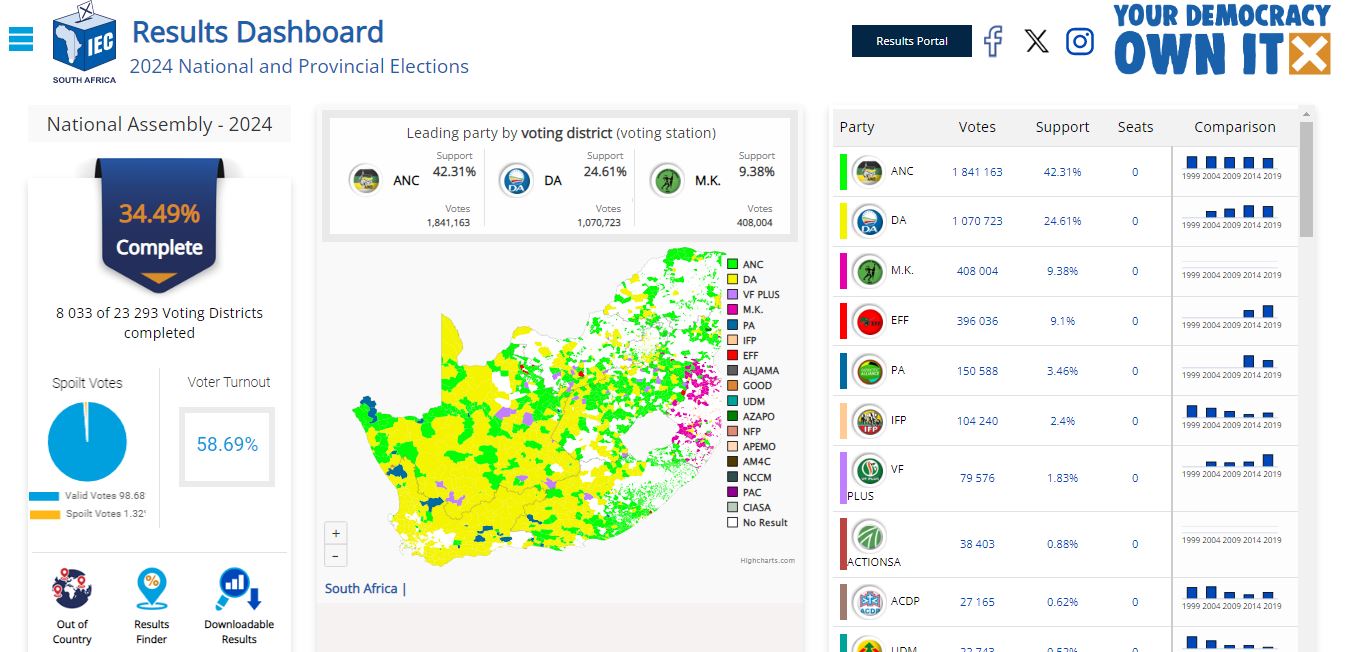
MK party moves into third position
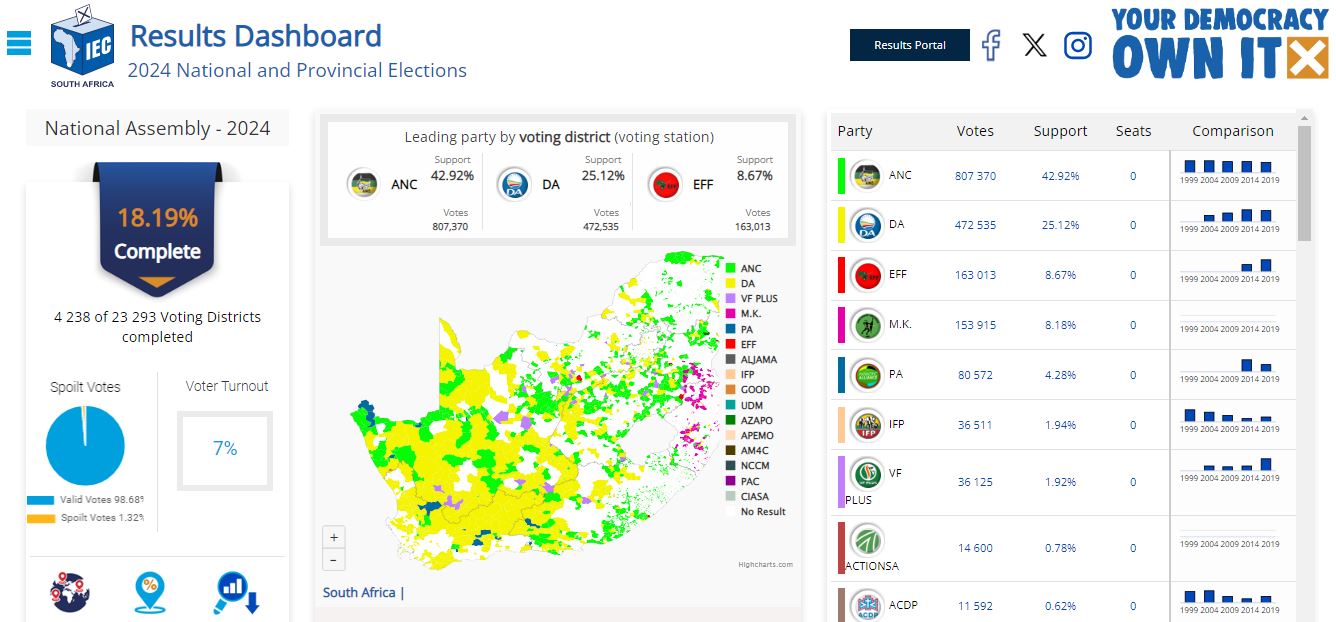
The Electoral Commission of South Africa (IEC) shows MK with 9.17 percent, while the EFF now has 9.03 percent, giving MK a small lead for third place that could change as more votes come in.
ANC remains in first place with 42.1 percent, and DA is in second with 24.8.
————————————————-
Who is John Steenhuisen?
Steenhuisen is one of the architects of the Multi-Party Charter, a coalition of 11 parties seeking to end the ANC’s majority.
But the DA has been bashed by critics as a party of the middle class with little understanding of the problems faced by the country’s poor.
The party’s leaders are also largely white, contributing to perceptions that the DA is a party for those with relative advantage. Steenhuisen has downplayed those concerns by stating that South Africans are eager for competence above all else.

————————————————-
Zuma’s tenure as former president helps fuel success in Umlazi district
“When you ask people why they’re supporting Jacob Zuma and his MK party, they say first of all it’s frustrations with the ANC. But they also say this is Zuma’s home province, so they expected him to do well here,” Al Jazeera correspondent Haru Mutasa reported from Umlazi.
“They also say that when he was president of South Africa a few years ago, they feel that he put a lot of effort into developing this province, that he improved the roads, the infrastructure, built hospitals, educated poor children. They feel loyal to him because of that.”
South Africa Elections Results 2024 (06:51 pm)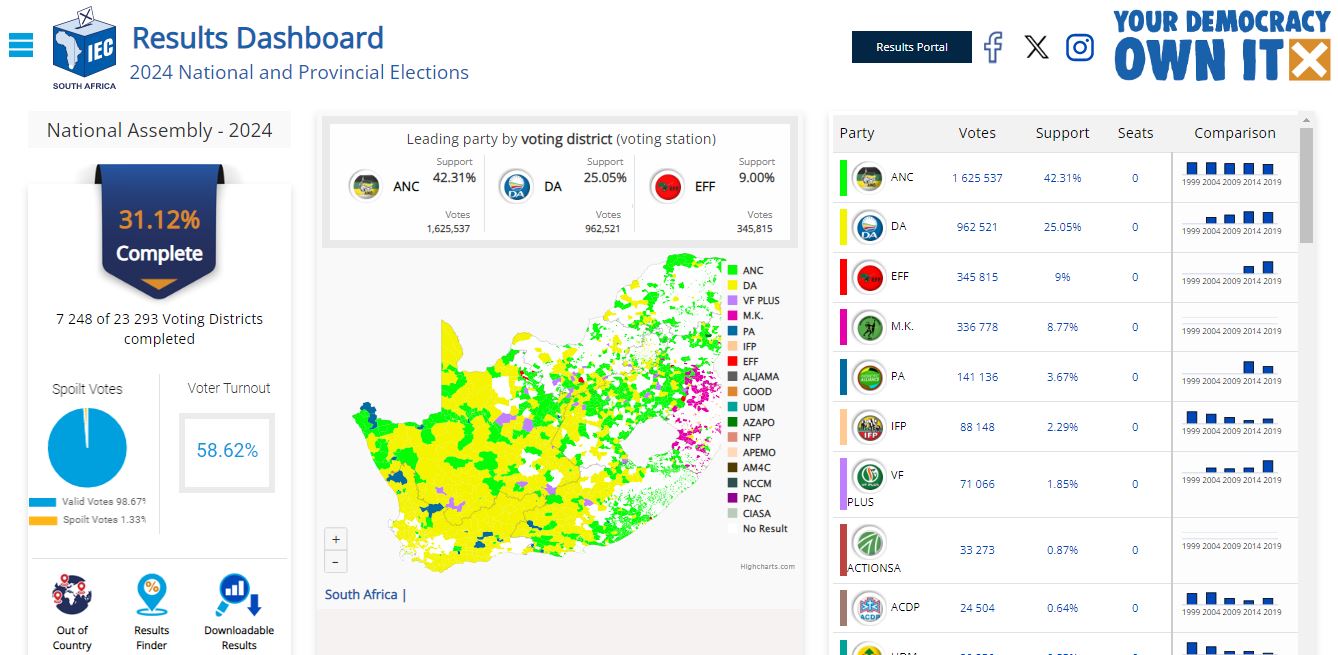
————————————————-
Do we know what day and time the election results will be released?
In the last election in 2019, voting took place on a Wednesday, like this year, and final results were announced on Saturday.
However, this year, experts said it may take a bit longer because of voting delays and because there were three ballots instead of two.
Early results show poor trend for ANC
“At the moment we’ve got just over 20 percent of the vote counted, and at this stage the ANC has around 43 percent of the vote,” Al Jazeera correspondent Mike Hanna reported from a results operation centre in Midrand, South Africa, adding that this result is lower than the ANC might have expected.
“But a couple of caveats. We’re looking at a rural picture at the moment. We haven’t had many of the urban areas coming through, and we’re waiting through the day, and possibly tomorrow, for all the votes to come in to get a clearer picture.”
————————————————-
Photos: Votes are counted in South Africa elections
More than a quarter of the votes are now counted, according to the Electoral commission.


What does Zuma want?
“I think what Zuma wants is two things. He’s not interested in being anywhere close to government. What he wants is a presidential pardon, so he is going to look for a coalition with a governing party at the national level that can give him a presidential pardon. He has got multiple corruption, racketeering charges, and has been trying for years to get out of it.
“He has run out of legal runway, has to face corruption charges, and is very likely to go to jail in his old age. What he wants to do is prevent that from happening. And the only way to prevent that from happening is to get a presidential pardon. So everything he does is based on that. He wants to get the high numbers [for the MK party] so he can get into a national coalition, where whoever is elected president gives him that pardon.”
————————————————-
MK won’t form coalition with ANC, Zuma’s daughter says
Speaking to journalists at the Electoral Commission’s results centre, Duduzile Zuma-Sambudla said her father indicated he was open to working with “progressive Black parties”, the outlet reported.
Zuma and his party have been gaining ground in KwaZulu-Natal, which could make the former ANC member a kingmaker in the formation of a new government.
Results being validated
By 4pm (14:00 GMT), results were concluded for 22.6 percent of all voting districts.
A result is considered complete only when a result slip has been scanned, captured onto the results system, audited by independent auditors and goes through the automated results system exception parameters, he said.
The rate of result capture is as follows:
- Northern Cape – 63 percent
- Eastern Cape – 58 percent
- Western Cape – 57 percent
- Free State – 56 percent
- Mpumalanga – 42 percent
- North West – 36 percent
- Gauteng – 28 percent
- Limpopo – 26 percent
- KwaZulu-Natal – 23 percent
————————————————-
Vote counting ‘slowed down’ this election: Electoral officer
“Historically, in the first 24 hours, 80 percent of the results would have been finalised. However, the process in the 2024 elections has been slowed down by the third ballot, particularly in metropolitan areas,” he said.
“According to the Electoral Act, the commission has seven days within which to announce the results. We have always been able to declare and announce the results well within this period and will endeavour to do so even in this occasion.”
————————————————-
MK could ‘decimate’ ANC in KwaZulu-Natal: Analyst
“Zuma will be kingmaker potentially if the ANC reaches the 40 percent floor [nationally], but his strength is also KwaZulu-Natal, so he would be able to put a government together there with the EFF and could prevent the ANC from forming a government in KwaZulu-Natal.
“I think we can already say now that the ANC has lost KwaZulu-Natal … It seems like Zuma has already taken the vote from the ANC in the rural areas [in KZN] and that’s very dangerous for the ANC because they are already weak in the urban areas. So the ANC, it appears, is going to be decimated in KZN.”
————————————————-
How has Jacob Zuma’s MK party performed so far?
They have performed quite remarkably in his home province [KwaZulu-Natal]. His party was formed just last year and they managed to make major inroads in this province.
They’ve taken some areas away from the ANC. This is traditionally an ANC stronghold, so it’s quite a shake-up.
When you speak to his supporters, they say they’re supporting him because when he was president of South Africa, they feel he did develop this part of the country. They say he created jobs, he improved infrastructure, he made healthcare better for the poor; that’s why they support him.
That’s why some feel he is being unfairly persecuted by Ramaphosa’s ANC; they feel he is being victimised.
It’s remarkable – this party is only a year old and it’s managed to make inroads in this province. But people wait to see how it also does nationally.
————————————————-
South Africa’s DA seeks to prevent ANC alliance with two smaller parties
“We will do everything in our power to prevent an ANC, MK and EFF coalition. That would spook investors. It would tank the economy. It would be a disaster for South Africa. So we are very committed to prevent that outcome,” said Zille, a former DA leader who is chairperson of the party’s Federal Council.
Partial results showed the ANC on course to lose its parliamentary majority. The DA was expected to come second, the EFF third and MK fourth.
“We are not in negotiations with anybody,” Zille said.
Asked about what coalition options her party might pursue, she said: “My expectations are that my party will take the least bad option.”
————————————————-
South Africa Elections Results 2024 (04:37 pm)
————————————————-
Who is leading in South Africa’s 2024 elections?
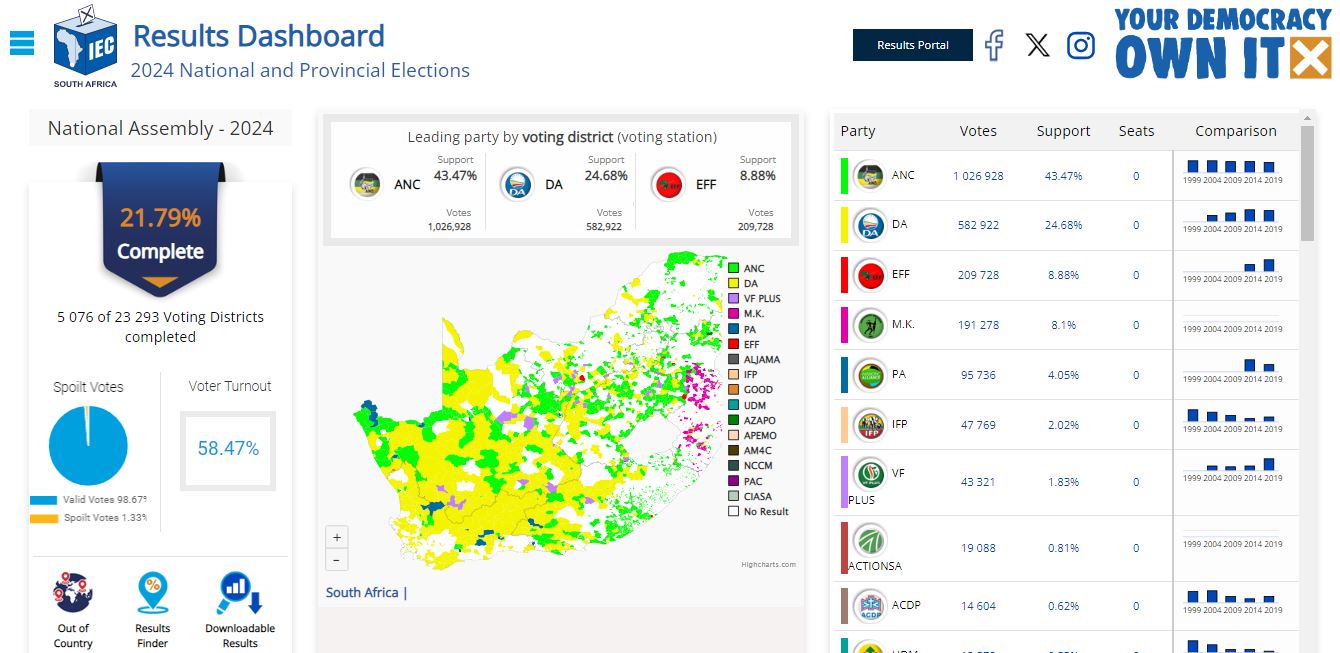
The EFF follows with 8.9 percent, but the newly formed MK is hot on its heels with 8.1 percent.
Despite the ANC’s lead, many analysts and polls project it will not gain a 50 percent majority for the first time.
The ANC is currently leading in all provinces besides the Western Cape where the DA is in the lead, and KwaZulu-Natal where the MK is gaining support.
————————————————-
‘ANC’s arrogance cost them votes’ in KZN as MK leads in polls: Report
Political commentator Thobani Zikalala told IOL the ANC’s arrogance cost them in the elections. If current polls are an indication, the MK will take the majority of the votes in KZN, he said.
“The ANC should have fixed its house. The voters are clearly saying that they want something different and something better. The MK party represents a break in the status quo,” he said.
Zikalala added that historically, Zuma has been touting radical economic transformation and the ANC discounted the “Zuma factor” in KZN.
“It is about the politics of personalities. People will follow personalities, and Zuma exemplified this, as it shows that no matter where the person goes, the people will vote for them,” he told IOL.
————————————————-
Who is Cyril Ramaphosa?
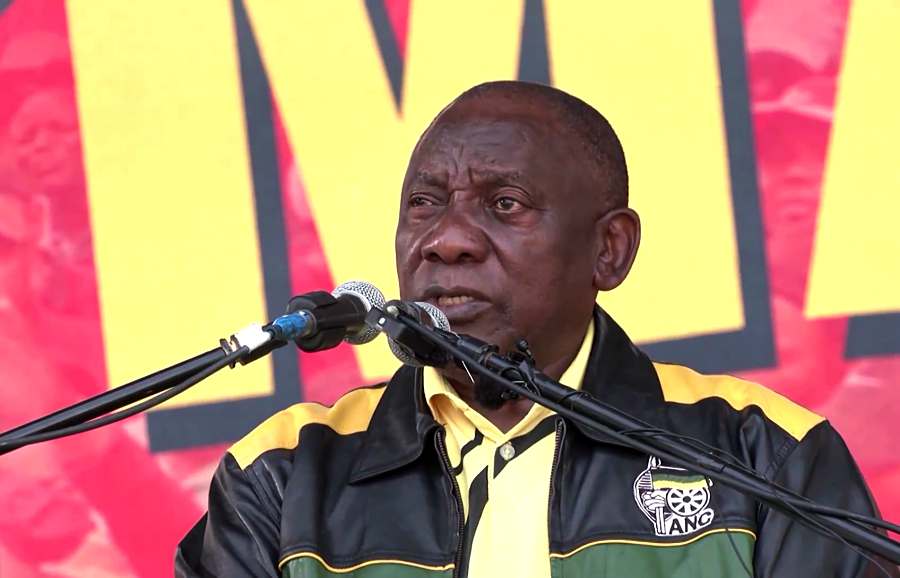
Before becoming president, Ramaphosa was a successful businessman in sectors ranging from mining to food.
He is considered a more level-headed leader than his immediate predecessor, Jacob Zuma. However Ramaphosa has also suffered his share of image-denting scandals in office, most notably the 2022 Phala Phala debacle when he was accused of hiding millions of dollars in laundered cash in his farmhouse.
If the ANC fails to win at least 50 percent of the national vote, it may be forced into a coalition with smaller opposition parties for the first time in history. Still, Ramaphosa, who has retained a steady support base, is the favourite for president, according to ANC internal polls.
————————————————-
‘Unbelievable’ that most in Eastern Cape still support ANC: ActionSA candidate
“It’s inexplicable to me,” he said. “I’ve been campaigning for a long time in this province where people are impoverished. We have the highest unemployment rate and poor service delivery levels. Our rural hinterland is completely impoverished, yet the people of this province still vote ANC.”
————————————————-
If formation of coalition is protracted, political gridlock may follow
“There will be checks and balances on the ANC power, but the ultimate risk is that the infighting could make governance ineffective,” Simon Harvey, head of foreign exchange analysis at Monex Europe, was quoted as saying by Reuters news agency.
Under South Africa’s constitution, the National Assembly will elect the next president. With the ANC still on course to be the largest party, that is likely to be its leader Ramaphosa, the incumbent.
However, a poor showing could make him vulnerable to a leadership challenge from within party ranks, whether in the immediate future or at some point during his term.
————————————————-
Some could not vote due to registration discrepancies: FF+
“We have many, many instances of the electorate just not being able to vote,” Wouter Wessels of the FF+ told SABC.
“They were correctly registered, they have proof, they checked their registration status over the registration weekend and all of a sudden, they are registered in a place where they have never lived, never registered at and that’s very, very strange. Then the system is saying a person is only eligible to vote in one place.
“Those people were turned away, they couldn’t vote.”
————————————————-
What are the main issues among South Africans?
Economy – The root cause of the joblessness crisis is sluggish economic growth. South Africa’s economy has barely grown in more than a decade with economic growth averaging 0.8 percent since 2012.
Power cuts – Known to South Africans as “load-shedding”, scheduled power cuts imposed by the state utility Eskom because of an inability to generate enough electricity to meet demand are the bane of households as well as companies.
Corruption – A long series of corruption scandals involving ANC figures or people connected to them has created a perception among many South Africans that the greed of people in office is contributing to poor service delivery for everyone else.
Crime – South Africa has one of the world’s highest rates of violent crime. The problem is worse in the densely populated townships on the peripheries of cities, where many Black working class people live.
Immigration – The most recent census in 2022 found that 2.4 million of South Africa’s population of 62 million people were immigrants, compared with 835,000 in 1996, the year the post-apartheid constitution was promulgated.
————————————————-
What are possible coalition options for the ANC?
“It will almost be like an old ANC, because the EFF and MK leaders were former ANC members. That type of coalition can be very tough for the ANC because MK and Jacob Zuma demand two things: Ramaphosa must go as president for him to be part of a coalition and for Zuma to get a presidential pardon so that all of his corruption cases are taken away. The EFF wants the deputy presidency and the finance ministry. So these are very tough and humiliating conditions for the ANC.
“The second one they could consider is to go into a coalition with the MPC, with the Multi-Party Charter that includes the DA, IFP, FF Plus, that’s almost a grand coalition or like a government of national unity. So that’s what the ANC will have to think of. But if the ANC falls below 40 percent, the MPC members could consider a coalition with other parties.”
————————————————-
South Africa Elections Results 2024 (01:46 pm)
————————————————-
Late voting likely to cause counting delays: Western Cape official
He said the last voting station in Parklands, Cape Town closed at about 1am (23:00 GMT). Some of the delays were due to voter management devices, personnel and training, he added.
Hendrickse added that counting is well under way in the Western Cape province. By 10am (08:00 GMT), 23.66 percent of Western Cape votes had been counted.
He said the late voting will likely delay ballot counting and metro areas with larger populations will take longer to tally.
————————————————-
Election to be contested in urban areas
“The rural vote comes in early and it’s always much smaller. The urban vote comes in quite late. I think this election will be a lot more contested in the urban areas,” she told Reuters at the results centre in Midrand, north of Johannesburg.
————————————————-
What if no party wins a majority?
Opinion polls suggest the governing ANC will likely lose its majority.
If this happens, the ANC will need to try to make a deal with other parties to form a coalition government. The choice of coalition partners depends on their distance from the 50 percent mark.
If the ANC performs much worse than expected, there is a slim chance it could be completely removed from government.
This may be a bloodbath for the ANC
“Many voters in rural areas come out, but many city voters don’t. This time, we saw higher urban voter turnout, which means that the ANC will be lower than the 50 percent and it may be closer to 40 percent.
“The ANC has become an increasingly rural party, it has been losing the urban areas. I think once the urban area vote comes out in terms of counting, this may be a bloodbath for the ANC.”
————————————————-
The forecasting tool, built by Media24 developers, is based on series of mathematical models developed by elections specialist Dawie Scholtz and was first used by News24 during the 2019 general election.

Courtesy: News24
————————————————-
How relevant is the ANC among the youth?
When you speak to the older voters, they will tell you they remember before apartheid ended in 1994, Black South Africans didn’t have many rights in this country. They see the ANC as a party that brought it liberation; now people have rights, the fact that they can come and vote is a big achievement.
But they do acknowledge there are a lot of things that have gone wrong in this country.
The younger people, some of them say they learn from their parents about the ANC’s history and how important it is that they fought for this country’s liberation. But some are saying our issues now are different – we don’t have jobs, we don’t have access to basic services; they want things to change.
The key thing, of course, is the ANC’s relevance or dominance in today’s society for young South African voters and we saw some of them waiting in long lines, at least in this part of Durban, yesterday.
“In previous elections, people could vote and express their support for the ANC, but the outcome was more or less guaranteed. The ANC would win a majority of votes, and now its not clear and it’s also not clear what a coalition government would look like,” Bax told Al Jazeera.
She added that the ANC has yet to say which parties it would join in a coalition government and is still maintaining that it will win the election.
“We don’t really know what the outcome is going to be, so we don’t know what coalition partners are most likely … so it’s really quite up in air at the moment, which also makes it really quite exciting,” she said.
————————————————-
Projection: National-to-national ballot puts ANC at 42.3%, a massive drop from 2019
News24’s election model reveals that the ANC has lost 15,2 percentage points from the 57,5% it secured in 2019.
The model, which calculates party support based purely on the national ballot and is exclusive of the regional ballot, puts the ANC at a projected number of 42,3%.
Former president Jacob Zuma’s MK Party looks set to replace the EFF as the country’s third largest party.
The regional ballot, which was the third ballot voters used, is also a national ballot and includes independent candidates. This ballot will be added to the national ballot.
News24’s modeling will later on Thursday confirm the combined national and regional ballot to reveal the final, national projection.
News24’s projection for national ballot is:
ANC: 42,3% (-15,2)
DA: 21,8% (1)
MK: 13,6% (-)
EFF: 9% (-1,8)
IFP: 3,5% (-)
PA: 2,2% (1)
FF+: 1,5% (-0,9)
ActionSA: 1% (-)
Rise Mzanzi: 0,4% (-)
BOSA: 0,3% (-)
————————————————-
(12:14 pm)
————————————————-
What kind of a coalition could the ANC form?
“If the ANC score up where they are currently at 42 percent, they may need one very large party to push them over 50 percent and they may be working with the EFF or they may work with a coalition of smaller parties which I think will be more complicated to manage,” he said.
“If they score in the higher 40s, if they come in at just 47, 48 percent, they may only need two or three smaller parties that are breakaways from their own original stable, to get them over that and that might be helpful for them.
“If they’re scoring below 40 – which is really unanticipated – then the dynamic is widely open and we may seen them combine in ways that nobody would’ve foreseen and that they’ve all denied they would, and that might be the two biggest parties.
“Politics is a very strange business and we’ve seen coalitions happen between people before, particularly in South Africa, that you wouldn’t have thought would go together.”
————————————————-
Current national assembly

————————————————-
South Africa’s rand drops
The currency dropped as much as 1.1 percent against the dollar to trade at 18.5955 per dollar as of 8:50am (06:50 GMT).
————————————————-
The youth ‘don’t feel loyalties to the ANC’
“You must look at the 30 years as a whole, not just the last five years or 10 years. As a whole, we’ve done remarkably well compared to what apartheid was,” he told Al Jazeera.
“We have had over 5m rands ($267,823) allocated to university and college. We have taken five million people overall through the system.
“They haven’t been through what apartheid was, and they’re angry at us. But it’s good that 18 to 42-year-olds was the largest component of the new registration and the ANC has to take that into account. We cannot reside solely on the memories of the older generation who were engaged in the struggle era before 1994.”
————————————————-
‘Big shock’ to ANC if they get below 50 percent of vote
“The question is, though, how badly will the ANC do, and at this stage it looks like they could possibly still make the 45 percent mark and up. It’s important to note they will still be by far the majority party in the country,” Verwoerd told Al Jazeera.
“The Democratic Alliance is the major opposition party. They’re not expected to get much more than the low or mid-20s.
“The Economic Freedom Fighters, under Julius Malema, [is] somewhere along the 10,11,12 percent. So the ANC will stay a dominant power in the political domain, but it will be a big shock for them when they fall under 50 percent for the first time since democracy.”
————————————————-
Concerns within the ANC over losing majority
The turnout has always been under the watch as it may indicate the outcome of this election. Many polling stations had to remain open after the allotted time because there were voters in the queue.
Analysts are saying a high turnout could possibly be bad news for the ANC and we could possibly see those people having voted for the opposition.
It’s still early days and we’re likely to get the final results by Sunday but until then, the biggest question will be around the ANC hanging on to its majority. There are concerns from within the party that it might not be the case.
————————————————-
Voter turnout ‘well beyond’ last election
When asked about specific numbers during a media briefing, he said: “It’s difficult to call until you complete the counting process but it’s safe to say it will be well beyond the 66 percent [turnout] we had in 2019.”
————————————————-
Why is this a historic election?
Several polls placed the ANC’s support at less than 50 percent ahead of the election, raising the possibility that it might not have a majority.
It is still widely expected to be the biggest party, but if it goes below 50 percent it would then need an agreement or coalition with another party or parties to stay in government and get the 201 votes it needs from lawmakers to re-elect President Ramaphosa for a second and final five-year term.
The new parliament must meet for its first session within 14 days of the election results being announced to choose the president. Should the ANC lose its majority, there would likely be a feverish period of bargaining between it and other parties to form some sort of coalition before parliament sits.
————————————————-
What’s happening with the vote count?
Counting began in each voting station shortly after polls closed, in some cities long after the planned 9pm (19:00 GMT) Wednesday shutdown, with long queues of voters snaking into the night.
The final result is not expected to be known before the weekend, but observers will scour turnout figures and partial results to predict whether the ruling African National Congress (ANC) party has finally lost its overall parliamentary majority.
If President Cyril Ramaphosa’s party drops below 50 percent for the first time since it came to power in 1994, it will force him to seek coalition partners if he is to be re-elected by parliament to form a new government.
The Independent Electoral Commission (IEC) said a last-minute rush in urban voting and high turnout were to blame for Wednesday’s late finish, but many voters complained at polling stations that the three-ballot system was too complex.
————————————————-
Who are the key people in this election?
South Africa’s current president and head of the African National Congress (ANC).
Ramaphosa, 71, is looking to secure his second and final election win, but many have predicted his party might not be able to secure an outright majority and will be forced to form a coalition government.
John Steenhuisen
Steenhuisen, 48, leader of the official opposition Democratic Alliance (DA), is situating his party as the party to “rescue South Africa” from the ANC.
Jacob Zuma
Although former President Zuma, 82, was barred from standing as a member of parliament, he is the face of the uMkhonto we Sizwe (MK) party, which is expected to gain seats from the ANC.
Julius Malema
Malema, 43, is the founder of the Economic Freedom Party (EFF), an anti-establishment, Marxist, Pan-Africanist party.
————————————————-
As polls close, many still wait for their chance to vote
The polls closed … but it has been announced that anybody who’s in a queue at the time that the polls close will be able to vote. It’s going to be a long long time before everyone gets to vote.
A first-time voter in the queue told Al Jazeera they were “very excited” to vote.
Another person also said they were “excited to see a lot of people come out”.
“It’s about time that we have change in this country and I’m really proud that people came out to come and vote, to come and make a change. We are tired, we need change,” she told Al Jazeera.
————————————————-
Why this is a historic election
Several polls placed the ANC’s support at less than 50 percent ahead of the election, raising the possibility that it might not have a majority.
It is still widely expected to be the biggest party, but if it goes below 50 percent it would then need an agreement or coalition with another party or parties to stay in government and get the 201 votes it needs from lawmakers to re-elect President Cyril Ramaphosa for a second and final five-year term.
The new parliament must meet for its first session within 14 days of the election results being announced to choose the president. Should the ANC lose its majority, there would likely be a feverish period of bargaining between it and other parties to form some sort of coalition before parliament sits.
It’s possible that several opposition parties could join together to oust the ANC completely from government and Ramaphosa as president if they don’t have a majority. That’s a very remote possibility, though, considering the two biggest opposition parties – the centrist DA and the far-left EFF – are as critical of each other as they are of the ANC and are seen as unlikely to work together.
————————————————-
Photos: Long queues as millions vote


————————————————-
Voter turnout ‘well beyond’ last election: Electoral commission chief
When asked about specific numbers during a media briefing, he said: “It’s difficult to call until you complete the counting process.
“But it’s safe to say it will be well beyond the 66 percent [turnout] we had in 2019.”
Polls closed
“All voters who are in queues will be assisted to vote,” the Electoral Commission’s deputy CEO Masego Sheburi said earlier in the day, assuring voters that they would not be turned away if they were in line by 9pm.
Vote counting will begin immediately, with final results to be announced this weekend.

————————————————-
Voters report power outages at polling booths
Power outages were also reported in the Free State and KwaZulu-Natal.
During a media briefing, Independent Electoral Commission CEO Sy Mamabolo said all voting stations were provided with lights in case of a blackout, adding that the commission would look into the reports.
Mamabolo said the commission did not want the votes to occur in the dark, but local media reported that that is precisely what was happening in some areas.
‘Exceedingly long queues’ as people hope to vote before polls close
Election organisers are very happy with the way the day is going, however, what they’ve been hit with, they say, is by a late surge in the afternoon.
The polls are due to close in 25 minutes, but throughout the country, there are still reports of exceedingly long queues. Now, the commission says as well that even when the polls close, those who are part of the queue will still be allowed to vote.
But let me just give you an idea: the fence behind me, there is a queue stretching for about a kilometre (0.6 miles) up the road.
I spoke to people at the front of this queue. It took them over two hours. Now if you put all of that arithmetic together, polls closing, you are still going to have people in a queue who will have to wait some two and a half hours to cast their votes. This is happening in many parts of the country.
What this means as well, is that the actual results will be delayed because you have to wait for all the votes to come in before you can start collating them.
————————————————-
Vote counting to take place at polling stations, says IEC
In a briefing, Mamabolo said the counting process will begin after all votes have been submitted.
The counting will take place at polling stations, and ballots will not be transported – observers will be allowed to monitor the counting process.
The IEC has seven days to complete the counting process, he explained, but said “it is not the intention of the commission to take the full seven days” to release the results.
————————————————-
‘Big shock’ to ANC if they get below 50 percent of vote
“The question is, though, how badly will the ANC do, and at this stage it looks like they could possibly still make the 45 percent mark and up. It’s important to note they will still be by far the majority party in the country,” Verwoerd told Al Jazeera.
“The Democratic Alliance is the major opposition party. They’re not expected to get much more than the low or mid-20s.
“The Economic Freedom Fighters, under Julius Malema, [is] somewhere along the 10,11,12 percent. So the ANC will stay a dominant power in the political domain, but it will be a big shock for them when they fall under 50 percent for the first time since democracy.”
————————————————-
When will results start coming in?
South Africa’s electoral commission normally starts releasing partial results within hours of the polling stations closing at 9pm (19:00GMT). The national picture will emerge gradually over the following days.
By law, the commission has seven days to announce full results.
The last election in 2019 was also held on a Wednesday, and the final result was announced on Saturday.
This year, voters have three ballots each – not two – so some analysts say voting may take a little longer, with final results predicted for Sunday.
————————————————-
Voters discuss the ‘Jacob Zuma’ effect
People are still trickling in, and in some places, we saw long lines. Some places the lines were a little bit shorter, but people here in this province have been talking about the Zuma effect.
They mean Jacob Zuma’s MK party, they’re talking about how well it could do, how many votes it could take away from the governing African National Congress.
In terms of issues, it’s the same as most people across South Africa.
They’re concerned about crime and unemployment; they want basic services to improve, but they’re also talking a lot about the smaller parties that are also participating in this election and how much of the votes they can also take away from the governing party.
————————————————-
‘I will never stop voting no matter my age’: 103-year-old voter
Norah Barnes, 103 years old, accompanied by her daughter, visited a school in Johannesburg to cast her vote in the election.
Barnes told the Rosebank Killarney Gazette that participating in the ballot was “extremely important”.
“I will never stop voting no matter my age,” Barnes told the outlet.
In a moving run-up to the upcoming elections, 103-year-old Norah Barnes made a special journey to H. A Jack School to cast her vote, embodying the timeless essence of civic duty and participation.https://t.co/SN5b5lMzH4
— Rosebank Killarney (@RK_Gazette) May 28, 2024
————————————————-
Hundreds queue at voting stations in KwaZulu-Natal
SA police say ‘no incidents’ reported at voting stations in eThekwini district
On X, the police said the provincial commissioner had landed after monitoring eThekwini, which has the highest number of voting stations, from the sky.
“Lt Gen Mkhwanazi confirmed that no incidents have been reported thus far and he said that police deployment at strategic areas in KwaZulu-Natal will remain in place until after the new government has taken over the reigns and the province is declared stable,” the police added.
————————————————-
Voter turnout ‘may surpass 66 percent’: Electoral official
Voter turnout has steadily fallen since the first post-apartheid election in 1994 as public faith in the ability of the ballot box to effect positive change has waned.
————————————————-
EFF’s Malema shows pro-Palestine support

South Africa’s support for Palestine amid Israel’s war on Gaza has been a key election issue. The governing ANC is vocally pro-Palestine, and so is the EFF. Meanwhile the official opposition DA has taken a more “neutral” stance.
————————————————-
‘Not clear’ on what a potential coalition government will look like
“In previous elections, people could vote and express their support for the ANC, but the outcome was more or less guaranteed. The ANC would win a majority of votes, and now its not clear and it’s also not clear what a coalition government would look like,” Bax told Al Jazeera.
She added that the ANC has yet to say which parties it would join in a coalition government and is still maintaining that it will win the election.
“We don’t really know what the outcome is going to be, so we don’t know what coalition partners are most likely … so it’s really quite up in air at the moment, which also makes it really quite exciting,” she said.
————————————————-
All voting stations in Free State working: Electoral commission
Liba said there were discrepancies due to the voter management devices (VMDs) not reflecting the stations as open, due to signal issues.
————————————————-
EFF slams ‘failure’ of voter roll machines at several polling stations
“This has led to the resolution by the organisation to use the physical voters’ roll, which is gravely worrying as it takes time as well as compromises the accuracy of the voting system,” the EFF said in a statement posted on X.
The opposition party added that the failures in the voting system were leading voters to give up and not cast their ballots.
“This is endangering our democratic process. The EFF hopes there is a genuine glitch in the system and this is not a ploy by the IEC (Electoral Commission of South Africa) for an unplanned second day of voting and having ballots sleep over in the homes of presiding officers,” it added.
The party called on the electoral commission to solve the issue and for supporters to “exercise patience”.
————————————————-
Inmates at Pollsmoor Prison cast their votes
Under Section 24B of the Electoral Act, prisoners in South Africa are allowed to vote in the districts in which they are imprisoned.
Pollsmoor Prison is particularly important after holding some of the country’s most prominent political prisoners under apartheid, including former President Nelson Mandela, who was held there before being sent to Victor Verster Prison before his release in the early 1990s.
Anti-apartheid activists Walter Sisulu and Ahmed Kathrada were also incarcerated at Pollsmoor.
#SAelections24| Inmates at Pollsmor Prison in Cape Town cast their votes today.
According to Section 24B of the Electoral Act, prisoners are allowed to vote in the national and provincial elections within the district they are imprisoned in. pic.twitter.com/AgrKcOtcoa
— South African Government (@GovernmentZA) May 29, 2024
————————————————-
How relevant is the ANC among the youth?
Al Jazeera’s Haru Mutasa reporting from Durban, South Africa
When you speak to the older voters, they will tell you they remember before apartheid ended in 1994, Black South Africans didn’t have many rights in this country. They see the ANC as a party that brought it liberation; now people have rights, the fact that they can come and vote is a big achievement.
But they do acknowledge there are a lot of things that have gone wrong in this country.
The younger people, some of them say they learn from their parents about the ANC’s history and how important it is that they fought for this country’s liberation. But some are saying our issues now are different – we don’t have jobs, we don’t have access to basic services; they want things to change.
The key thing, of course, is the ANC’s relevance or dominance in today’s society for young South African voters and we’re seeing some of them waiting in long lines, at least in this part of Durban.
————————————————-
Photos: South Africans take to the polls


————————————————-
Youth must ‘exercise their right to vote’
Balinde Njolo, who voted at Durban’s City Hall in KwaZulu-Natal, told Al Jazeera how she feels about this election:
“My expectation more than anything is that the youth come out and exercise their right to vote, so that we can be able to choose the people we feel can be great leaders for our country. I’m hoping that moving forward after these elections, we’ll see the results we are hoping for.”
On the key election issues, she flagged jobs and education: “First thing would be unemployment, the fact that we have people who went to school and got their qualifications, but they are not able to get their jobs. [Second], the issue of funding in higher institutions because we know that we have people who went to school, but they can’t get their qualifications because they do not have funds.
“So, those are the two main concerns that we should be focusing on fixing as the country.”


————————————————-
Death penalty needed to address plethora of murder cases: Cape Town voter
Many South Africans have expressed concerns regarding crime in the country.
In Kewtown, Athlone, a working-class suburb of Cape Town, Edwina Smith, 34, who is unemployed, told Reuters: “The government must bring back the death penalty because there are too many cases of murder and the people committing these crimes get away with it. Crime is a very big problem.”
Lamlani Lokoto, 39, in Langa, the oldest Black township in Cape Town, said: “There is a lot of crime in our Kasi [township], and we need more police patrols.” He added that the governing party had not done enough for the country.
————————————————-
Big crowds a feature as South Africans line up to vote
The start of the highly anticipated election day has been characterised by long queues snaking around suburban blocks, as South Africans lined up to vote.
The Electoral Commission of South Africa (IEC) expects the turnout in these elections to top the 66% of the 2019 elections.
—————————————————–
We casted the decisive vote in Moses Kotane Primary School, Ward 44 in Braamfischerville, the City of Johannesburg. The @EFFSouthAfrica will be number 1 in Ward 44 in our collective journey to total victory! It’s No surrender! No retreat! Victory is Certain! #VoteEFF! pic.twitter.com/Nig2gnu54h
— Floyd Shivambu (@FloydShivambu) May 29, 2024
—————————————————–
Five Eastern Cape voting stations closed due to service delivery protests, says IEC
Electricity outages, protests and lack of water were some of the issues that delayed and, in some cases, prevented some voters from casting their votes at voting stations in the Eastern Cape on Wednesday.
By lunchtime on Wednesday, the Electoral Commission of South Africa’s (IEC) Eastern Cape electoral officer, Kayakazi Magudumana, said five voting stations remained closed due to residents protesting over service delivery issues.
—————————————————–
‘Smooth start’ to voting, electoral commission says
“By 7am, 93 percent of our network of 23,292 stations were reported open,” he told a news conference, saying that by noon there had been “minimal incidents”.
“We also unfortunately report that there were a number of voting stations that opened late due to materials arriving late and in some lack of security escort.”
One such delay was outside a voting station in Alexandra township, Johannesburg, where an election official was offloading ballot boxes at 11am, nearly four hours after polls had opened.

IEC Deputy Chief electoral officer, Masego Sheburi, discusses voter turnout on the day of elections.
Meanwhile, Zuma’s new MK has been gaining in the polls, even threatening to take voters from other opposition parties. This has led some analysts to suggest Zuma may be in a position to be kingmaker – with the MK possibly becoming the majority party in his home province, KwaZulu-Natal.
However, other analysts are less convinced that the former leader has enough widespread support.
—————————————————–
What are the issues for South African voters?


—————————————————–
‘Nothing has changed’ over 30 years
“I had so much trust in Ramaphosa but I see he is not really able to do anything, so maybe a change is good,” she was quoted as saying by Reuters news agency. “When we voted in 1994, it was about Mandela. This is not the Mandela era any more. Things have changed for the worse.”
Bradley Ruiters, 42, a pest control operator says his vote “is for the future of the children”.
“Thirty years down the line and nothing has changed. We want something new,” he said.
“Things are tough at the moment. Unemployment is at its peak and it’s been promised to us for 30 years already. We just want a better life and if the government can’t do it, it needs to step down and give somebody else a chance.”
—————————————————–
Politicians have not addressed what the electorate is seeking
“That is one thing that has been disappointing,” Naidu told Al Jazeera. “The signposts are there to say we are moving towards a coalition political landscape yet everybody wants to try and win it and then talk to each other. That makes it very difficult and it underestimates what the electorate wants.
“What has happened in most campaigns is that it has been very transactional but political parties have also not spoken to what the electorate is thinking. They try to telegraph what they want… but have been speaking past the electorate in this campaign.”
—————————————————–
Young people are feeling excluded’ – Jhb mayor Kabelo Gwamanda
Johannesburg executive mayor Kabelo Gwamanda and his wife were at the West Rand Lutheran Church on Wednesday to cast their votes.
Check our dedicated blog on SA elections 2024 👇🏼https://t.co/lakxMTHl5i pic.twitter.com/jtJMFt7506
— INDEPENDENT PRESS (@IpIndependent) May 29, 2024
Johannesburg executive mayor Kabelo Gwamanda and his wife were at the West Rand Lutheran Church on Wednesday to cast their votes.
Officials at the station said they had no idea the mayor was coming and were thrilled to see him.
After his vote, Gwamanda told the media he wanted more young people to vote.
“Our young people feel excluded. When you have a sense of exclusion, it is your responsibility to take initiative and be included. It is up to you to decide how you make a mark in society,” he said.
He said voting was a key tool for the youth and that young people needed to step up.
“Young people need to engage robustly on the contributions in which they can make,” he added.
After the vote, Gwamanda went to stations around Johannesburg where the Al Jama-Ah voter turnout would be strong.
He will spend the afternoon in Soweto where voters are protesting the lack of electricity by refusing to vote.
—————————————————–
Hear from the voters
“Since voting started [in 1994], I’ve been voting for only ANC,” said Charles Louw, 62, a pensioner who was voting in Alexandra, a sprawling township east of Johannesburg. He said he distrusted the promises made by opposition parties to create jobs, end power cuts or crack down on crime.
“The ANC have been trying to do it, they are there, they have got experience, they know how to accommodate everything. But the new parties, where will they start?” he said.
Etienne Olivier, 64, a logistics manager wearing a shirt with prints of the South African flag, said he was voting for the DA because it had a good record of competent governance in Western Cape, the sole province not controlled by the ANC.
“They seem the only reasonable solution that can sort this out, the corruption and whatever’s happening in South Africa,” he said after casting his ballot in Johannesburg.
—————————————————–
RISE Mzansi National Leader @SongezoZibi cast his vote for new leaders in Centurion today. He waited in the queue for four hours, starting at 8 AM.
This is a historic moment for RISE Mzansi and the national leader, who for the first time marked an X next to his own name.
Today,… pic.twitter.com/MfRPZBqJYT
— RISE Mzansi (@Rise_Mzansi) May 29, 2024
[WATCH 🎥] A historic moment as RISE Mzansi National Leader, @SongezoZibi, casts his first vote for new leaders.
Over the past 12 months, he has traveled across South Africa, calling for the nation to RISE for new leaders who have a plan, listen, care, and are committed to… pic.twitter.com/OzoxUxmV1c
— RISE Mzansi (@Rise_Mzansi) May 29, 2024
—————————————————–
South Africa needs new faces at the front: Steenhuisen
“This is the most consequential election since 1994,” he said after casting his ballot in Durban.
Steenhuisen said if the electoral maths allowed, it would be preferable for parties other than the ANC to come together to govern.
“I don’t think we’re going to solve the problems of South Africa by keeping the same people around the same table making the same bad decisions with the same bad results for South Africa,” he said.
—————————————————–
Former President Thabo Mbeki casts his vote at Killarney Country Club.
Former President Thabo Mbeki casts his vote at Killarney Country Club. #SAElections24 #ElectionDay pic.twitter.com/jU9v1qbLuP
— South African Government (@GovernmentZA) May 29, 2024
—————————————————–
Former President Cde Thabo Mbeki encourages all South African citizens,to take an active interest in our national democracy and its future by casting their vote
A message from the Former President Cde Thabo Mbeki to Volunteers of the ANC#IAmVotingANC#LeadUsRamaphosa
🖤💚💛 pic.twitter.com/65zhy5TL0w
— Gauteng ANC #VoteANC (@GautengANC) May 29, 2024
Former President Cde Thabo Mbeki encourages all South African citizens,to take an active interest in our national democracy and its future by casting their vote #IAmVotingANC #LeadUsRamaphosa 🖤💚💛 pic.twitter.com/X2HlM9j3E2
— Gauteng ANC #VoteANC (@GautengANC) May 29, 2024
—————————————————–
The queue at the Erasmia Primary polling station


—————————————————–
Jacob Zuma is voting at Ntolwane primary school this afternoon
#saeletions2024 Jacob Zuma is voting at Ntolwane primary school this afternoon @TimesLIVE pic.twitter.com/mPzXzGWMNF
— Zimasa Matiwane (@ZimasaMatiwane) May 29, 2024
Former President Jacob Zuma has voted at Ntolwane Primary School in Nkandla.#ElectionDay pic.twitter.com/kTrQFcnVHn
— MDN NEWS (@MDNnewss) May 29, 2024
—————————————————–
When are results expected?
Partial results are expected within hours of polls closing. The electoral commission will announce the final results on Sunday.
—————————————————–
Retshepile Mashego is a first-time voter. She explains what is so important about this election.
—————————————————–
When does voting end?
Today is a public holiday in South Africa.
The population of South Africa is about 62 million. According to authorities, 27.79 million people are registered to vote – up from 26.74 million in the last election in 2019.
Registered voters living abroad cast their votes on May 17 and 18 and voters with special needs, including pregnant women and people with disabilities, cast their ballots on May 27 and 28.
—————————————————–
—————————————————–
Andrea Nel and Anthony Lawrence say their experience at the Paarl Community Hall was much better than in the previous elections. They spoke to IOL journalist John Goliath
EFF leader Julius Malema says today’s election will mark a turning point for South Africa. He adds that all voters are speaking the same language that they want the “change”.
[WATCH] EFF leader Julius Malema says today’s election will mark a turning point for South Africa. He adds that all voters are speaking the same language that they want the “change”.#Newzroom405 #Vote24 pic.twitter.com/Ras3cpGipM
— Newzroom Afrika (@Newzroom405) May 29, 2024
[WATCH] EFF leader Julius Malema says his party aims to surpass the ANC, not merely overtake the DA. “We see ourselves overtaking the ANC… we don’t have time for small boys.”#Newzroom405 #Vote24 pic.twitter.com/m6SivDdIeG
— Newzroom Afrika (@Newzroom405) May 29, 2024
—————————————————–
Malema and his wife, Mantoa Matlala have joined a queue of voters at Mponegele Primary School in Seshego.
The incoming President of South Africa @Julius_S_Malema accompanied by our First Lady Ms Mantoa Matlala have arrived at Mponegele Lower Primary School to cast their vote. #VoteEFF #MalemaForSAPresident #IamVotingEFF pic.twitter.com/eRo36ml5mY
— Economic Freedom Fighters (@EFFSouthAfrica) May 29, 2024

The incoming of President of South Africa @Julius_S_Malema in conversation with members of the media where he will be casting his vote for LAND, JOBS and an end to loadshedding today.
When elected President, he will immediately send a highly skilled team of professionals to… pic.twitter.com/FeG12IULjB
— Economic Freedom Fighters (@EFFSouthAfrica) May 29, 2024
—————————————————–

—————————————————–
Coalition talks key on everyone’s agenda
“Will the ANC win, by what margin, will it have to go into a smaller coalition arrangement or will it have to start thinking about bigger arrangements, and who will those coalition partners be?” Naidu told Al Jazeera.
“One big thing for me is how combatant, competitive and aggressive political parties were to try and unseat each other. With the aggression that I saw in election campaigning, on the road to elections, speeches made that were completely trying to discredit other political parties and the ANC, gave us a sense that the election is a high rolling event right now.”
—————————————————–
🚨Happening Now🚨
Our Good Doc, EFF Gauteng Convenor, Commissar Dr. @MbuyiseniNdlozi in the queue waiting to cast his vote #VoteEFF #DrNdlozi pic.twitter.com/joaajUSEhf— EFF Gauteng (@EFFGautengProv) May 29, 2024
—————————————————–
EFF deputy president Floyd Shivambu has arrived at the Moses Kotane Primary School in Braamfisherville to cast his vote.

—————————————————–
Keiskammahoek boycotts vote over outstanding land claim payments
“For the past two days, the community of Lower Zingcuka has been protesting, blocking access to the village and preventing special voting. It is one of nine voting stations disrupted by communities in the Eastern Cape to vent their grievances with the government,” the report said.
—————————————————–
DA Party leader John Steenhuisen casts his vote at the Northwood Boys High School in Durban. Video : Dhivana Rajgopal / IOL
—————————————————–
ANC chairperson Panyaza Lesufi ready to cast his vote.

—————————————————–
Deputy president Paul Mashatile speaks to the media after casting his vote.
—————————————————–
ActionSA leader Herman Mashaba has joined the queue at the Sandton Fire Station voting station. Speaking to the media he reiterated the party would not work with the ANC or the EFF. Mashaba says Gauteng Premier Panyaza Lesufi and ANC will not return to office.
—————————————————–
Immameleng Raphuthing, 50, a resident from Soweto says she’s been voting for 30 years but has not reaped any benefit from the ANC government.
—————————————————–
This is a great day for democracy in South Africa. Today we vote for the stability and the extension of our democracy.
Today South Africa decides on the future of our country and I have no doubt that once again the people will invest their confidence and give the mandate to the… pic.twitter.com/6RUhQxaPlr
— Cyril Ramaphosa 🇿🇦 (@CyrilRamaphosa) May 29, 2024
WATCH: The moment President Cyril Ramaphosa and First Lady Dr. Tshepo Motsepe voted at the Hitekani Primary School in Soweto on Wednesday. Ramaphosa was in good spirits during the process. @News24 pic.twitter.com/8VHRyjz1ph
— Amanda Khoza – The Journalist (@MandaKhoza) May 29, 2024
—————————————————–
WATCH: President Cyril Ramaphosa and the first lady have arrived at the Hitekani Primary School where he is now voting. @News24 pic.twitter.com/RQ3Wmyp125
— Amanda Khoza – The Journalist (@MandaKhoza) May 29, 2024
—————————————————–
Palestine issue big for voters in central Cape Town
“The Palestinian issue is big for voters here,” reported journalist Crystal Orderson. “There is a large voter turnout. It’s definitely a bigger turnout here than in 2019.”
![South Africa Palestine elections [Crystal Orderson/Al Jazeera]](https://www.aljazeera.com/wp-content/uploads/2024/05/IMG-20240529-WA0014-1-1716976054.jpg?w=770&resize=770%2C513&quality=80)
[Crystal Orderson/Al Jazeera]
![[Crystal Orderson/Al Jazeera]](https://www.aljazeera.com/wp-content/uploads/2024/05/IMG-20240529-WA0012-1-1716976046.jpg?w=770&resize=770%2C513&quality=80)
[Crystal Orderson/Al Jazeera]
—————————————————–
South African Police Service Minister Bheki Cele cast his vote in Lamontville in Durban.


According to a police spokesperson, the three women went to a voting station at Bosugakobo Primary School and blocked the entrance, demanding the removal of the presiding officer.
In another incident in North West, police had to disperse a group of about 50 people at Shaleng Village in Taung as “their presence could threaten other voters to stay away from voting”.
“It was subtle intimidation,” a police spokesperson said.
—————————————————–
Opposition parties hope for high turnout
Many say they don’t think democracy or voting will bring the change they want or that it will make a difference because they’ve seen such poor performance from the ANC and wonder who else to vote for and if that party would make any difference.
Opposition parties are hoping for as high a turnout as possible, so hopefully, they would have lured voters to cast a ballot in their favour.
Analysts say the ANC could possibly do well if there’s a lower turnout because the people coming out would be committed to the party and would stick to that vote and the ANC would rely on that loyalty.
Still, it’s very early to say what the turnout would be, but there are many who say that it won’t exceed perhaps 60 percent.
—————————————————–
‘The last party I voted for, their promises didn’t work out’
Kqomotso Mtumba, a 44-year-old bank official, said she had voted ANC in the past but had now chosen an “upcoming party” whose manifesto had impressed her.
“The last party I voted for, their promises didn’t work out so I’ll be trying this one,” she said.
In the working-class Johannesburg district of Alexandria, even public sector workers were frustrated.
“I really need to see change,” the 34-year-old Keletso said. “We need new people, fresh blood. Unemployment is bad. To put bread on the table some people do crime, others become prostitutes.”
—————————————————–

—————————————————–
Voting delayed in parts of Johannesburg
Voting started at about 9am at Craighall Primary School, as ballot papers arrived late.
“It is very frustrating. You had from 2019 to get this all together and you would think it would be all together but it isn’t,” one voter told SABC News. “I think we have been waiting here since 5:30am and they arrive just now.”
Crime a concern but the main issue is unemployment: Voter
Noting how Inanda has become notorious as a crime hotspot, Thowakhe Zondi, a former soldier, attributed it to poverty.
“Crime is a concern. We have to be accountable as a community to root out crime because the criminals live in our midst. But we should also not shy away from the causes of crime, which in the main is joblessness,” Zondi said.
Vusumuzi Hlongwane said although he was voting, he had doubts about whether he would see change.
“I was built an RDP [subsidised] house but it was a shoddy structure. When heavy rains pelted Durban, my house collapsed. I am going to vote for a different party but I am not sure if I will see change,” Hlongwa said.
—————————————————–
Instead, they elect 400 members of the National Assembly, which then selects the president by a simple majority – 201 or more votes.
If the ANC secures more than 50 percent of the vote, President Cyril Ramaphosa will most likely be re-elected as president to serve a second and final five-year term.
Ramaphosa has ‘no doubt’ South Africa will back ANC
The ANC has enjoyed an absolute majority in the National Assembly since the advent of democracy in 1994, but opinion polls suggest that it could fall below 50 percent for the first time.
Talking to reporters after voting in Soweto, Ramaphosa said he had “no doubt whatsoever that the people will once again remain confident in the ANC”.
—————————————————–

—————————————————–
What are the main election issues?
Jobs – The jobless rate stood at 32.4 percent in 2023, nearly 10 points higher than in 1994 when the ANC came to power. Young people account for more than half of the country’s unemployed with a rate of more than 40 percent.
Economy – The root cause of the joblessness crisis is sluggish economic growth. South Africa’s economy has barely grown in more than a decade with economic growth averaging 0.8 percent since 2012.
Power cuts – Known to South Africans as “load-shedding”, scheduled power cuts imposed by the state utility Eskom because of an inability to generate enough electricity to meet demand are the bane of households as well as companies.
Corruption – A long series of corruption scandals involving ANC figures or people connected to them has created a perception among many South Africans that the greed of people in office is contributing to poor service delivery for everyone else.
Crime – South Africa has one of the world’s highest rates of violent crime. The problem is worse in the densely populated townships on the peripheries of cities, where many Black working class people live.
Immigration – The most recent census in 2022 found that 2.4 million of South Africa’s population of 62 million people were immigrants, compared with 835,000 in 1996, the year the post-apartheid constitution was promulgated.
—————————————————–
‘Government needs to see to the less fortunate’
“[There are] so many issues that need tending to. The government needs to pull their weight and see to the less fortunate,” he said. “The less fortunate on the ground are the ones doing all the voting and they’ve not been met according to their needs. It’s a matter of meeting the needs of the people … I hope the change will come about.”
#saelection2024
Terrence Moses in eShowe hopes his vote brings about change – in issues such as loadshedding, water access. He also wants a government that takes care of the less fortunate @TimesLIVE pic.twitter.com/W3BsF47V0i— Zimasa Matiwane (@ZimasaMatiwane) May 29, 2024
—————————————————–
Who are the key people in this election?
John Steenhuisen – The 48-year-old head of the opposition DA. Eager to sell his party as one that will “rescue South Africa” from the ANC.
Jacob Zuma – Former President Zuma was set to run for parliament but was kicked off the candidate list for the MK party by a last-minute court decision because of a 2021 conviction. Now he’s fielding a stand-in and testing a new role as kingmaker.
Julius Malema – The founder of the EFF, an anti-establishment, Marxist, Pan-Africanist party that keeps a sharp focus on the rights of Black South Africans and accuses the ANC of failing to cater to that core population.
Paul Mashitile – The deputy president of the ANC and South Africa. In line to potentially become the next president after Ramaphosa – if the party manages to retain its majority of the vote in these elections.
—————————————————–
People queue up early
Thousands turn out as the voting stations open in #SouthAfrica. #SAElections24 #DemocracyinAction #BastionVD pic.twitter.com/7w6GlzMqKH
— Beverley Schäfer (@bevschafer) May 29, 2024
—————————————————–
High security for the elections today
#sapsGP [HAPPENING TODAY] #NatJOINTS together with the #ProvJOINTS to deploy ten multi-disciplinary airborne surveillance helicopters and drones for #SAelections24 monitoring in Gauteng.
Date: 29 May 2024
Time: 08:00 for 08:30
Meeting Point: Arthur Block, Dolphin Street,… pic.twitter.com/0eaVOqmw4e— SA Police Service 🇿🇦 (@SAPoliceService) May 29, 2024
—————————————————–
How will people vote?
National ballot (blue ballot)
- Same ballot across the country
- Voters elect one of 52 political parties
- Ballot will decide 200 seats in the National Assembly
Regional National Assembly (orange ballot)
- Ballot is unique to each province
- Voters elect either a political party or an independent candidate
- Ballot chooses the remaining 200 seats in the National Assembly
Provincial legislature (pink ballot)
- Ballot is unique to each province
- Voters choose political parties and independent candidates
- The number of seats is determined by the population size in each province
Four arrested over election-related incidents
Limpopo police spokesperson Brigadier Hlulani Mashaba said a 34-year-old man was arrested after he allegedly “disrupted members of a certain political party during a door-to-door campaign” while three others were detained for allegedly threatening a woman over her choice of vote.
No load shedding on election day
Since 2007, electricity cuts have become so common that the state-owned Eskom has devised a schedule for them. It calls these periods of national exasperation “load shedding”.
More recently, the country has experienced uninterrupted power for 57 days – the longest consecutive period in more than two years – drawing allegations of electioneering ahead of next week’s general ballot.
—————————————————–
When will the results be out?
Partial results are expected within hours of polls closing. The electoral commission will announce the final results on Sunday.
—————————————————–
One dead, 6 injured in car accident in Umhlanga
Paramedics arrived to find six people wounded. One male was declared dead.
It is not clear whether it was an ANC campaign vehicle or supporters on the way to vote, the report said.
—————————————————–
Who is running?
The Independent Electoral Commission (IEC) cleared 14,889 candidates who will contest 887 seats in the elections.
They were nominated by 70 political parties except for 11 candidates who are independent.
A total of 31 political parties will contest the national elections for the first time.
Photos: South Africans line up to vote


—————————————————–
When does voting start?
Voters will use 23,292 polling stations in nine provinces to vote from 7am (05:00 GMT) to 9pm (19:00 GMT).
Today is a public holiday in South Africa.
The population of South Africa is about 62 million. According to authorities, 27.79 million people are registered to vote – up from 26.74 million in the last election in 2019.
Registered voters living abroad cast their votes on May 17 and 18 and voters with special needs, including pregnant women and people with disabilities, cast their ballots on May 27 and 28.
—————————————————–
