Tue 18 November 2025:
Reviving old myths to fuel new divides
The Taj Mahal, one of the Seven Wonders of the World, continues to symbolize India’s cultural identity and artistic brilliance. Nobel laureate Rabindranath Tagore once called it “a teardrop on the cheek of time.” This masterpiece in white marble, a UNESCO World Heritage Site maintained by the Archaeological Survey of India (ASI), attracts millions of visitors each year. Miniature replicas of the Taj are even presented as diplomatic gifts to visiting world leaders, representing India’s elegance and craftsmanship.
A Monument of Love — and a Target of Hate
Built by Mughal Emperor Shah Jahan in memory of his wife Mumtaz Mahal, the Taj Mahal stands as an enduring symbol of love. Yet, for decades, it has been an eyesore for sections of the Hindu right wing, who view Mughal contributions to Indian culture with hostility.
Despite clear historical documentation and the ASI’s repeated clarifications—and even the admission by former Culture Minister Mahesh Sharma in 2017 that the Taj is not a Hindu temple—right-wing groups keep reviving baseless claims. These controversies are politically motivated, designed to deepen communal divides and rewrite history to suit an ideological narrative.
__________________________________________________________________________

https://whatsapp.com/channel/0029VaAtNxX8fewmiFmN7N22
__________________________________________________________________________
When Taj Mahal ‘Did Not Reflect Indian Culture’
The first major controversy erupted after Yogi Adityanath became Chief Minister of Uttar Pradesh. His government’s tourism booklet omitted the Taj Mahal from its list of major attractions, even though the monument draws nearly 12,000 visitors daily and accounts for about 23% of all foreign tourists visiting India.
When questioned, Adityanath retorted that the Taj “does not reflect Indian culture.” The statement revealed the deep-seated prejudice that fuels such manufactured disputes.
‘The Taj Story’: Cinema as a Tool for Propaganda
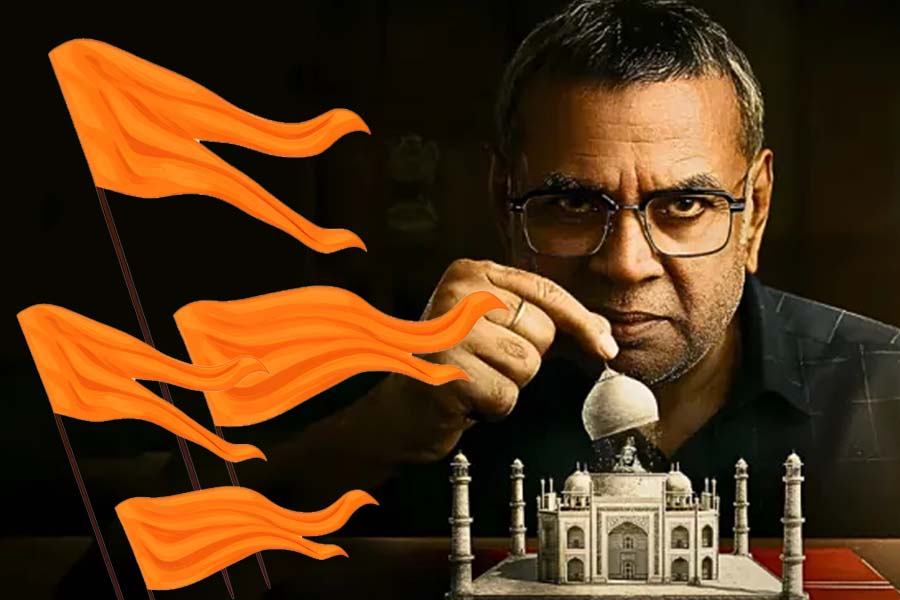
A new film, The Taj Story, starring Paresh Rawal, is now seeking to revive the long-debunked theory that the Taj Mahal was once a Hindu temple—a “Tejo Mahalaya” dedicated to Lord Shiva—allegedly converted into a mausoleum by Shah Jahan.
The trailer even shows the dome being lifted to reveal an idol of Lord Shiva. Such imagery leaves little doubt about the film’s intent—to distort history and inflame communal passions.
The Myth of ‘Tejo Mahalaya’ and P. N. Oak’s Fantasies
This theory originates from P. N. Oak, a fringe writer who first claimed the Taj was a 4th-century temple, later revising it to the 11th or 12th century. His ideas have been categorically dismissed by historians.
“Oak, who did not even know Farsi, missed crucial details that disprove his theory,”
— Historian Ruchika Sharma
Renowned art historian Giles Tillotson also refuted Oak’s claim, noting that “the technical know-how to construct a building like the Taj simply did not exist in pre-Mughal India.”
The much-hyped “21 locked rooms” in the Taj’s lower structure, Oak’s key talking point, were long ago explained by the ASI as structural chambers designed for stability and maintenance—nothing more.
Courts Rebuff Pseudohistory
After his 4th-century theory collapsed, Oak petitioned the Supreme Court of India in 2000, claiming that the Taj was built by Raja Paramar Dev’s minister Salakshan in the 12th century. The Court dismissed his plea for lack of evidence.
In 2005, another petitioner, Amarnath Mishra, approached the Allahabad High Court claiming the Taj was built by a Chandela king—this too was thrown out.
These judicial rejections underscore the absence of any credible evidence behind the “Tejo Mahalaya” narrative.
Authentic Historical Records
Contemporary records from the Mughal era, such as the Badshah Nama, along with writings by travelers Peter Mundy and Jean-Baptiste Tavernier, confirm Shah Jahan’s role and vision in constructing the Taj Mahal.
The chief architect was Ustad Ahmad Lahori, assisted by a team that included Hindu artisans. The land for the monument was acquired from Raja Jai Singh of Amber, either through fair compensation or as a gesture of goodwill.
The Taj’s design reflects India’s syncretic architectural tradition, blending Persian, Turkish, and Indian elements. The double dome structure, seen also in Humayun’s Tomb and the Red Fort, was a Mughal innovation later adopted in temple architecture as well.
Debunking Myths, Preserving Legacy
Over 20,000 artisans were employed in constructing the Taj, their wages and material expenses meticulously recorded in Mughal archives. The popular myth that Shah Jahan cut off their hands has no historical basis.
P. N. Oak’s imaginative excesses went beyond the Taj. He claimed that Christianity came from “Krishna Niti,” that “Vatican” derived from Vatika, and “Rome” from Ram. Such assertions, once confined to RSS shakhas, are now finding new life through cinema and social media.
A Political Agenda Behind Historical Distortion
Most of the claims made in The Taj Story have been debunked for decades, yet they are being revived for political reasons—to vilify Mughal rulers and indirectly stigmatize Indian Muslims.
Just like The Kashmir Files, The Kerala Story, and The Bengal Files, this film appears to be part of a broader trend of right-wing propaganda cinema, using emotionally charged narratives to divide society and manipulate public sentiment.
The Taj Beyond Hate
The Taj Mahal is not just a monument—it is a metaphor for love, loss, and artistic transcendence. To reduce it to a political tool is to insult centuries of shared heritage and craftsmanship.
Despite attempts to distort its story, the Taj remains what it has always been a luminous symbol of harmony and eternal love, untouched by the noise of hate and propaganda.
Ram Puniyani
Ram Puniyani is an Indian author and former professor of biomedical engineering. He worked at the Indian Institute of Technology Bombay as a senior medical officer. He began his medical career in 1973 and served at IIT in various capacities for 27 years, starting in 1977.
__________________________________________________________________________
FOLLOW INDEPENDENT PRESS:
WhatsApp CHANNEL
https://whatsapp.com/channel/0029VaAtNxX8fewmiFmN7N22

TWITTER (CLICK HERE)
https://twitter.com/IpIndependent

FACEBOOK (CLICK HERE)
https://web.facebook.com/ipindependent

YOUTUBE (CLICK HERE)
https://www.youtube.com/@ipindependent

Think your friends would be interested? Share this story!