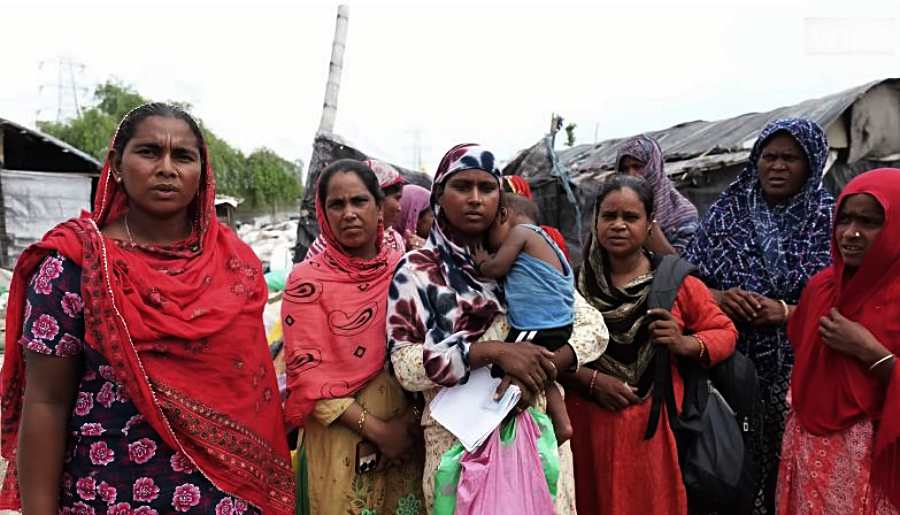
 Hundreds of Bangla Speaking Migrant Workers Detained in “Holding Centres” Across Gurugram
Tue 29 July 2025:
In Haryana’s Gurugram, tensions are at an all-time high as thousands of Bengali-speaking migrant workers, particularly from the Muslim community, are being detained by the police in an ongoing crackdown targeting them as alleged foreign nationals from Bangladesh.
On July 19, police detained at least 74 migrant workers—11 from West Bengal and 63 from Assam—accusing them of being undocumented Bangladeshi nationals. They were taken to what police have termed “holding centres,” which rights activists describe as makeshift detention camps. However, on the ground, residents say that even those who showed valid documents were picked up randomly.
Amid the chaos, thousands have been forced to leave the city, fearing sudden raids and arrests. Many have also stopped going to work, claiming that people were picked up by police on their way to their jobs.
The crackdown has triggered widespread outrage, with civil society organisations calling it a targeted operation against Bengali-speaking Muslims—part of a pattern that has surfaced in other parts of the country, including Delhi.
__________________________________________________________________________

https://whatsapp.com/channel/0029VaAtNxX8fewmiFmN7N22
__________________________________________________________________________
Maktoob visited two settlements—Chakkarpur and Sector 43 of Gurugram—where people have been living for years. Hafeeza, who works as a domestic worker in a nearby housing society, is visibly tense. In a crowded colony, she lives with her husband and children, but the ongoing crackdown forced her to send her children back home.
Originally from Malda in West Bengal, Hafeeza said the experience has left the family frightened.
“My daughter is in class 9 and the others are younger. I sent them back with their uncle because I was scared,” she told Maktoob.
Due to financial constraints, Hafeeza cannot leave herself.
“Who wants to stay away from their children? But there is no work in the village. I came here to earn and give them a better life, but now we’re at a breaking point,” she said.
This fear and helplessness is echoed by many others. Hafeeza has been living in Gurugram for five years.
Most residents in these clusters work as daily wage labourers, auto drivers, domestic help, cooks, or ragpickers—collecting and selling waste to recycling firms.
Jahangir Alam, an auto driver, said he has stopped working out of fear.
“We only dare to drive in the mornings or early afternoons, but even then it’s dangerous. People are being picked up from the roads,” he said.
There is growing anger and disbelief among the people, many of whom ask why they are being treated as outsiders in their own country.
Several residents allege that their documents were taken for verification, yet the police returned later to detain them.
Abina Banu said there was no opportunity to even present documents.
“They didn’t look at anything. They just arrested people straight away,” she said.
A graduate working in a private company, Banu said she can’t afford to quit her job, her only source of income.
“If they’re looking for Bangladeshis, they should check the papers. Just because we speak Bengali, they’re targeting us,” she said.
Standing next to her was Shofiqul Miyan, now regarded as a local hero for getting at least 29 people—including women—released from the detention centre.
“The police came dressed in plain clothes and started detaining people. Some were picked up while heading to work. I got wind of it and made calls to some political leaders,” he said.
Miyan went to the holding centre and, after pressure from higher-ups and verification of documents, the detainees were released.
“The police should do their work, but it must be done properly. Picking up innocent people makes no sense,” he said.
Amidst the sweeping crackdown, some locals have stepped forward in solidarity with the migrants. Saurabh, a software engineer living in a high-rise society, told Maktoob that his domestic worker shared her fear of being picked up.
“She was scared and was thinking of returning home. That shook me. Given the political climate, we know what’s going on,” he said.
Saurabh joined lawyers, activists, and journalists to navigate the areas under crackdown and support those being targeted.
“When people who identify as Indians are being subjected to this torture, it’s outrageous,” he added.
He said several residential societies, including his own, plan to write to local MLAs and officials, demanding answers on why people with valid documents were being detained and interrogated.
But not everyone is willing to speak up. In another settlement near Sector 43, a local resident named Krishna tried to prevent media from talking to residents.
Siddiqui, in the process of relocating due to fear, said he has all the necessary documents and hasn’t yet been approached by the police.
Krishna began shouting and called the property owner, whose house is next to a large eco-park.
“You are spreading misinformation. The police are only doing their job,” he said.
Siddiqui, however, said that while nothing had happened to them yet, the fear is real.
“…why those who speak Bengali?” he asked. He added that Hindus are also being targeted.
“It doesn’t matter if you’re Muslim or Hindu. If you speak Bangla, they’re picking you up,” he said.
Several residents told Maktoob they have already booked tickets to return home.
“How can we live here with this constant fear and no jobs? We left because there was nothing back home. Now we are being forced to return,” said Alam.
Meanwhile, civil society groups and reports confirm that arrests are ongoing.
Dozens remain in detention centres after being identified by the police as ‘Bangladeshis’.
According to officials, deportation processes have begun.
Association for Protection of Civil Rights (APCR), a civil society collective, has demanded an immediate independent judicial inquiry into the illegal detentions, immediate release or. tracing of missing persons, accountability and prosecution of police and other officials involved, compensation and rehabilitation of affected families and public disclosure of MHA guidelines under which this punitive drive is being undertaken.
“People who have been living and working here for 20–30 years also with voter IDs, Aadhaar cards, ration cards are now being hunted, harassed, and branded as outsiders, ” said APCR activist Nadeem Khan. “This is not law enforcement. This is communal profiling, plain and simple. ”
CPI-ML, which has been offering legal support on the ground, condemned the crackdown as a “targeted attack on Bengali (predominantly Muslim) migrant workers.”
“The arbitrary citizenship verification process initiated by the Home Ministry is akin to building a discriminatory National Register of Citizens (NRC), against which Indians had protested in large numbers in 2019–2020,” the party said in a statement.
At a recent protest in Kolkata, West Bengal Chief Minister Mamata Banerjee led a rally against attacks on migrants in Delhi’s Jai Hind colony, NCR, and Odisha. She challenged the BJP to imprison her and called the targeting of migrants unconstitutional.
“Bangla, the second most spoken language in the country, is also the second most spoken in Assam,” she wrote.
“To threaten citizens—who want to coexist peacefully and respect all languages and religions—with persecution for speaking their mother tongue is discriminatory and unconstitutional…”
TMC Rajya Sabha MP and head of the Bengali Migrant Board, Samirul Islam, accused the BJP of fuelling anti-Bengali sentiments. TMC MP Mahua Moitra called the detentions “illegal abductions.”
This article is republished from Maktoob Media. Read the original article.

__________________________________________________________________________
FOLLOW INDEPENDENT PRESS:
WhatsApp CHANNEL
https://whatsapp.com/channel/0029VaAtNxX8fewmiFmN7N22

TWITTER (CLICK HERE)
https://twitter.com/IpIndependent

FACEBOOK (CLICK HERE)
https://web.facebook.com/ipindependent

YOUTUBE (CLICK HERE)
https://www.youtube.com/@ipindependent

Think your friends would be interested? Share this story!