Mon 09 March 2026:
Oil prices surged past $105 and briefly hit $108 after Iran’s leadership change during the US-Israel war. African economies reliant on fuel imports face rising inflation, currency pressure & higher transport costs as Strait of Hormuz risks threaten global supply.
US-Israel war on Iran is sending economic shockwaves across Africa as surging global oil prices threaten to raise fuel costs, inflation and currency pressure across import-dependent economies.
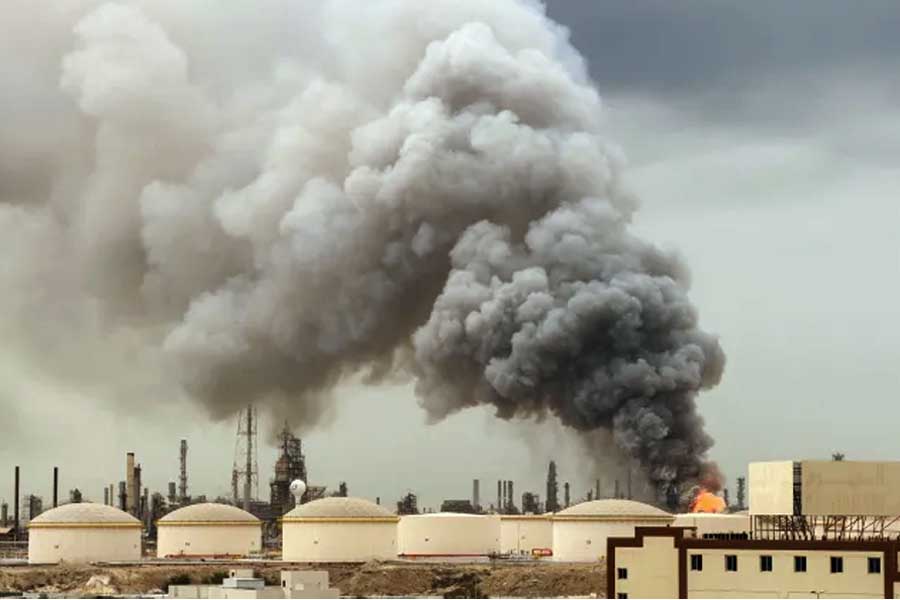
Crude prices surged above $105 per barrel and briefly reached $108 on March 9 amid escalating Middle East tensions following the naming of Mojtaba Khamenei as Iran’s supreme leader after the death of his father in a U.S.-Israeli airstrike.
The spike reflects growing uncertainty around energy flows through the Strait of Hormuz, a narrow maritime corridor that carries roughly 20 percent of the world’s crude oil shipments.
__________________________________________________________________________

https://whatsapp.com/channel/0029VaAtNxX8fewmiFmN7N22
__________________________________________________________________________
Analysts warn that the economic effects will be particularly severe for African economies because most countries import the majority of their refined petroleum products.
“Africa is a net importer of oil products, meaning it is heavily exposed to shocks like these,” said Nick Hedley, an energy transition research analyst at Zero Carbon Analytics.
Higher oil prices typically trigger a double shock for African economies. Import bills increase while currencies weaken as investors move capital into safe-haven assets such as the U.S. dollar.
“The near-term risks come from mainly the rising oil prices and weakening exchange rates as investors move to safe-haven assets,” said Brendon Verster, senior economist at Oxford Economics.
That dynamic is particularly damaging for countries such as Kenya and Ghana, which rely heavily on imported refined fuel products to power transport and industrial sectors.
The pattern has appeared before. After Russia’s full-scale invasion of Ukraine in 2022, rising global crude prices and currency depreciation pushed South African transport fuel prices up by more than 25 percent within six months, Hedley noted.
Because road transport dominates logistics across the continent, fuel price increases rapidly cascade into broader consumer inflation.
“Rising fuel costs therefore feed quickly into broader inflation and reduce household purchasing power,” Hedley said.
Oil markets remain particularly sensitive to the conflict because of the potential disruption to shipping through the Strait of Hormuz.
According to analysis cited by the Wall Street Journal, if the corridor were seriously disrupted, oil prices could surge toward an inflation-adjusted record of approximately $215 per barrel.
Such a scenario would significantly amplify the economic stress facing African governments already grappling with weak currencies and high external debt.
Most African economies lack domestic refining capacity and depend on imported gasoline, diesel and aviation fuel, leaving them exposed to supply shocks originating far from the continent.
The economic effects will vary widely depending on each country’s energy structure.
Oil exporters such as Nigeria, Angola, Algeria and Libya could see short-term fiscal gains if high prices persist. Nigeria, for example, exports roughly 1.5 million barrels of crude oil per day and has based its fiscal projections on prices between $64 and $66 per barrel through 2028.
With global prices now exceeding $100 per barrel, government revenues in those countries could increase significantly.
However, analysts caution that many African oil producers still import most of their refined fuel products, which limits the benefits for domestic consumers.
Nigeria and Ghana, for instance, produce crude oil but import large volumes of gasoline and diesel due to limited refining capacity.
For most African households, the immediate impact of the oil surge is expected to be rising living costs. Transport expenses account for a large share of consumer spending across the continent, and higher fuel prices quickly push up the cost of food and other goods.
Peter Attard Montalto, managing director at the South African advisory firm Kruthan, said the early market reaction has so far been contained in some countries.
“So far the impact has really been muted, for countries like South Africa,” he said, citing recent reforms that have stabilized financial markets.
However, he added that higher energy prices will likely filter into inflation in the coming months.
Countries already operating under International Monetary Fund (IMF) programs could face additional stress as rising energy import bills drain scarce foreign exchange reserves.
Among the most vulnerable economies are Sudan, The Gambia, Central African Republic, Lesotho and Zimbabwe, where government budgets are already under pressure.
At the same time, humanitarian crises and political instability in several regions further complicate fiscal management.
Over the longer term, analysts say the crisis could strengthen calls for African governments to diversify their energy systems and reduce reliance on imported fossil fuels.
“It makes strategic sense for African countries to ensure long-term energy security and sovereignty,” said Kennedy Mbeva, research associate at the Centre for the Study of Existential Risk at the University of Cambridge.
Achieving that shift, however, would require balancing short-term economic pressures with long-term investment in clean energy infrastructure and green industrialization.
-Source: Clash Report
__________________________________________________________________________
FOLLOW INDEPENDENT PRESS:
WhatsApp CHANNEL
https://whatsapp.com/channel/0029VaAtNxX8fewmiFmN7N22

TWITTER (CLICK HERE)
https://twitter.com/IpIndependent

FACEBOOK (CLICK HERE)
https://web.facebook.com/ipindependent

YOUTUBE (CLICK HERE)
https://www.youtube.com/@ipindependent

Think your friends would be interested? Share this story!