Wed 19 August 2026:
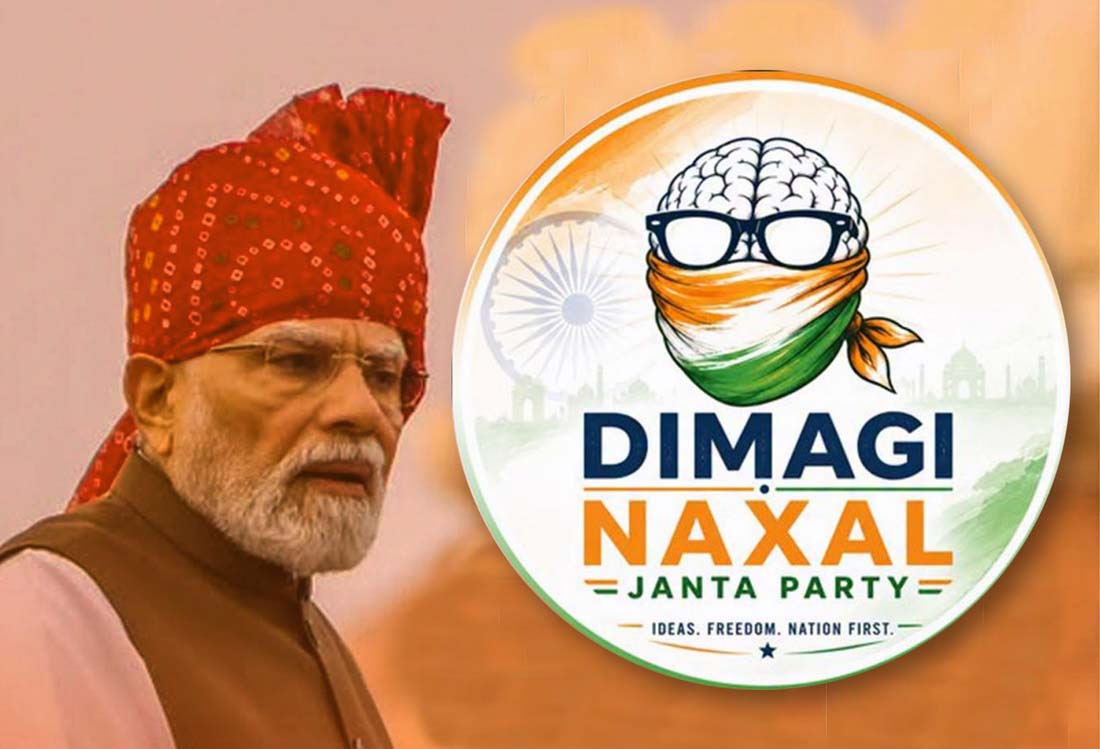
New accounts on X and Instagram calling itself the ‘Dimagi Naxal Janta Party’ has emerged amid the political controversy surrounding Prime Minister Narendra Modi’s recent ‘dimagi naxal’ remark in his Independence Day address on Saturday.
India’s Prime Minister Narendra Modi said the country has largely eliminated a Maoist rebellion which it battled for decades but still faces a threat from the movement’s ideological backers.
Speaking on India’s Independence Day on Saturday, Modi said India had succeeded in “getting rid of armed Naxals” – referring to members of the Maoist-influenced Naxalite movement that challenged state authority across swaths of central and eastern India.
However, he said “dimagi Naxals” (intellectual Naxals) are looking for opportunities to create violence, and need to be “identified and isolated”.
The phrase “dimagi Naxal” echoes the politically charged label “urban Naxal,” a term Modi and leaders of his Bharatiya Janata Party have previously used for activists, academics, intellectuals and other government critics.
The remarks come weeks after a youth-led protest movement, the Cockroach Janta Party, emerged as a rare challenge to Modi’s government and helped force the resignation of his education minister.
Our Weapon is the Mind, Our Revolution of Ideas
Jain Hind, Vande Mataram 🇮🇳 pic.twitter.com/LvTLKkiqDO
— Dimagi Naxal Janta Party (@DNJP_India) August 16, 2026
‘Dimagi Naxal Party’
While the identity of its founder (who is simply going by the name ‘a dimagi Indian’ online) has not yet been publicly disclosed, DNJP calls CJP a sibling party on its website. Its first tweet Sunday, “What if all dimagi naxals come together?” was also a hat tip to CJP’s origin, which began with Abhijeet Dipke’s now-iconic May 16 tweet, “What if all the cockroaches come together?”
Unlike CJP, however, DNJP’s ‘manifesto’ states that there will be no flag, no font, or founder doing press, and the only criteria for joining the party is a “functioning brain and a willingness to ask ‘wait, why though’ out loud”. It is also clear about one thing: the deployment of terms such as ‘dimagi Naxals’ and ‘anti-nationals’ crosses party lines and is often used to shut down criticism.
“Every side of Indian politics has, at some point, called the other side ‘anti-national’ for disagreeing,” the website says. “DNJP’s bet: the people who actually think for themselves are scattered across every one of those parties – and a label meant to isolate them is exactly what could bring them back together.”
__________________________________________________________________________

https://whatsapp.com/channel/0029VaAtNxX8fewmiFmN7N22
__________________________________________________________________________
‘Dimagi Naxal Party’ Instagram Page Gets 584k followers
An Instagram account called “Dimagi Naxal Party” emerged after PM Modi’s Independence Day remark and quickly attracted a large following.
Information on Instagram showed the account was opened this month. The log showed the username was changed once.
Who ran the account was not mentioned.
On 19 August the account has crossed 584k followers. The account’s stated motto is “Think | Research | Resist.” It also has an X account called “Dimagi Naxal Janta Party”.
DNJP followers
The account, @DNJP_India, followed by millions, including Congress leader and Leader of Opposition Rahul Gandhi, Samajwadi Party chief Akhilesh Yadav, AAP leader Arvind Kejriwal, YouTuber Dhruv Rathee, comedian Kunal Kamra, actor Prakash Raj and fact-checker Mohammed Zubair. The account also follows political content creator Arpit Sharma, YouTuber Shyam Meera Singh, political commentator Tarun Gautam, Dr Nimo Yadav 2.0, parody account Rofl Gandhi 2.0 and the Cockroach Janta Party.
The account’s rapid growth shows how quickly a political phrase can become an internet identity, particularly when it is adopted and repurposed by people who see the original remark as a criticism of dissent.
The emergence of the page, however, does not change the legal or political status of the phrase itself.
Is ‘dimagi Naxal’ the same as ‘Naxalite’?
No.
Naxalism refers to the Maoist insurgency and armed groups associated with it.
“Dimagi Naxal”, as used in the current political debate, refers to people whom PM Modi and the government describe as having or promoting a Naxal or Maoist mindset.
The two terms should therefore not be treated as interchangeable.
Most importantly, being called a “dimagi Naxal” is not proof that someone belongs to a banned Maoist organisation or has committed an offence.
Why has the phrase become controversial?
The debate is ultimately about where the line lies between ideological support for Maoism and political dissent.
The government has argued that even as armed Naxalism declines, its ideology can continue to influence people and institutions.
Critics, meanwhile, have questioned whether a term associated with Naxalism could be used too broadly against activists, students, young people or political opponents who question the government.
That is why the distinction between a political label and a legal allegation matters.
Kiren Rijiju explains ‘Dimagi Naxal’ remark
Following PM’s remarks, Congress’ P Chidambaram called himself a ‘proud dimagi Naxal’ in a post on X, while actor Prakash Raj posted a reel urging people to become ‘dimaagi’ and not ‘bewakoof’. Union minister Kiren Rijiju clarified that the term was not directed at opposition, and even came out with a three-point definition of who qualifies as a dimagi Naxal: those who support Maoists and reject Constitution, those who stand with separatists and support Article 370, and those who want to cut the chicken neck to separate the Northeast from India.
Naxalite
India’s Naxalite movement began in 1967 with an uprising in the village of Naxalbari in eastern India, and grew into a decades-long armed rebellion championing the rights of landless farmers, the rural poor and Indigenous communities. Thousands of civilians, rebels and security personnel died in the fighting.
Rights groups have for years accused India’s government of using anti-terror laws, sedition-related provisions and foreign-funding rules to squeeze civil society and target activists, journalists and groups critical of its policies.
SOURCE: INDEPENDENT PRESS AND NEWS AGENCIES
__________________________________________________________________________
FOLLOW INDEPENDENT PRESS:
WhatsApp CHANNEL
https://whatsapp.com/channel/0029VaAtNxX8fewmiFmN7N22

TWITTER (CLICK HERE)
https://twitter.com/IpIndependent

FACEBOOK (CLICK HERE)
https://web.facebook.com/ipindependent

YOUTUBE (CLICK HERE)
https://www.youtube.com/@ipindependent

Think your friends would be interested? Share this story!