Tue 29 September 2026:
Human rights groups warn returnees could face persecution and forced military service under Myanmar’s military government
Malaysia has begun repatriating thousands of asylum seekers from Myanmar under a controversial agreement with the country’s military ruler, Min Aung Hlaing, in a major shift in Kuala Lumpur’s approach to the Myanmar refugee crisis.
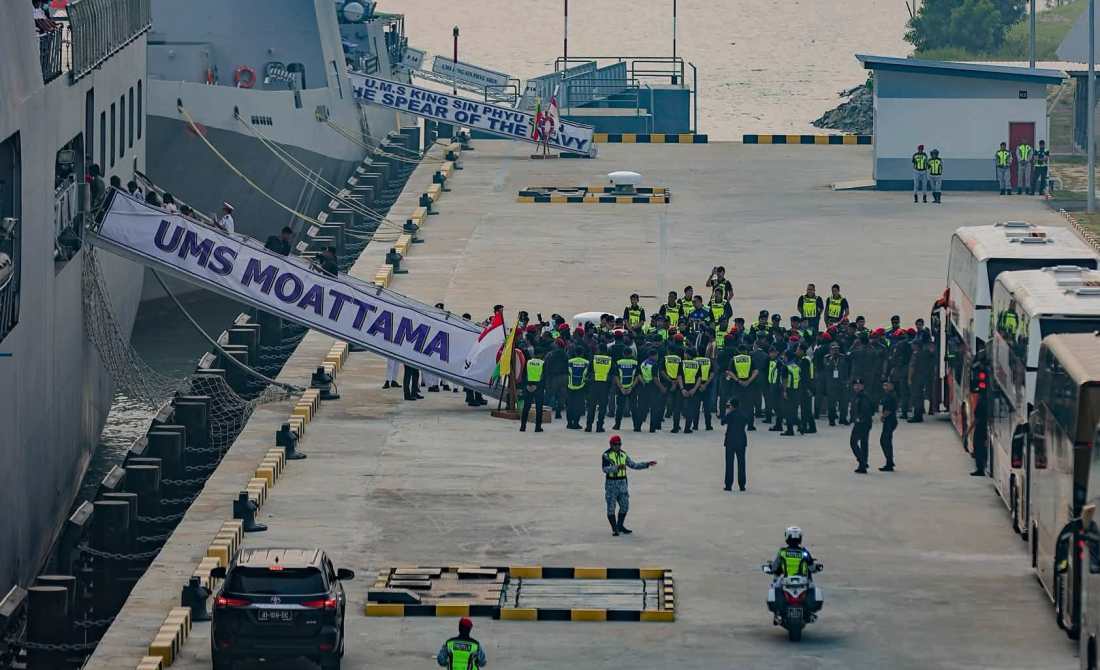
Around 5,000 people are expected to be returned. Three Myanmar navy ships are scheduled to leave Malaysia carrying the first 1,476 returnees.
Human rights organisations have strongly criticised the move, warning that people sent back to Myanmar could face violence, persecution and forced recruitment into the military.
Malaysia says the repatriations are voluntary. But the United Nations refugee agency, UNHCR, has been prevented from accessing or screening the people involved, who have been held in Malaysian detention centres.
The arrangement is particularly controversial because some of those being returned are expected to be Rohingya, a predominantly Muslim minority that has faced decades of persecution in Myanmar.
__________________________________________________________________________

https://whatsapp.com/channel/0029VaAtNxX8fewmiFmN7N22
__________________________________________________________________________
Rohingya among those facing return
Malaysian Prime Minister Anwar Ibrahim has confirmed that Rohingyas are among the people affected by the repatriation plan.
The Rohingya have sought refuge in Malaysia in large numbers after fleeing Myanmar, where they have faced discrimination and are generally denied citizenship.
The largest mass displacement came in 2017, when a Myanmar military campaign in Rakhine State drove around 750,000 Rohingya into neighbouring Bangladesh.
Many of those who later left the overcrowded refugee camps in Bangladesh attempted to reach Malaysia by sea, hoping to find safety and employment.
More than 200,000 Rohingya are now believed to live in Malaysia, where many work informally in low-paid manual jobs.
For years, Malaysia’s government has attempted to prevent Rohingya boats from reaching its shores. But large numbers managed to enter the country through different routes, and for a considerable period public attitudes remained relatively sympathetic towards them.
That position has changed significantly.
Economic pressures fuel resentment
The shift has been particularly visible since the COVID-19 pandemic, which placed additional pressure on Malaysia’s economy and household incomes.
As living costs rose, resentment towards migrant and refugee communities increased. During the pandemic, accusations targeting Rohingya people circulated widely on social media.
Some posts called for their deportation and accused the community of placing excessive demands on Malaysia.
The government responded by taking a harder line on refugees and undocumented migrants, including raids on communities suspected of harbouring people without legal status.
Similar tensions have resurfaced in 2026.
In May, an online complaint alleging that Rohingya residents had improperly disposed of animal waste after the Muslim Eid al-Adha festival triggered a wave of social-media activity.
The campaign was followed by false claims that Rohingya leaders were demanding land and citizenship in Malaysia.
An online petition calling for Rohingyas to be expelled from the country subsequently collected more than 400,000 signatures before it was removed.
Anwar’s position marks a major shift
The government’s current policy represents a significant change from Anwar Ibrahim’s previous political image.
Anwar spent years as an opposition leader and political prisoner and built a reputation as a supporter of democratic reform, human rights and greater political freedoms.
His government has also refused to formally recognise Min Aung Hlaing’s military regime and has been among the stronger voices in Southeast Asia calling for a negotiated political solution to Myanmar’s civil war.
Anwar has previously spoken strongly about the need to protect the Rohingya.
But the government’s position has hardened as political and economic pressure has increased.
In a recent podcast interview, Anwar said Malaysian authorities should treat Rohingya detainees humanely.
“We can arrest them, but do not beat, intimidate or humiliate them,” he said.
Human rights organisations, however, have accused Malaysian officials of mistreating migrants and refugees in immigration detention facilities.
At the same time, Anwar has argued that the Rohingya population can no longer remain in Malaysia indefinitely.
“They have clearly become a burden,” he said in the same interview. “A security burden, an economic burden and a source of hostility among the people.”
Critics accuse Anwar of abandoning his principles
The policy has angered some former supporters of the prime minister, who argue that his treatment of the Rohingya contradicts the human-rights principles he previously championed.
Latheefa Koya, a former head of Malaysia’s Anti-Corruption Commission, described the decision as “disgraceful, amoral, and shames the nation in the eyes of the international community”.
Human rights groups have also questioned whether people can genuinely be considered to have returned voluntarily when they are being held in detention and are unable to receive independent screening or assistance from UNHCR.
The absence of UNHCR access is particularly significant because Malaysia is not a party to the 1951 Refugee Convention and does not have a comprehensive national asylum system.
That means refugees and asylum seekers in Malaysia generally lack the formal legal protection available in countries that have signed the convention.
Political calculations behind the policy
Anwar’s government is also operating in a difficult political environment.
He became prime minister in 2022 after years of waiting for the opportunity to lead the country. But forming a government required an uneasy coalition that included UMNO, the party that had dominated Malaysian politics for more than six decades before losing power in the historic 2018 election.
Since then, Malaysia has experienced repeated changes in governing coalitions and political alliances.
Anwar’s own political support has weakened, while his party suffered losses in recent local elections. A general election must be held by early 2028.
The Rohingya issue has consequently become intertwined with broader concerns over migration, living costs, jobs, public services and national security.
For Anwar, the repatriation agreement therefore represents a difficult balancing act between his earlier human-rights commitments and growing domestic pressure to reduce the country’s refugee population.
Myanmar’s wider crisis
The return of asylum seekers is taking place while Myanmar remains engulfed in a civil war that began after the military seized power in a 2021 coup.
The conflict has displaced millions of people and fractured the country’s political and security landscape. Armed resistance groups are fighting the military across large parts of the country, while the junta continues to face international criticism over alleged abuses against civilians.
For Rohingya returnees, the situation is particularly sensitive. The community’s citizenship rights remain unresolved, and many of those who fled Myanmar have spent years living outside the country.
Human rights organisations argue that returning people to such conditions without independent assessment could expose them to serious risks.
Malaysia, meanwhile, maintains that it must address the growing domestic pressures associated with undocumented migrants and refugees.
The first group of returnees is now due to leave on Myanmar navy vessels, making the agreement a significant test of Malaysia’s evolving refugee policy — and of Anwar Ibrahim’s attempt to reconcile his longstanding human-rights rhetoric with mounting political pressure at home.
SOURCE: INDEPENDENT PRESS AND NEWS AGENCIES
__________________________________________________________________________
FOLLOW INDEPENDENT PRESS:
WhatsApp CHANNEL
https://whatsapp.com/channel/0029VaAtNxX8fewmiFmN7N22

TWITTER (CLICK HERE)
https://twitter.com/IpIndependent

FACEBOOK (CLICK HERE)
https://web.facebook.com/ipindependent

YOUTUBE (CLICK HERE)
https://www.youtube.com/@ipindependent

Think your friends would be interested? Share this story!