Sun 19 April 2026:
Silence, in international politics, is rarely neutral. In Sudan, it has become lethal. Three years into a civil war that has displaced more people than any other conflict on earth, the scale of devastation sits in jarring contrast with its absence from global consciousness.
Since fighting erupted on 15 April 2023 between the Sudanese Armed Forces and the Rapid Support Forces, nearly 12 million people have been forced from their homes, with around 7.7 million internally displaced and another four million pushed across borders. That is roughly one in four Sudanese — a demographic rupture that would dominate headlines if it unfolded anywhere closer to the geopolitical centre of gravity.
et Sudan remains peripheral, spoken of in policy corridors with a kind of resigned abstraction. The numbers are staggering, but they have not translated into urgency. This is not simply a failure of attention; it is a failure of imagination in global policymaking.
The war itself is brutally straightforward in origin, if not in consequence. A power struggle between General Abdel Fattah al-Burhan and General Mohamed Hamdan Dagalo — once allies in overthrowing Omar al-Bashir — metastasised into a nationwide conflict when integration of rival forces collapsed. What followed has not been a conventional war. Still, a fragmentation of the state, with cities like Khartoum, Darfur, and the Kordofans transformed into theatres of attrition where civilians are the primary targets.
Reports of atrocities now carry the unmistakable cadence of history repeating itself. In Darfur, the Rapid Support Forces’ campaign against non-Arab groups has been described by UN investigators as bearing the ‘hallmarks of genocide’. Hospitals have been shelled, markets razed, and entire communities erased. The World Health Organisation has verified hundreds of attacks on healthcare facilities, contributing to the collapse of a system where 37 per cent of services are no longer functional. Disease, as ever, follows violence: cholera, dengue, measles, and malaria now sweep through camps where sanitation is a luxury.
Hunger has become a weapon as much as a consequence.
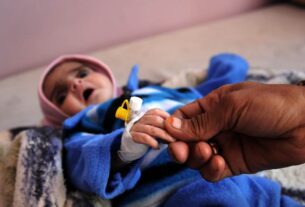
Around 19 million people face acute food insecurity, with famine conditions already confirmed in parts of Darfur and Kordofan. Children bear the sharpest edge of this crisis — more than four million under the age of five are expected to require treatment for severe malnutrition this year alone. These are not projections in a distant future; they are present-tense realities unfolding largely unseen.
What explains this disconnect? Part of the answer lies in the hierarchy of global crises. Russia’s war in Ukraine and the conflicts across the Middle East have consumed diplomatic bandwidth and media oxygen. A Chicago Council survey found that three-quarters of Americans admit they do not understand Sudan’s war at all. In Britain, only five per cent recognised it as the world’s worst humanitarian crisis. Awareness, it seems, is not correlated with severity but with proximity to power.
The Rapid Support Forces, once formalised as a paramilitary actor within Sudan’s fractured security architecture, have positioned themselves as a rival centre of power rather than a subordinate force. The Rapid Support Forces are not an aberration of this war but its inheritance—an evolution of the Janjaweed militias whose shadow still lingers over Darfur, carrying forward a legacy of violence that was never fully confronted, only repackaged and redeployed.
It is within this historical continuum that current reports of ethnic targeting, mass killings, and systematic brutality must be understood, not as isolated excesses of war, but as the reactivation of a model of violence that the world had once vowed never to ignore again.
There is also a structural bias at play — a quiet triage within international systems that privileges conflicts perceived to threaten global order. Sudan, despite its strategic location along the Red Sea and its significance for Nile water security, is treated as a regional problem. Yet instability here reverberates far beyond its borders. Refugee flows strain neighbouring states such as Chad and South Sudan. Disruptions to Red Sea routes intersect with already fragile global supply chains.
External actors, including Russia and Gulf states, pursue interests that complicate any path to resolution. This is not neglect born of ignorance alone. It is, increasingly, a calculated indifference.
For strategists from global power and far beyond the familiar corridors of power, Sudan forces a far more unsettling reckoning than a simple question of priorities; it exposes a moral fracture at the heart of the international system. What, in truth, now qualifies as a crisis demanding sustained engagement in an era saturated with competing tragedies?
When a nation unravels in full view of the world—when more than 12 million lives are uprooted on a scale reminiscent of the darkest chapters of the twentieth century, when credible accusations of genocide resurface with chilling familiarity, when an entire health system collapses into silence and disease fills the void—yet still fails to command consistent diplomatic gravity, something deeper than oversight is at play.
This is not merely a lapse in attention; it is the quiet normalisation of selective empathy, in which suffering is filtered through strategic relevance, media visibility, and geopolitical convenience. Across global institutions, from the UN Security Council to regional blocs and development banks, the thresholds for action appear less anchored in human cost than in perceived risk to power, proximity, or prestige. Sudan, then, is no longer just a test case—it is an indictment.
It asks whether the architecture of global response has drifted so far from its founding principles that even catastrophe on this scale can be absorbed, rationalised, and ultimately sidelined. If so, the implications stretch well beyond Sudan’s borders, casting a long, uneasy shadow over every future crisis that may unfold in the margins of global attention, waiting to see whether it too will be measured—and quietly dismissed—against a threshold that no longer recognises the full weight of human suffering.
There are, of course, no easy solutions. Ceasefire efforts have faltered repeatedly, undermined by mutual distrust and the absence of unified external pressure. Regional mechanisms, including those led by the African Union and IGAD, have struggled to maintain momentum. Meanwhile, humanitarian appeals remain critically underfunded, with agencies such as the World Food Programme warning that immediate injections of hundreds of millions of dollars are required simply to stabilise conditions.
Yet the absence of perfect solutions cannot justify inertia. There are concrete steps that could alter the trajectory.
First, diplomatic engagement must be elevated, not outsourced.
Sudan cannot remain a ‘back burner’ issue while its statehood unravels. Coordinated pressure from middle powers — including middle power states — could help shift calculations among external sponsors and local actors alike.
Second, humanitarian access must be treated as non-negotiable. Blockades and bureaucratic impediments are costing lives at scale; they demand consequences.
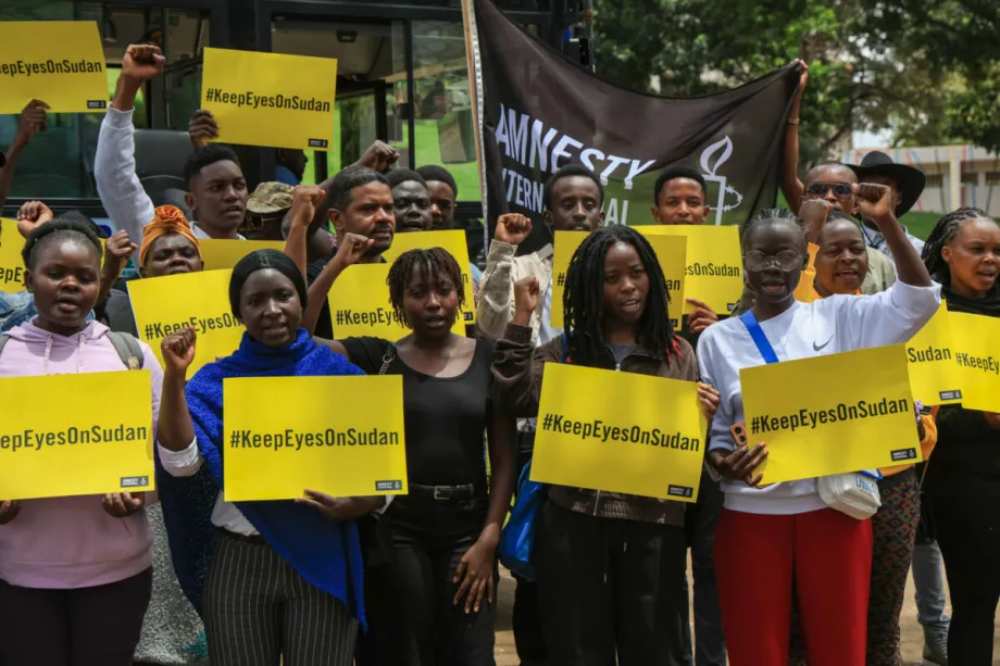
Third, and perhaps most overlooked, is the information deficit. Journalists have been killed, detained, or driven into exile, with more than 30 killed since the war began. Without reporting, there is no accountability; without visibility, there is no pressure. Supporting independent Sudanese media is not ancillary to the crisis — it is central to any meaningful response.
Across the Arab world, the response has not simply been fragmented—it has revealed a deeper tension between declared solidarity and strategic calculation. Sudan, long woven into the political, economic, and cultural fabric of the region, has been recast less as a humanitarian emergency than as a contested arena of influence.
Gulf capitals, despite their financial reach and diplomatic weight, have approached the war as something to be managed rather than resolved. Saudi-led mediation in Jeddah flickered with early promise before stalling into procedural repetition, while the United Arab Emirates faces mounting allegations of materially sustaining one side of the conflict, blurring the line between engagement and entanglement.
__________________________________________________________________________

https://whatsapp.com/channel/0029VaAtNxX8fewmiFmN7N22
__________________________________________________________________________
Egypt, guided by its existential concerns over the Nile waters and border stability, has leaned toward the Sudanese Armed Forces, viewing the war through the prism of national security rather than as a human catastrophe. Beyond state actors, the silence is perhaps even more profound. The Organisation of Islamic Cooperation—an institution ostensibly built to amplify collective Muslim concerns—has remained confined to carefully worded communiqués, offering rhetorical empathy in place of coordinated action.
In a crisis that has displaced millions and hollowed out entire communities, this restraint resonates not as neutrality but as absence. What emerges is not merely a regional failure, but a reflection of a broader global pattern: where proximity does not guarantee responsibility, and where shared identity—religious, cultural, or historical—proves insufficient against the gravitational pull of state interest.
Sudan, in this sense, becomes more than a tragedy; it becomes a measure of how far the idea of collective obligation has eroded, even among those for whom the ties should have run deepest.
Underlying all of this is a deeper erosion of trust. For many Sudanese, the international community’s response recalls a familiar pattern: moments of rhetorical concern followed by prolonged disengagement. During the Darfur crisis two decades ago, global campaigns mobilised public opinion and shaped policy. Today, despite a far larger catastrophe, that mobilisation is conspicuously absent.
The implications extend beyond Sudan. Each neglected crisis chips away at the credibility of a rules-based order that purports to uphold universal values. When responses appear selective, shaped more by strategic convenience than by human need, the legitimacy of that order is quietly diminished.
Sudan is not an outlier; it is a mirror. It reflects a world in which attention is finite, empathy uneven, and action contingent. The question is not whether the international community can respond — it is whether it chooses to. For now, the answer is written in the absence.
The statements, views and opinions expressed in this column are solely those of the author and do not necessarily represent those of Independent Press.
Author:

__________________________________________________________________________
FOLLOW INDEPENDENT PRESS:
WhatsApp CHANNEL
https://whatsapp.com/channel/0029VaAtNxX8fewmiFmN7N22

TWITTER (CLICK HERE)
https://twitter.com/IpIndependent

FACEBOOK (CLICK HERE)
https://web.facebook.com/ipindependent

YOUTUBE (CLICK HERE)
https://www.youtube.com/@ipindependent

Think your friends would be interested? Share this story!