Mon 17 August 2026:
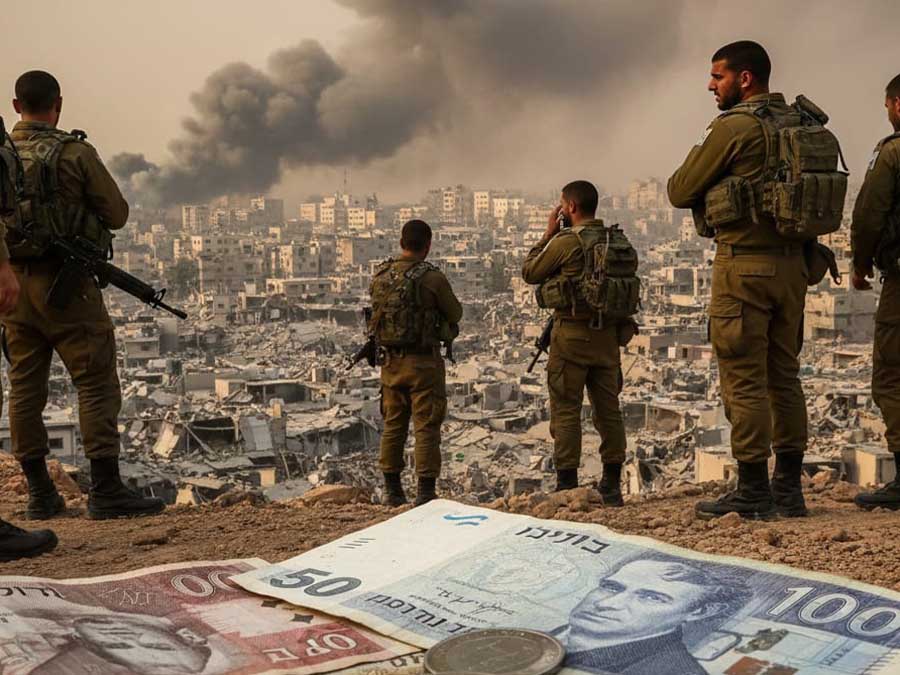
Israel’s genocidal war on Gaza, which began on October 7, 2023, has become the longest and most expensive war in Israel’s history, with costs reaching about 420 billion shekels ($142bn) and national debt rising by roughly 400 billion shekels ($135bn), Haaretz newspaper reports.
The report said Israel entered its ground offensive in Gaza in late October 2023, expecting at least three months of fighting, despite ammunition stockpiles having been prepared for shorter wars.
A former Israeli military officer told Haaretz that stocks of some types of ammunition were insufficient even for a short war, while actual consumption in some categories reached twice the levels originally planned.
Estimates indicate that the cost of the war, initiated by Israel on October 7, approximately three years ago and still ongoing, is nearly 420 billion shekels (about 135.3 billion dollars) to date, and this cost is expected to rise soon to half a trillion shekels. Its impact on the Israeli economy will continue for many years to come.
However, such unprecedented military spending does not guarantee security for Israel. An Israeli economic official said, “If we had sufficient security, there would be no need to double the security budget in the next decade,” as reported by the newspaper “The Marker” on Sunday.
__________________________________________________________________________

https://whatsapp.com/channel/0029VaAtNxX8fewmiFmN7N22
__________________________________________________________________________
National debt has increased due to the war by 400 billion shekels, and there will be a necessity to finance this military expenditure, which will rise by hundreds of other billions of shekels in the coming years, especially given the “wasteful use of weapons and ammunition and the excessive and unconventional reliance on reserve forces”. However, the sources of financing for this are currently unclear.
The newspaper quoted a former high-ranking officer as saying, “The war has dragged on for too long, and the same results, and even better results, could have been achieved in a shorter war if the political level had been interested in political settlements.”
According to the newspaper, “Israel will spend about 1.5 trillion shekels on security in the next decade.” A document prepared by the Director General of the Ministry of Defense, Amir Baram, stated that Israel is preparing for a “severe decade” in terms of security, while it seems that annual U.S. security assistance, amounting to 3.8 billion dollars, may completely halt starting from 2029.
The paper reported that in normal times, the size of reserve forces in the army was 6,000 soldiers. Days after the outbreak of the war, 220,000 reserve soldiers were called up, necessitating the allocation of quick financial resources to fund food and sleeping arrangements for these forces, “but no one attempted to make economic calculations throughout the war, money was not a consideration, and reserve soldiers served long periods even when there was no need for that, or when cheaper solutions could have been explored.”
The senior officer pointed out that “the army found itself unprepared to accommodate the huge number of reserve soldiers, and one of the military divisions that participated in the war in Gaza was never qualified to enter the Gaza Strip, and there was no suitable equipment available to the soldiers.”
Following the “Al-Aqsa Flood” attack, the then Director General of the Ministry of Defense and the current Chief of Staff of the Israeli army, Eyal Zamir, sent a message to the officers saying, “Work and do not worry about money,” while the Israeli Prime Minister, Benjamin Netanyahu, who was still stunned by the security failure that led to the Hamas attack and the high number of Israeli casualties and the evacuation of about 200,000 Israelis from their homes and towns, said, “There is money for everyone, and my instructions are clear: open the faucets and pump money to anyone who needs it.”
At the beginning of the Israeli military incursion into the Gaza Strip in late October 2023, it was believed that the war would last at least three months, while the army’s ammunition stock was for shorter wars. A former officer in the General Staff stated, “In reality, we had an ammunition stock that was less than required for short wars, while actual consumption was double what was planned,” according to the newspaper.
After it became clear that the war was lengthy and extended to other distant fronts, including Iran and Yemen, officials in the Ministry of Finance began making decisions aimed at financing the war, foremost among them raising taxes by 35 billion shekels in 2025, after three international credit rating agencies, Moody’s, Standard & Poor’s, and Fitch, downgraded Israel’s rating in anticipation of a further decline in credit ratings without tax increases, leading to a severe financial crisis.
It is expected that taxes will be raised even further after the elections. The newspaper noted that a series of economic and security decisions are expected to be approved after the elections, including additional questions such as: increasing the security budget; continuing the call-up of reserve forces “and when will it collapse due to the burdens?”; reducing annual U.S. aid under a new agreement; whether the resilience of Israeli financial markets and the economy will remain high amid enormous security budgets and reduced U.S. aid; and who will actually pay the cost of the war in the reality created?”.
SOURCE: INDEPENDENT PRESS AND NEWS AGENCIES
__________________________________________________________________________
FOLLOW INDEPENDENT PRESS:
WhatsApp CHANNEL
https://whatsapp.com/channel/0029VaAtNxX8fewmiFmN7N22

TWITTER (CLICK HERE)
https://twitter.com/IpIndependent

FACEBOOK (CLICK HERE)
https://web.facebook.com/ipindependent

YOUTUBE (CLICK HERE)
https://www.youtube.com/@ipindependent

Think your friends would be interested? Share this story!