Sun 22 March 2026:
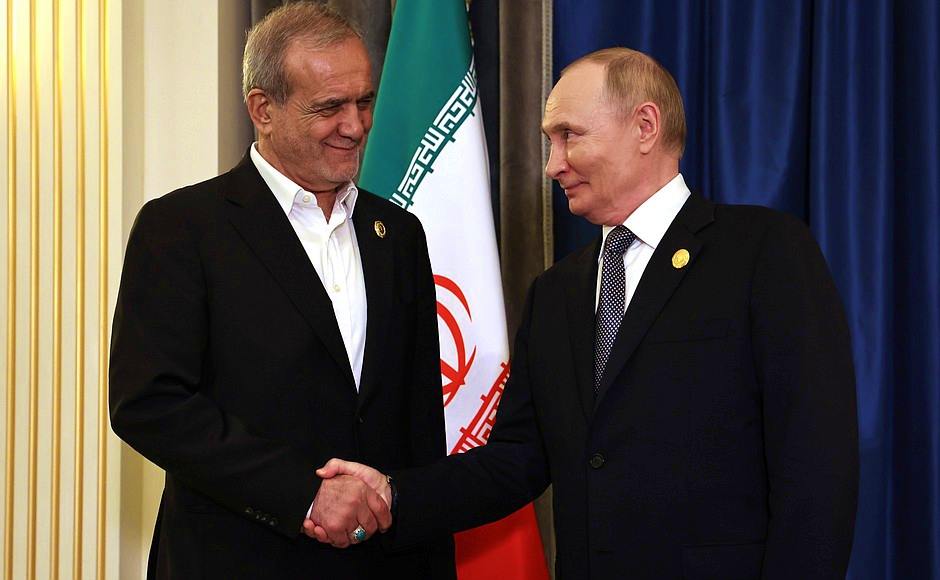
The Nowruz greeting Vladimir Putin sent to Iran’s leadership and people is little more than a seasonal postcard—politically meaningless in a time of war. The Kremlin announced that Putin had extended congratulations to Mojtaba Khamenei and President Masoud Pezeshkian on the occasion of the Iranian New Year. But anyone familiar with Moscow’s strategic mindset knows that Putin does not shed political tears for anyone—not for Khamenei, not for Bashar al‑Assad, and certainly not for Nicolás Maduro. He does not see these figures as “allies,” but as expendable assets to be used and discarded.
The language claiming that “Russia will remain a loyal friend and reliable partner to Iran” belongs to the lexicon of public relations, not to the vocabulary of wartime alliances.
The much‑advertised “strategic partnership” between Tehran and Moscow contains no mutual defense clause, no binding political commitments, and no guarantees of protection. Throughout its modern political history, Russia has never been a faithful friend to anyone. It sees other states not as partners, but as temporary opportunities to be exploited and then abandoned.
__________________________________________________________________________

https://whatsapp.com/channel/0029VaAtNxX8fewmiFmN7N22
__________________________________________________________________________
Even inside Iran, officials quietly acknowledge that Moscow has offered Tehran virtually no meaningful assistance during the most severe crisis the Islamic Republic has faced since the fall of the U.S.-backed Shah in 1979.
This should surprise no one. As the American historian Stephen Kotkin wrote, “Putin does not build alliances; he builds networks of influence whose expiration date arrives the moment the cost of defending them rises.”
That single sentence explains everything.
Russia does not enter wars for allies.
Russia enters wars only for itself.
And because Moscow views Iran’s predicament as a bargaining chip rather than an alliance, it recently floated a striking proposal to Washington: the Kremlin would stop providing intelligence to Iran if the United States halted intelligence support to Ukraine. Washington rejected the offer, and Moscow returned to its natural posture—the spectator who bargains, not the ally who defends.
History offers abundant evidence.
Take Iraq: Russia extracted maximum economic benefit from Baghdad through massive arms and oil deals worth billions, only to abandon Iraq the moment it needed a political stance.
Moscow did not issue even a symbolic objection to the invasion, as if decades of relations had never existed.
This is not the behavior of a loyal ally; it is the behavior of a state that sees others merely as revenue streams.
The same pattern has repeated itself with Bashar al‑Assad, but in an even more revealing way. For more than a year now, he has no longer been a de facto president in Syria, but a political refugee in Moscow—living there like a man expelled from his own house, under the protection of the very state that once claimed to be his ally. His presence in Russia is not an extension of his authority; it is an announcement of its end. And if this is the fate of the “ally” who ended up as a refugee in Moscow, what future can Iran expect as it collapses before Russia’s eyes and its leaders are killed in their own bedrooms?
The political history of Russia is full of such moments.
Houari Boumédiène, the late Algerian president, once told Soviet leaders bluntly:
“You look at us as if we were camel herders, and you help us with a condescending, self‑interested attitude.”
He was not exaggerating. He was describing the exact nature of Moscow’s relationships: hierarchical, selective, transactional, and devoid of trust.
So when Putin sends an emotional message to Iran today, he is not offering political support, military commitment, or even a diplomatic position that can be relied upon. He is offering a symbolic sentence with no value in a moment when Iran is being bombed from the air…
its senior officials are being targeted in the heart of its capital, and its regional influence is eroding at unprecedented speed.
More importantly, Russia knows that Iran is not a neighbor—it is a distant actor that can be sacrificed without consequence.
For Moscow, Iran is a bargaining chip in its confrontation with the West.
A chip to be used, not defended.
A chip to be waved, not protected.
A chip to be discarded the moment it becomes a burden.
Putin’s message, therefore, is nothing more than a seasonal courtesy—sent in moments of ceremony, not in moments of fate.
A message that changes nothing in the balance of power, offers Iran no protection, reassures no one, and frightens no adversary.
A message that resembles what small states send to one another, not what a great power sends in wartime.
In war, words that are not translated into action have no value.
And Iran, which is being struck from every direction, knows perfectly well that Moscow will never be its umbrella.
For Russia, as history repeatedly shows, there are no friends—only interests.
And interests, as we all know, do not stay with the weak.
The statements, views and opinions expressed in this column are solely those of the author and do not necessarily represent those of Independent Press.
Author:

__________________________________________________________________________
FOLLOW INDEPENDENT PRESS:
WhatsApp CHANNEL
https://whatsapp.com/channel/0029VaAtNxX8fewmiFmN7N22

TWITTER (CLICK HERE)
https://twitter.com/IpIndependent

FACEBOOK (CLICK HERE)
https://web.facebook.com/ipindependent

YOUTUBE (CLICK HERE)
https://www.youtube.com/@ipindependent

Think your friends would be interested? Share this story!