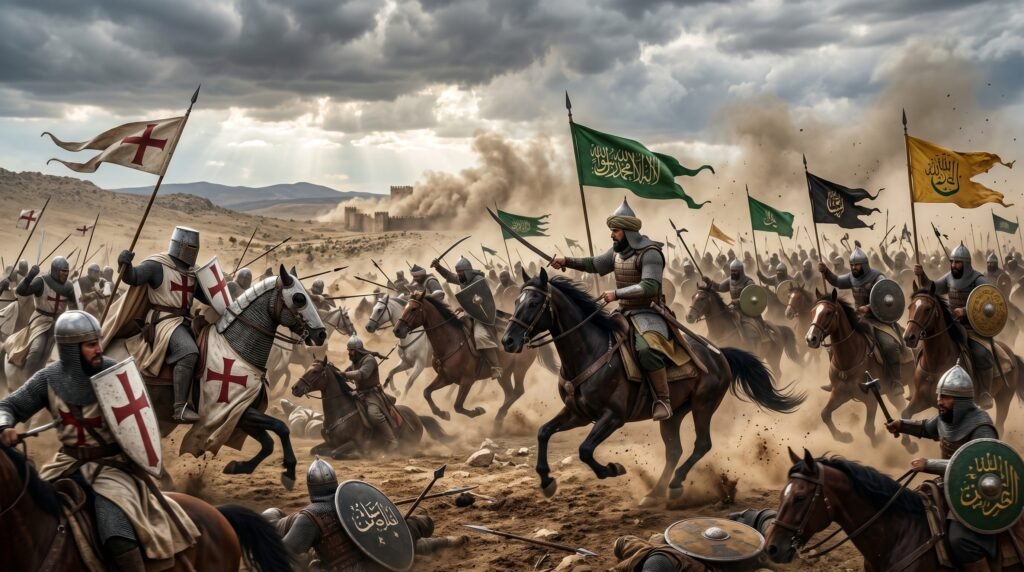
On 2 October 1187, history witnessed one of its most pivotal moments. After nearly nine decades of Crusader rule, Sultan Salahuddin Ayyubi—known in the West as Saladin—peacefully re-entered and liberated Jerusalem. This monumental achievement was not merely a military victory, but the culmination of a life defined by unwavering faith, tactical brilliance, political unification, and profound magnanimity.
Early Life and Rise to Power
Born in 1137 in Tikrit (modern-day Iraq), Yusuf ibn Ayyub grew up in a Kurdish family with a strong military and administrative tradition. His father, Najm al-Din Ayyub, served the Zengid dynasty.
Salahuddin’s early education focused on theology, law, and the Quran rather than just martial training, instilling in him a deep spiritual foundation.
His military career blossomed under his uncle, Shirkuh, during campaigns into Egypt. At the time, Egypt was ruled by the declining, Shia Fatimid Caliphate. Through tactical maneuvering and political acumen, Salahuddin successfully dismantled the Fatimid administration, ending the Shia Fatimid Caliphate and restoring Sunni Islamic governance under the Abbasid Caliphate, while establishing himself as the founder of the Ayyubid Dynasty.
Navigating Threat: The Order of Assassins
Unifying the Muslim world under a single banner was fraught with peril. A major internal security threat came from the Order of Assassins (the Nizari Isma’ili Shia military order founded by Hasan-i Sabbah in 1090 from their mountain stronghold of Alamut).
Operating in the rugged terrain of Syria, the Assassins posed a constant danger to political leaders who opposed them. They made at least two documented attempts on Salahuddin’s life—most notably in 1174 and 1176—using stealth and dagger attacks. Though Salahuddin survived these attempts (escaped with minor wounds in one and executing precautions thereafter), he successfully neutralized their existential threat by besieging their strongholds, eventually forcing them into a tactical truce.
The Path to Jerusalem: Battle of Hattin (1187)
Salahuddin’s ultimate strategic vision was the reclamation of Jerusalem and the expulsion of the Crusader states. His masterstroke came on 4 July 1187 at the Battle of Hattin.
-
The Strategy: Salahuddin lured the combined armies of the Kingdom of Jerusalem into a waterless, arid plateau during the scorching summer heat.
-
The Defeat: Trapped and dehydrated, the Crusader army—led by Guy of Lusignan and Raynald of Châtillon—was utterly crushed.
-
The Aftermath: The victory shattered Crusader military power, leaving cities and fortifications across the Levant undefended and paving the immediate road toward Jerusalem.
The Liberation of Masjid Al-Aqsa
Following Hattin, Salahuddin marched on Jerusalem, accepting its surrender in late September. On 2 October 1187, the banners of Islam were raised once more over the city, and Masjid Al-Aqsa was recaptured.
Unlike the horrific massacre perpetrated by the Crusaders when they conquered Jerusalem in 1099, Salahuddin ordered his troops to guarantee the safety of the civilian population. Christian inhabitants were allowed to either ransom themselves and leave peacefully or remain under Muslim protection, showcasing a standard of chivalry that astonished European chroniclers.
The Execution of Raynald
• Sworn Vengeance: Salahuddin had sworn to kill Raynald twice—first for Raynald’s violent raids along the Red Sea threatening Muslim pilgrim routes to Mecca, and again after Raynald broke a truce by attacking a wealthy Muslim caravan in late 1186 or early 1187.
• Battle of Hattin: After Salahuddin defeated the Crusader army at the Battle of Hattin in July 1187, Raynald was brought before him as a captive.
• The Final Moments: Saladin offered Raynald water but then confronted him over his repeated broken oaths and provocations. According to historical accounts, Salahuddin gave him a final chance to convert to Islam or face death; when Raynald refused, Saladin personally executed him by beheading him.
While Salahuddin showed clemency to other captured leaders—such as sparing King Guy of Lusignan with the famous remark that “a king does not kill a king”—he explicitly denied mercy to Raynald due to his severe violations of truces and sacrilegious raids.
Death and Final Legacy
Salahuddin Ayyubi passed away on 4 March 1193 in Damascus, Syria, at the age of 55, likely of a brief fever.
True to his lifelong asceticism and devotion, an inventory of his personal possessions at the time of his death revealed a poignant truth: he left almost nothing behind. When his treasurers opened his personal chest, they found no gold or silver coins—only enough money to pay for his simple shroud and modest funeral. Everything else he possessed had been given away in charity to the poor, orphans, and veterans of his campaigns. He left behind a unified Islamic realm, a liberated Jerusalem, and an enduring blueprint for principled leadership.