Fri 26 June 2026:
The death toll from the back-to-back earthquakes has risen to about 235, Health Minister Carlos Alvarado says, and at least 4,300 people were injured in the back-to-back earthquakes.
As Venezuelans continue to tally the human toll of the earthquakes, experts have warned that the economic fallout of the disaster could also be severe.
Estimates released on Thursday predicted that the damage from the earthquakes could equal between 1 and 7 percent of the country’s gross domestic product, or GDP.
Countries around the world, including Mexico, Canada, the US, Iran, El Salvador and Turkiye, have sent aid and their condolences to the people of Venezuela.
The US-based Center for Economic and Policy Research (CEPR) is urging the US and other countries to immediately lift sanctions on Venezuela to strengthen Caracas’s ability to respond to the earthquakes.
__________________________________________________________________________

https://whatsapp.com/channel/0029VaAtNxX8fewmiFmN7N22
__________________________________________________________________________
Amnesty International chief Agnes Callamard warns that the earthquakes risk “further compounding an already severe and protracted human rights crisis and humanitarian emergency suffered by the Venezuelan people for over a decade”.
Families in northern Venezuela are digging through rubble with their bare hands as rescue efforts continue after two powerful earthquakes devastated parts of the country.
In La Guaira, one of the worst-hit areas, Amparo del Giudice searched through a mound of concrete for her son, who she believed was trapped beneath the ruins.
“It is a lot of rock, and with bare hands it is impossible,” she told the AFP, sitting near the wreckage.
Her 23-year-old grandson, Alessandro, put on a volunteer firefighter’s helmet and joined the search for his missing father.
“He is in there,” he said, crying as he looked at the remains of a collapsed building.
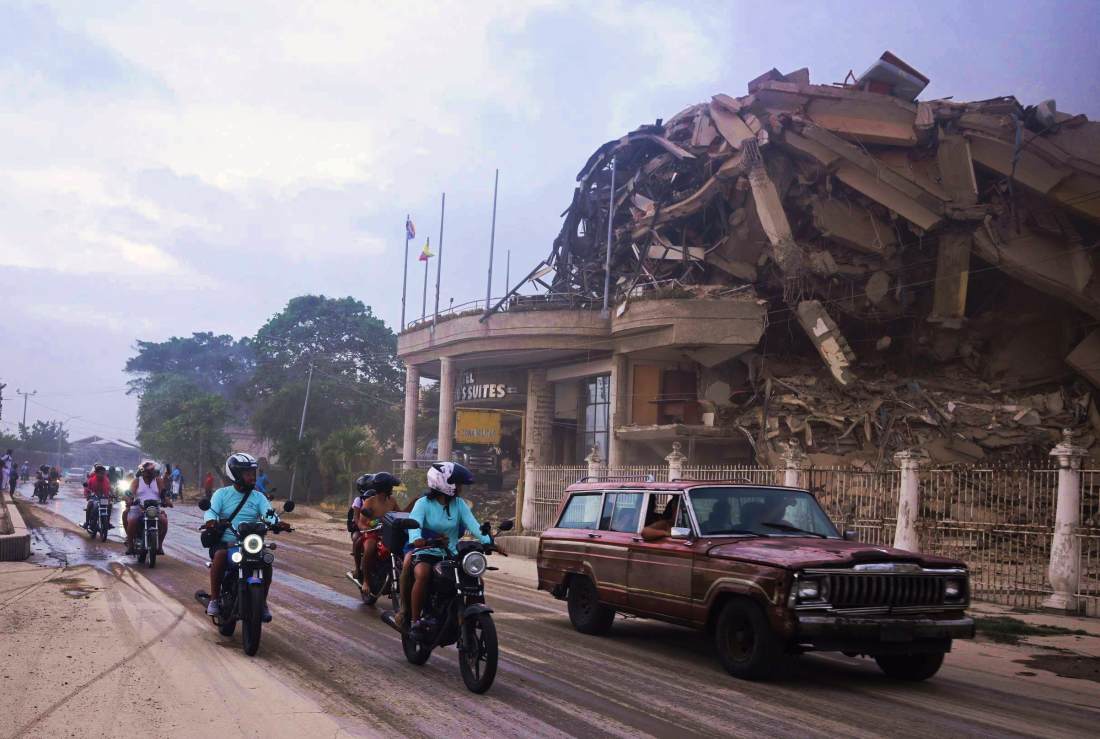
La Guaira, once a Caribbean getaway for residents of Caracas, now lies shattered. High-rise buildings, seaside flats and hotels have collapsed or suffered severe damage. AFP journalists saw looting, broken roads and residents standing in shock amid clouds of dust.

‘People afraid to go back into their houses’
Independent journalist Maria Emilia Miro Quesada says that people are sleeping in parks and squares because they are afraid that more buildings may collapse.
“People are afraid to go back into their houses,” Miro Quesada told Al Jazeera from Caracas. “They are very uncertain … about the structures, the damages.”
Many people are also feeling uncertain about the future because of how fragile Venezuela’s economy is, she said.
However, Miro Quesada added that the focus now is on the urgency of securing resources for rescue efforts, including equipment to reach people trapped under collapsed buildings.
“What is more important is the speed, the scale, and the access to reach out to the affected areas and help people that are trapped and injured,” she said.
What we know about La Guaira state
- One of Venezuela’s 23 states, La Guaira has an estimated population of more than 480,000.
- The state lies along the country’s northern coast and is home to one of Venezuela’s main seaports and its principal international airport, making it a crucial economic hub.
- It is sandwiched between the Caribbean Sea to the north and a belt of steep mountains known as the Venezuelan Coastal Range to the south. This leaves it particularly vulnerable to natural disasters, including earthquakes and landslides.
- La Guaira state has adapted to its narrow coastal strip, with many residential and commercial buildings constructed on the foothills and slopes overlooking the coast.
- As we reported earlier, Venezuela’s interior minister said more than 100 buildings have collapsed in La Guaira due to the earthquakes, and more than 70,000 local families have been affected by the disaster.
US army official lands in Venezuela to oversee quake response
“US Marine Corps Maj. Gen. Kevin J. Jarrard arrived in Caracas, Venezuela, today, to oversee Department of War support to Venezuela earthquake relief efforts,” says the US Southern Command (SOUTHCOM), whose area of responsibility covers Latin America and the Caribbean.
SOUTHCOM is supporting relief operations by the State Department and Jarrard is serving as the senior SOUTHCOM official on the ground, it said in a statement on X.
“The interim Government of Venezuela formally requested U.S. support following the earthquakes,” the statement said.
The post included a photo of Jarrard greeted by what appeared to be two Venezuelan representatives at an unspecified location.
US military forces “will utilise fixed and rotor wing aircraft to provide specialised mobility services” and assist with damage assessment and delivering aid, according to SOUTHCOM.
US Defense Secretary Pete Hegseth said earlier that he “immediately mobilised the War Department” at President Donald Trump’s direction to work alongside the State Department to support the Venezuelan people.
UNICEF calls for assistance for thousands of affected children
The UN’s child rights agency, UNICEF, has warned that thousands of children are at risk following the quakes and called for their needs to be prioritised.
“The images we are seeing from Venezuela and the stories we hear from colleagues on the ground are heartbreaking,” UNICEF chief Catherine Russell said in a statement.
“Our thoughts are with the children and families who have lost loved ones and all of those whose lives have been upended,” she added.
“As the scale of the damage becomes clearer, children’s safety, protection and well-being must remain at the centre of the response.”
Amnesty urges int’l community to ‘urgently mobilise’ for Venezuela
Amnesty International chief Agnes Callamard warns that the earthquakes risk “further compounding an already severe and protracted human rights crisis and humanitarian emergency suffered by the Venezuelan people for over a decade”.
“The country’s health system has been decimated while state repression has greatly weakened human rights protection,” she said in a statement.
Callamard urged the Venezuelan authorities to provide relief “in compliance with humanitarian and disaster relief standards as well as with international human rights law”.
“The international community, in turn, must urgently mobilise to provide and deliver the critical humanitarian assistance that the Venezuelan people so urgently need,” she added.
Starlink offers free satellite internet service
Starlink says it will give users in Venezuela one month of free satellite internet service after two earthquakes struck the country.
The SpaceX-owned company announced the move in a post on X, saying it was also working to bring connectivity back to areas hit hardest by the tremors.
Starlink said it was moving to “rapidly deploy Starlink terminals and restore connectivity to the hardest-hit areas”.
The company’s satellite internet network, which also has military and intelligence applications, is sometimes used in disaster zones where damaged infrastructure disrupts mobile and fixed-line services.
Why is Venezuela prone to earthquakes?
The Latin American country is vulnerable to deadly earthquakes because of its location in a seismically active region.
Venezuela sits on the boundary between the Caribbean and South American tectonic plates, which move past each other at a rate of about 22mm per year.
Wednesday’s double earthquake occurred when stress that had accumulated along the boundary between the two plates was suddenly released, triggering two powerful tremors in quick succession.
Venezuela also lies along several active fault zones. According to the United States Geological Survey, a fault is a fracture or zone of fractures between two blocks of rock. Earthquakes occur when accumulated stress causes the rocks on either side of a fault to slip suddenly.
The country is also susceptible to shallow earthquakes, which occur less than 20 kilometres (12 miles) below the Earth’s surface. Because they originate closer to the ground, shallow quakes typically produce stronger shaking and can cause more damage than deeper earthquakes of a similar magnitude.
However, the country has experienced few earthquakes as deadly as Wednesday’s.
It was struck by earthquakes of magnitude 6 or stronger in 2009, 1989 and 1975. The deadliest on record was a magnitude 6.6 earthquake in 1967, which killed up to 300 people.
SOURCE: INDEPENDENT PRESS AND NEWS AGENCIES
__________________________________________________________________________
FOLLOW INDEPENDENT PRESS:
WhatsApp CHANNEL
https://whatsapp.com/channel/0029VaAtNxX8fewmiFmN7N22

TWITTER (CLICK HERE)
https://twitter.com/IpIndependent

FACEBOOK (CLICK HERE)
https://web.facebook.com/ipindependent

YOUTUBE (CLICK HERE)
https://www.youtube.com/@ipindependent

Think your friends would be interested? Share this story!