Fri 25 September 2026:
Two election commissioners reportedly objected 14 times to decisions linked to voter registration, electoral databases and the Special Intensive Revision
India’s Election Commission is facing renewed scrutiny after an investigation reported that two of its three commissioners repeatedly raised concerns about decisions involving the country’s electoral rolls and voter-registration systems.
The Election Commission of India (ECI) is headed by Chief Election Commissioner Gyanesh Kumar, with Sukhbir Singh Sandhu and Vivek Joshi serving as the other two commissioners. According to The Indian Express, Sandhu and Joshi formally objected at least 14 times over the past 10 months to decisions and orders that they said had been taken without their knowledge.
The reported objections cover some of the commission’s most important responsibilities, including adding and deleting voters, the security of electoral databases and the administration of the ongoing Special Intensive Revision (SIR).
In one case, the two commissioners reportedly wrote separately to Cabinet Secretary T V Somanathan after raising concerns about changes to the management of the Election Commission’s information-technology systems.
Who really controls India’s electoral rolls?
Indian Express Investigation: How Two Election Commissioners Objected To Proceedings
The Indian Express spent months investigating the Election Commission of India (ECI) and found internal objections, letters, and a centralised… pic.twitter.com/mEplFUPllJ
— INDEPENDENT PRESS (@IpIndependent) September 23, 2026
Dispute over voter-registration changes
Among the issues was a change to Form 6, which is used by citizens applying to become voters.
The revised form asked applicants to establish whether their own or a relative’s name appeared in an earlier electoral roll linked to the SIR process. The Indian Express reported that Joshi had warned the change could not be introduced without amending the relevant rules, while Sandhu later described it as “unauthorised and illegal” and called for it to be removed.
The commissioners also raised concerns about what they described as the “gradual centralisation of the electoral roll database”, questioning whether officials responsible for maintaining voter lists at the state and constituency levels retained adequate access to the systems.
__________________________________________________________________________

https://whatsapp.com/channel/0029VaAtNxX8fewmiFmN7N22
__________________________________________________________________________
SIR puts Election Commission under pressure
The internal dispute comes as the ECI continues its nationwide Special Intensive Revision, an exercise aimed at updating electoral rolls by identifying entries involving people who have died, moved away, left the country or appear more than once.
The SIR has become politically contentious, particularly because millions of names have been removed from draft electoral rolls. The Indian Express reported that more than 13 crore names had been struck from draft rolls across 30 states and union territories during the exercise.
Opposition parties have alleged that the process could exclude legitimate voters and have accused the commission of acting in ways that could benefit Prime Minister Narendra Modi’s Bharatiya Janata Party (BJP). The BJP and the Election Commission have rejected those allegations.
In West Bengal, the process has also generated a large number of appeals. The ECI told the Supreme Court that more than 27 lakh voters had been removed during the revision, while more than 22 lakh had appealed for reinstatement. Overall, more than 38 lakh appeals were filed, including cases seeking further deletions.
Opposition demands action against CEC
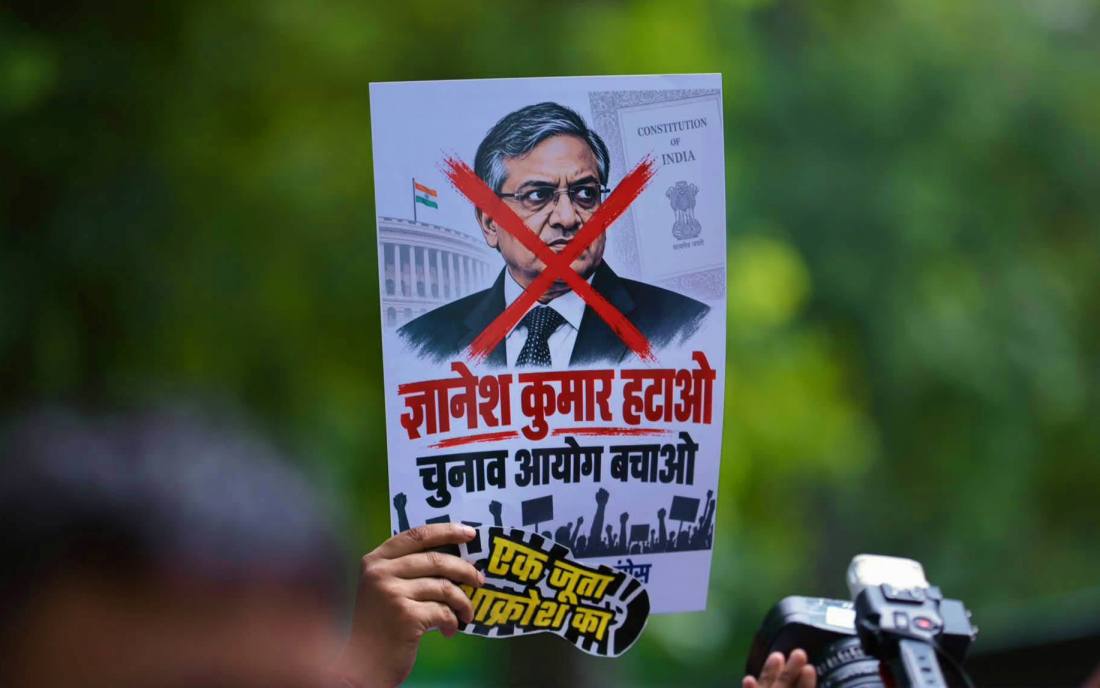
The latest revelations have intensified criticism from opposition parties, with leaders demanding Kumar’s resignation and questioning the transparency of the electoral process.
Some opposition politicians have also called for criminal action against the chief election commissioner.
The Election Commission, however, has maintained that differences between commissioners can form part of its internal decision-making process. The reported dispute has nevertheless drawn attention because the objections from Sandhu and Joshi concern fundamental aspects of how India’s voter database is managed.
Under India’s constitutional framework, the three commissioners form the Election Commission, with decisions generally taken collectively. The law governing the commission provides for decisions by majority when commissioners disagree.
Rahul Gandhi demands CEC Gyanesh Kumar’s resignation, says Modi, Shah “will be investigated” over vote theft
The Leader of the Opposition in the Lok Sabha said Prime Minister Narendra Modi and Union Home Minister Amit Shah “will be investigated” for “stealing the votes” of ordinary Indians.
At the start of his press conference, Gandhi displayed photographs of businessperson Gautam Adani, Rashtriya Swayamsevak Sangh chief Mohan Bhagwat, Shah, Modi, National Security Advisor Ajit Doval and Kumar. He alleged that they were “conspirators” in stealing votes.
Gandhi claimed that anti-incumbency had “disappeared” in several states because votes had been stolen. If “votes are destroyed”, he said, then “our Constitution has been destroyed”.
“It no longer has its power,” the Congress leader said. “If our Constitution is destroyed, our laws are illegal, and our institutions are attacked.”
Warning that there “are going to be consequences to this”, Gandhi said the Congress would not let “democracy be destroyed”. He described Kumar turning an approver as something that “would be an act of nationalism.”
BJP calls criticism a “smear campaign”
The BJP has defended Kumar and rejected the opposition’s accusations.
Party spokesperson Sambit Patra described the criticism as a “smear campaign” and said dissent was “a sign of a vibrant democracy”.
Patra also said “ever since the Modi government came to power in 2014, opposition parties have been collapsing one after the other”.
Because they could not win elections, he said, opposition parties were attempting to “undermine the institutions of the country”.
The dispute now places the ECI’s internal decision-making and the administration of India’s electoral rolls at the centre of a wider political and institutional debate.
SOURCE: INDEPENDENT PRESS AND NEWS AGENCIES
__________________________________________________________________________
FOLLOW INDEPENDENT PRESS:
WhatsApp CHANNEL
https://whatsapp.com/channel/0029VaAtNxX8fewmiFmN7N22

TWITTER (CLICK HERE)
https://twitter.com/IpIndependent

FACEBOOK (CLICK HERE)
https://web.facebook.com/ipindependent

YOUTUBE (CLICK HERE)
https://www.youtube.com/@ipindependent

Think your friends would be interested? Share this story!