Thu 17 September 2026:
At least 70 miners are dead after shafts collapsed in West Kordofan, highlighting the dangers of Sudan’s informal gold industry amid a conflict increasingly linked to the precious-metal trade
At least 70 people have been killed after a gold mine collapsed in Sudan’s West Kordofan state, with dozens more feared trapped underground, according to local monitoring and medical groups.
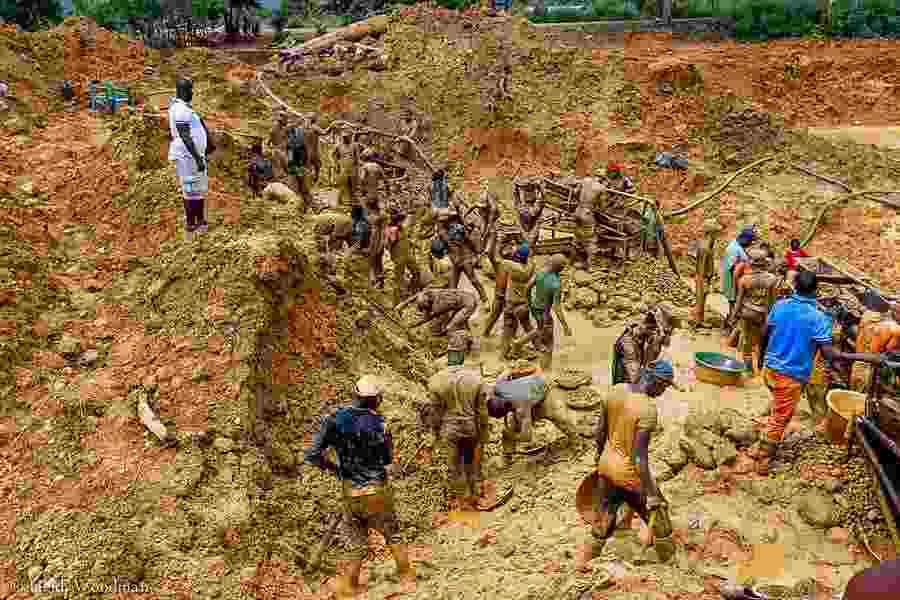
The collapse occurred at the Al-Zaraa gold mine near Al-Nuhud, where adjoining artisanal mining shafts gave way. Rescue efforts have been severely hampered by a lack of specialised equipment, forcing local residents and fellow miners to dig through loose, sandy soil using basic tools.
The death toll remains uncertain. A source from the paramilitary Rapid Support Forces (RSF), which controls the area, told AFP that at least 82 people had been killed and another 50 wounded, while an unknown number remained trapped.
__________________________________________________________________________

https://whatsapp.com/channel/0029VaAtNxX8fewmiFmN7N22
__________________________________________________________________________
“There is an unknown number of people still trapped under the rubble and rescue efforts are being conducted with rudimentary methods,” the source, who requested anonymity because he was not authorised to speak to the media, said.
Khair al-Sayyed Jabara, a miner who survived the collapse, said he and other miners worked through the night attempting to reach people buried underground. He said heavy machinery was urgently needed.
“We don’t know how many more are still inside,” he said.
Another miner, Amin Suleiman, said the shafts had been constructed so close together that the collapse of one triggered failures in neighbouring shafts.
Local sources told Reuters that the high number of casualties was linked to inadequate safety procedures and the absence of proper rescue equipment. The Sudan Doctors Network also warned that the death toll could increase as the search continues.
The medical group condemned the “negligence” it said had placed miners at serious risk.
Gold and Sudan’s wartime economy
The disaster highlights the dangers facing Sudan’s vast artisanal gold-mining sector, which has become increasingly important as the country’s economy has been devastated by war.
Sudan is one of Africa’s major gold producers, and millions of people depend on informal and small-scale mining for their livelihoods. Much of the country’s gold is extracted at unofficial or poorly regulated sites where workers often lack protective equipment, engineering oversight and emergency rescue services.
Gold has also become closely linked to the financing of Sudan’s war. The conflict began in April 2023, when fighting erupted between the Sudanese Armed Forces and the RSF. The two sides have since fought for control of territory, resources and economic infrastructure.
The United Nations has documented the continued importance of gold to the competing sides, noting that the war and the resulting governance vacuum allowed gold-smuggling networks to expand.
The RSF controls significant gold-producing areas in parts of Darfur and Kordofan, making access to mines and gold-trading networks strategically important. The United Kingdom said in July 2026 that Sudan’s gold industry had become a major component of the country’s war economy, with billions of dollars’ worth of gold estimated to leave the country through illicit channels each year.
The European Union has also introduced measures targeting Sudan’s gold trade, including a ban on the purchase, import or transfer of gold originating in Sudan, as part of efforts to restrict sources of financing for the conflict.
RSF-controlled territory under scrutiny
West Kordofan is controlled by the RSF, which has been fighting Sudan’s army for more than three years. The region’s gold deposits have attracted large numbers of artisanal miners, particularly as the war has destroyed other sources of employment and income.
“Mining activities in areas under RSF control, in the absence of safety standards and adequate protection and rescue equipment, turn mining into a direct threat to the lives of civilians,” the Sudan Doctors Network said.
The group called for rescue operations to continue and for urgent medical and logistical assistance to reach the mine. It also urged authorities controlling the area to halt unregulated mining activities.
The collapse is not an isolated incident. Fatal accidents have repeatedly occurred at Sudan’s informal gold mines, where unstable shafts, limited oversight and inadequate rescue capacity leave miners particularly vulnerable.
Rescue operation continues
Survivors and local residents continue to search the site for people who may still be alive beneath the rubble. But the lack of heavy machinery and specialised rescue teams has slowed the operation.
The final death toll remains unclear because authorities and local groups have yet to establish exactly how many miners were underground when the shafts collapsed.
The disaster has therefore become both a humanitarian emergency and a stark illustration of the risks surrounding Sudan’s gold industry — a sector that provides livelihoods for millions but has also become an important source of revenue within a war economy.
SOURCE: INDEPENDENT PRESS AND NEWS AGENCIES
__________________________________________________________________________
FOLLOW INDEPENDENT PRESS:
WhatsApp CHANNEL
https://whatsapp.com/channel/0029VaAtNxX8fewmiFmN7N22

TWITTER (CLICK HERE)
https://twitter.com/IpIndependent

FACEBOOK (CLICK HERE)
https://web.facebook.com/ipindependent

YOUTUBE (CLICK HERE)
https://www.youtube.com/@ipindependent

Think your friends would be interested? Share this story!