Tue 11 November 2025:
From Gaza to Darfur, we are told we are witnessing “humanitarian crises” and “failures of diplomacy”. But this language obscures the reality of more than two decades of war that has raged in Sudan, that has only now pierced the veil of global consciousness.
Gaza and Darfur are not aberrations. They are what happens when a centuries-long system of colonial management begins to tear at the seams and when social media lets those on the receiving end narrate the violence for themselves.
Sudan’s war, like Israel’s assault on Gaza, sits on the same imperial map: a corridor stretching from the Eastern Mediterranean, through Suez, down the Red Sea and into the Gulf. At one end is a settler state born out of the British Mandate in Palestine. At the other is a petro-monarchy assembled out of British protectorates along the Trucial Coast. Between them lies a country, Sudan, that has been treated for decades as a testing ground for peace deals, militia experiments and “civilian transitions” designed elsewhere. Africa has always been a space for delusions of power and exploitation – except that now those same delusions are packaged in more insidious ways.
__________________________________________________________________________

https://whatsapp.com/channel/0029VaAtNxX8fewmiFmN7N22
__________________________________________________________________________
Two ends of the same corridor: Israel and the UAE
In 1917, the Balfour Declaration committed Britain to supporting a “national home for the Jewish people” in Palestine – while still part of the Ottoman Empire. Historians have long pointed out that British leaders saw control of Palestine as a way to secure Egypt and the Suez Canal, and thus the route to India. After the First World War, Britain received the League of Nations Mandate for Palestine and governed it explicitly as a strategic asset: a base, a buffer and a way to manage both European Zionist ambitions and Arab nationalism. This was not about recognizing a nation or its equal place amongst others but a patronizing mask for exploitation.
At the other end of the corridor, from 1820 onwards Britain signed maritime truces and “exclusive agreements” with a chain of Gulf sheikhdoms that claimed no legitimacy from the people, and that became known as the Trucial States. Under the 1892 Exclusive Agreement, their created rulers promised not to cede territory or deal with other foreign powers without British consent; in return, London guaranteed their defense.
The Trucial States remained under this protective umbrella until the treaties were revoked on 1 December 1971. The next day, six emirates formed the United Arab Emirates; the seventh joined a few weeks later.
In other words:
Israel emerges from a British imperial design in Palestine, later folded into a US-led security architecture, as a militarised settler state at the Eastern Mediterranean end of the Arab world.
The UAE is created from British protectorates along the Gulf coast as a petro-federation hosting foreign bases, controlling ports and shipping, and projecting power across the Red Sea and Horn of Africa.
Despite their seemingly different histories the two states share the same strategic function as anchor points for external power along the same imperial corridor.
That is the context in which Abu Dhabi now arms or hosts actors in Sudan, and normalises ties with Israel, while both present themselves as “stabilising” forces.
Sudan’s militia state: from CPA to Janjaweed to RSF
Sudan’s current catastrophe did not begin in April 2023. It was prepared in the early 2000s, when the US and its partners pushed for the Comprehensive Peace Agreement (CPA) between Khartoum and the SPLM/A to end the North–South civil war.
The CPA, signed in 2005 with US, UK and other backing, did end one of Africa’s longest conflicts.
But it also reflected one brutal priority in Washington: keep the North–South process on track, even if that meant treating other crises – above all Darfur – as “secondary tracks” to be “managed” rather than resolved. A US Congressional research report from the time makes this explicit. It highlighted that US policy should focus on three priorities, with CPA implementation and “ending the conflict in Darfur” listed separately, as if they could be neatly compartmentalized.
This mindset encouraged a convenient fiction that allowed incorrect political shorthand to dominate, that the Sudanese People’s Liberation Army (SPLA) = “the South”. In reality, the SPLA’s political line and its behavior on the ground were often at odds with Southern sentiment. John Garang insisted for years on a united, secular Sudan, while many southerners considered breaking away from the North. International human rights reporting in the 1990s and early 2000s documented SPLA abuses including forced recruitment, looting and violence against civilians, including in refugee communities in Kenya and Uganda.
Still, legitimising the SPLA as the voice of “the South” made negotiations tidier. One signature in Naivasha could be presented as peace. Meanwhile, in Darfur, Khartoum’s counter-insurgency relied on a different instrument: the Janjaweed.
Those militias, drawn largely from Arab tribes that shared ancestral links with tribes across the Sudanese border into Chad, were armed, trained and coordinated by the Sudanese state to crush rebel movements in Darfur in the early 2000s. They became infamous for scorched-earth campaigns, mass killings and systematic sexual violence.
In 2013, instead of dismantling this system, the regime rebranded it. The Janjaweed were grouped into a new paramilitary force, the Rapid Support Forces (RSF), placed under the National Intelligence and Security Service and later directly under the presidency.
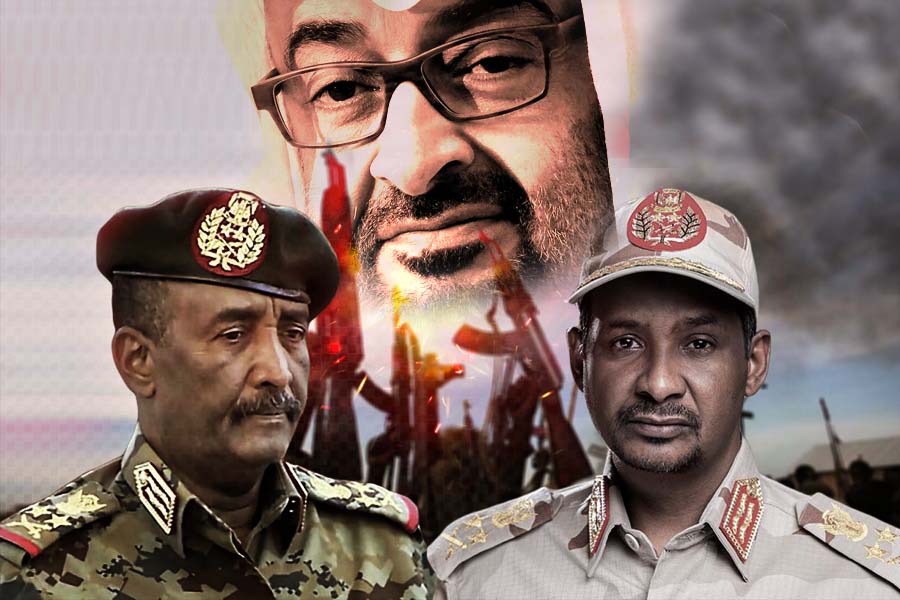
Their commander, Mohamed Hamdan Dagalo (Hemedti), used his position to build a business empire around gold mining and mercenary contracts in Yemen and elsewhere.
This is the militia state that now dominates Sudan: a hybrid of army, intelligence and paramilitary forces, each with its own business interests, with Darfur as its original laboratory.
The UAE steps in: arms, gold and a parallel government
Into this vacuum stepped the UAE.
Abu Dhabi had already built a network of bases from Eritrea’s Assab to Yemen’s Socotra and elsewhere, explicitly to control maritime routes and project power across the Red Sea and Horn of Africa.
As Sudan’s new war escalated after April 2023, UN experts, Reuters investigations and other media began tracking a pattern:
Dozens of cargo flights from the UAE to an airstrip in eastern Chad that a UN panel said had become a hub for supplying weapons to RSF – allegations the UAE denies, insisting the flights were humanitarian.
Mortar rounds exported from Bulgaria to the UAE later found in an RSF convoy in Darfur, according to a letter from UN sanctions monitors.
UAE-manufactured armoured vehicles with French systems documented by Amnesty International as being used by RSF in Sudan in likely violation of the UN arms embargo.
Sudan has taken the rare step of dragging the UAE before the International Court of Justice, accusing it of complicity in genocide by arming RSF. The UAE has rejected the allegations and challenged the court’s jurisdiction; the ICJ has since declined to proceed on technical grounds without ruling on the underlying facts.
However one reads the legal arguments, the political pattern is unmistakable: a Gulf petro-monarchy built out of British protectorates is now a central sponsor – political, financial or logistical – of the most powerful militia in Sudan.
Exactly as in other theatres, from Yemen to Libya, this sponsorship is justified in the language of “counter-terrorism”, “stability” and “anti-Islamism”. But on the ground, it looks like drones hitting mosques in El Fasher, displacement camps being attacked, and entire communities reduced to famine under RSF siege.
The advocacy–intelligence complex
Between Washington and Abu Dhabi stands a whole industry of Western advocacy and expertise.
Former US official John Prendergast, who served on the National Security Council in the Clinton era, went on to co-found the Enough Project and later The Sentry with actor George Clooney. Their stated aim is to target “violent kleptocracies” – including in Sudan and South Sudan – by using financial intelligence and sanctions to hit warlords and their business networks.
In a typical formulation, Clooney and Prendergast argue that “real leverage for peace” comes when the people who profit from war “pay a price” through asset freezes and travel bans.
On a more academic register, figures like Alex de Waal and institutions like the Rift Valley Institute (RVI) have produced detailed analysis of Sudanese war and politics for years. RVI’s Sudan Open Archive and training courses have become standard references for diplomats and NGOs.
Prendergast’s work exposes the hypocrisy of the ‘save Africa’ brigade, whose silence around Israel’s genocide in Palestine is deafening. The NGO and activist enrvironment also sits in a particular economy where Sudan becomes a stage where Western advocates, scholars and celebrities can apply new policy tools (Responsibility to Protect yesterday, “anti-kleptocracy” today), publish reports and speak in the name of “ending conflict” – often with limited input from Sudanese grassroots movements.
The default solution remains the same recycled for new administrations and looks like more lists, more sanctions, more technocratic peace processes. What is rarely on the table is the one thing Sudanese uprisings have consistently demanded: a transfer of power and wealth away from a militarised centre and its foreign backers.
Hamdok and Sumoud: the “civilian” fig leaf
If militias and foreign patrons are two legs of this order, elite civilians are the third.
Abdalla Hamdok – former UN economist, Bashir-era technocrat and prime minister after the 2019 revolution was marketed abroad as the face of Sudan’s “civilian transition”. In reality, the 2019 power-sharing deal left the army and RSF in control of key security and economic sectors, while Hamdok negotiated with the IMF and donors.
That transition collapsed with the October 2021 coup. Hamdok briefly returned under an agreement with the same generals, then resigned under street pressure.
In late 2023, he reappeared with Taqaddum, an “anti-war” coalition of parties, civil society groups and armed movements. In January 2024, Taqaddum signed a Declaration of Principles with RSF leader Hemedti, just weeks after RSF seized Wad Madani, where local groups reported widespread abuses. The agreement was widely criticised inside Sudan as lending civilian cover to a militia accused of atrocities.
By early 2025, Taqaddum had splintered. One wing moved closer to RSF; another claimed neutrality. Hamdok dissolved the structure and launched Sumoud, billed as a cleaner civilian front. An Al Jazeera analysis describes how Taqaddum fractured under accusations of being too close to RSF and too dependent on regional capitals such as Abu Dhabi.
From the perspective of Sudan’s resistance committees, all of these rebrands look similar: a coalition led largely from exile, headquartered in the UAE, heavily dependent on foreign funding and diplomatic platforms, claiming to speak for “civilians” while refusing to directly confront the role of RSF and its Gulf sponsors.
Once again, the pattern is familiar: a post-imperial garrison state picks a warlord to arm and a civilian to market, then sells the package to Western capitals as “peace”.
The civilian politics that actually exist
The tragedy is that Sudan has long had forms of civilian politics far more deeply rooted in everyday life than any technocratic coalition.
Historically, the country’s two main parties – the Umma Party and the Democratic Unionist Party (DUP) – emerged from the Ansar and Khatmiyya Sufi brotherhoods. These religious orders anchored extensive rural networks, providing social services, mediation and patronage; they were the backbone of parliamentary politics after independence.
These brotherhood-parties were conservative and hierarchical, but they were socially embedded in villages and towns, much as the Muslim Brotherhood elsewhere built influence through welfare and education.
Today, that older party system is weakened. But its basic logic – neighbourhood-level solidarity and religiously inflected moral obligation – has flowed into new forms:
Resistance committees, non-hierarchical local groups that organised the protests that brought down Omar al-Bashir in 2019.
Emergency Response Rooms (ERRs) and mutual-aid networks that have taken the lead in providing food, water, shelter and medical care during the current war, especially where international agencies cannot reach.
ERRs have just been recognised with major human rights awards for delivering “life-saving humanitarian assistance where state institutions have collapsed and international responses have fallen short”, as one citation put it.
This is Sudan’s real civil society: messy, decentralised, rooted in mosques, Sufi lodges, neighbourhood kitchens and women’s savings circles. It is also largely excluded from the elite talks in Gulf hotels that are supposed to decide Sudan’s future.
Gaza and Darfur: the knife that cuts the veil
Gaza and Darfur are often described as “humanitarian catastrophes” or “crises of international law”. In reality, they mark something deeper: a rupture in how imperial violence is seen and narrated.
In both places, the violence is not new. Israel has waged war on Palestinians for decades; Sudan’s peripheries have been subjected to counter-insurgency and famine since the colonial era. What is new is the visibility.
Researchers and media critics have documented how, during Israel’s latest assault on Gaza, social media has undermined the state’s ability to control the narrative. Palestinians in the Strip have used phones to broadcast bombardment, starvation and displacement in real time, challenging official claims filtered through Western media.
In Sudan, young people in El Fasher and Omdurman do something similar: filming RSF attacks on displacement camps, army airstrikes on neighbourhoods, and the day-to-day work of Emergency Response Rooms under siege.
For most of the last century, colonial wars were narrated to the world through imperial communiqués and carefully framed news. Today, the people on the receiving end are narrating it themselves – and their images sit uneasily next to the language of “tribal conflict” and “complex crisis” still used in official forums.
Gaza and Darfur are not deviations from an otherwise rules-based order. They are the knife that has cut through the veil of that order, exposing “international diplomacy” as what it has long been in this region: a way of managing colonial borders, securing energy and trade routes, and disciplining populations – while calling it peace.
Stop mistaking hotel lobbies for politics
If the US, Europe, Gulf monarchies and the broader “international community” are serious about peace in Sudan, they have to stop treating the country as a laboratory and a backdrop.
That means:
No more elite settlements packaged as “civilian transitions” while real power stays with men who command militias and control gold.
No more Emirates-based coalitions presented as the authentic voice of civilians, while resistance committees, ERRs, women’s groups and Sufi-rooted networks are sidelined.
No more impunity – or plausible deniability – for those who arm RSF and similar forces, whether in Khartoum, Tel Aviv, Abu Dhabi, London or Washington.
It also means recognising that any democratic future in Sudan will be built, if at all, out of the infrastructures that have already kept people alive: mosque courtyards, nafir campaigns, community kitchens, informal unions and decentralised committees. Peace will not come from another communique drafted in a five-star hotel and marketed by advocacy brands; it will come from dismantling the militia state and giving those structures control over land, budgets and security.
For decades, Sudan has been treated as a test case for a failed model: an agreement in the capital, a militia in the periphery, a civilian frontman for foreign consumption and an expert chorus to explain why this is the only realistic option. Sudanese people have already rejected that model in the streets, at enormous cost.
The question now is whether the rest of the world is prepared to hear what Gaza and Darfur are telling it – or whether it will once again choose the comfort of hotel diplomacy over the risk of genuine popular sovereignty.
The statements, views and opinions expressed in this column are solely those of the authors and do not necessarily represent those of Independent Press.

By Mariam Jooma Çarikci
Mariam Jooma Çarikci is an Independent researcher, focused on the politics of Africa, Zionism in Africa, and Türkiye’s evolving role in the Middle East and Africa.
__________________________________________________________________________
FOLLOW INDEPENDENT PRESS:
WhatsApp CHANNEL
https://whatsapp.com/channel/0029VaAtNxX8fewmiFmN7N22

TWITTER (CLICK HERE)
https://twitter.com/IpIndependent

FACEBOOK (CLICK HERE)
https://web.facebook.com/ipindependent

YOUTUBE (CLICK HERE)
https://www.youtube.com/@ipindependent

Think your friends would be interested? Share this story!
__________________________________________________________________________
FOLLOW INDEPENDENT PRESS:
WhatsApp CHANNEL
https://whatsapp.com/channel/0029VaAtNxX8fewmiFmN7N22
TWITTER (CLICK HERE)
https://twitter.com/IpIndependent
FACEBOOK (CLICK HERE)
https://web.facebook.com/ipindependent
YOUTUBE (CLICK HERE)
https://www.youtube.com/@ipindependent
Think your friends would be interested? Share this story!