Tue 22 September 2026:
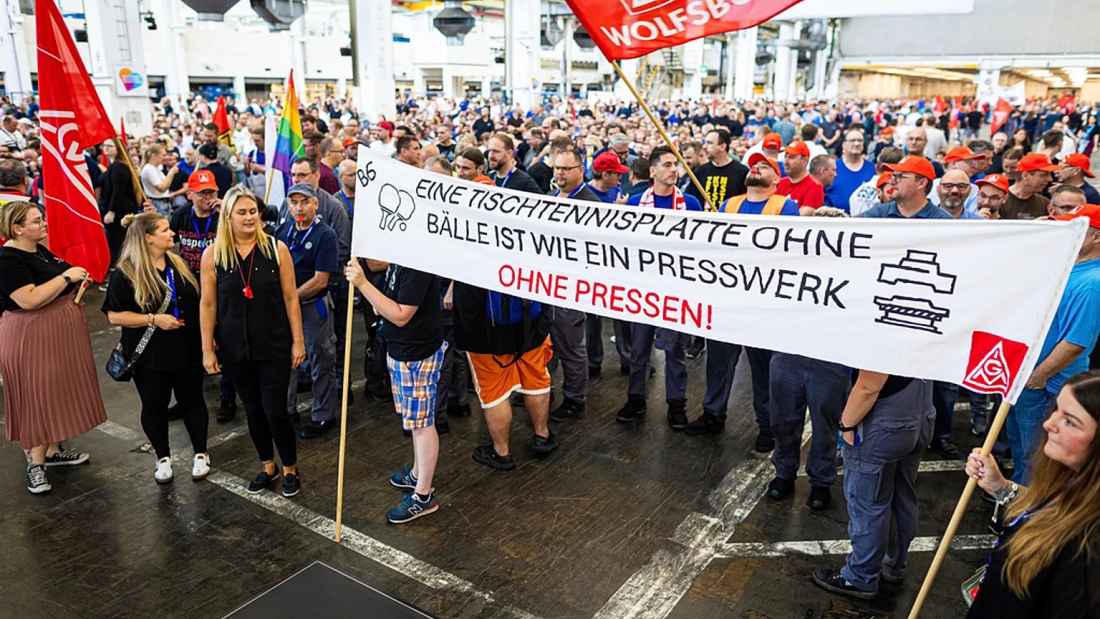
Roughly 175,000 German auto workers joined nationwide protests on Monday against planned job cuts and factory shutdowns, according to the IG Metall union.
Employees from every major carmaker plus many large and small suppliers turned out at about 280 sites, including key industry hubs such as Wolfsburg, Zwickau, and Stuttgart, the union said.
IG Metall leader Christiane Benner accused companies of years of poor management and inadequate responses to the current crisis.
__________________________________________________________________________

https://whatsapp.com/channel/0029VaAtNxX8fewmiFmN7N22
__________________________________________________________________________
“Managements must finally understand: throwing people out will not save the economy,” she said. “Success will only come through innovation and bold investments in products, technology, and production sites.”
According to IG Metall, employees from Volkswagen, VW subsidiaries, suppliers and partner companies in development and transport participated in the protests. In Salzgitter, employees from MAN and Bosch joined the protests.
Ahead of upcoming wage negotiations, IG Metall is demanding greater investment in German production sites and the preservation of the 35-hour working week. The union also urged the government to help protect the industry by lowering electricity prices and reducing bureaucracy.
Union leader Christiane Benner blamed years of mismanagement and demanded investment in German plants, cheaper energy, and stronger protection against cheap imports.
The industry is in its deepest slump in decades. Volkswagen is planning up to 100,000 job cuts worldwide by 2030 and has put four German factories at risk. BMW, Mercedes and suppliers such as Bosch are also cutting thousands of roles. Employment in the sector has already fallen sharply.
A big driver is China. German brands are losing share in China, once their most profitable market. At the same time, Chinese makers such as BYD and Chery have pushed their combined European market share above 10 percent with cheaper electric and hybrid cars. EU tariffs mainly cover battery EVs, so unions and some politicians want extra duties on Chinese plug-in hybrids. High energy costs, a late EV shift, and U.S. tariffs add to the pressure. Workers argue they should not pay for a crisis they did not create.
SOURCE: INDEPENDENT PRESS AND NEWS AGENCIES
__________________________________________________________________________
FOLLOW INDEPENDENT PRESS:
WhatsApp CHANNEL
https://whatsapp.com/channel/0029VaAtNxX8fewmiFmN7N22

TWITTER (CLICK HERE)
https://twitter.com/IpIndependent

FACEBOOK (CLICK HERE)
https://web.facebook.com/ipindependent

YOUTUBE (CLICK HERE)
https://www.youtube.com/@ipindependent

Think your friends would be interested? Share this story!