Mon 13 October 2025:
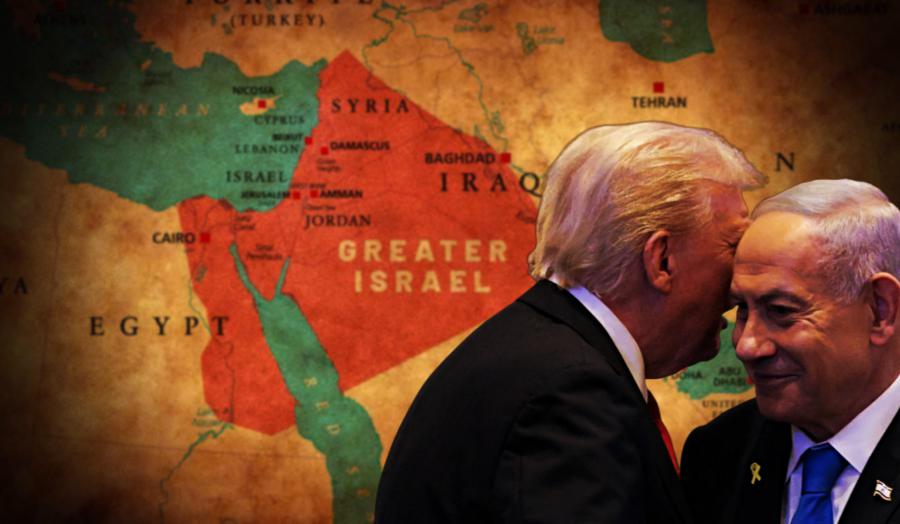
The twenty-point plan introduced by Donald Trump in the fall of 2025, presented as a solution to end the Gaza war, outwardly attempts to establish a framework for peace and reconstruction in the Middle East. However, beneath its surface, this plan is less of a peace proposal and more a sign of a new geopolitical engineering; one whose aim is not to end conflict but to redefine power and territory in the Middle East in favor of Israel. In reality, this political document, like previous Washington plans, is merely a diplomatic veneer for the gradual emergence of “Greater Israel,” a concept with a fundamental place in the political history of Zionism. While ostensibly offering mechanisms for Gaza’s reconstruction and management, it, in practice, leads to the entrenchment and institutionalisation of Israel’s influence throughout the geography of Palestine and its surrounding areas.
__________________________________________________________________________

https://whatsapp.com/channel/0029VaAtNxX8fewmiFmN7N22
__________________________________________________________________________
Trump’s twenty-point plan appears to be based on three main pillars: security, reconstruction, and transitional governance. However, a closer examination of its content reveals that the concept of security in this plan is not about achieving mutual security for both parties, but rather about consolidating Israel’s security at all levels. In this framework, the complete disarmament of Palestinian resistance groups and the deployment of international forces along Gaza’s borders effectively mean handing over security control to structures that will be either aligned with or subordinate to Tel Aviv. Although this mechanism is presented as a peace guarantee, in practice, it hollowed out Palestinian sovereignty and legalizes the continuation of occupation under a multilateral guise. Such an approach has been seen before in post-regional conflict agreements, with the result being the stabilisation of the status quo.
In the second pillar, reconstruction, the plan emphasizes Arab investments and the management of projects by international consortiums. However, within the proposed economic architecture, Israel’s role as the primary partner in technology, infrastructure, and logistical control is firmly established. This structure effectively turns reconstruction into a tool for Gaza’s economic integration into Israel’s sphere of dependency. From a critical perspective, this reconstruction framework is not a humanitarian act but a stage in what could be called a “neoliberal peace“—a peace that, through controlled economics, paves the way for political expansion. In other words, the economic provisions of the plan, despite their appearance of regional cooperation, reflect a structural dominance that transforms Gaza’s economy into a precursor to the extension of Israeli influence.
The third pillar, transitional governance, is the most ambiguous and yet the most significant part of the plan. It foresees that, until “full stability” is achieved, Gaza will be governed by an international body composed of selected actors. From an international law perspective, this model constitutes a kind of informal guardianship that operates without national sovereignty or internal elective mechanisms. Though labeled as transitional, historical precedent shows that temporary structures in Middle Eastern conflicts often evolve into permanent orders. Consequently, the concept of “transition” in this plan is more accurately described as a suspension of Palestinian sovereignty—a suspension that lays the groundwork for the stabilisation of new forms of territorial control. In this way, the transitional provisions cleverly pave the way for the long-term presence of Israel and its allies within Gaza’s administrative framework.
Beyond the internal structure of the plan, the geopolitical context surrounding it also reveals deeper connections to the Greater Israel project. In recent years, U.S. foreign policy in the Middle East has moved away from a balanced mediation model, shifting toward crisis management that benefits its strategic allies. Trump’s plan, within this context, is a step toward legitimising the new field realities that Israel has created during the Gaza war. The delegation of security powers, the formalisation of de facto borders, and the elimination of the possibility of refugee return all align with the logic upon which the Greater Israel idea is built: territorial expansion, demographic control, and political hegemony over the surrounding environment. This model can be traced not only in Palestine but also in Washington’s regional policies toward Lebanon, Syria, and Jordan.
An important component in the critical analysis of the plan is the language and discourse used within it. Words like “sustainable security,” “regional reconstruction,” and “joint management” carry positive connotations, but from a discourse analysis perspective, they perform an ideological function. This language persuades the international audience to accept a situation where the name of peace conceals the continuation of domination. In reality, the plan utilises soft concepts to cover hard policies. This technique, known in international relations as “peace conditional on hegemony,” is an effective tool for reproducing power without the need for overt occupation. Thus, the terms used in the plan are themselves part of the strategy of dominance.
An analysis of the plan’s field implications confirms this interpretation. The implementation of its security and economic provisions, even before formal approval, has already shifted the balance of power in Gaza and the West Bank. Local institutions have been weakened in the face of new international structures, and Palestinian political dialogue has effectively been sidelined. These trends indicate that the plan is not a crisis resolution mechanism but rather a tool for gradually altering the political reality in favor of Israel. If this trajectory continues, the medium-term future may witness the stabilisation of a regional order in which Israel not only controls the occupied territories but dominates the broader Middle Eastern equation. In this scenario, geographical borders give way to borders of influence and dependency—the very image outlined in the Greater Israel theory for years.
Trump’s twenty-point plan, outwardly an attempt to end a bloody war, ultimately serves not as a peace treaty but as a political statement to consolidate dominance. Using diplomatic language, it establishes a mechanism in which peace becomes a tool for reproducing power. Each provision, from security to reconstruction and transitional governance, ultimately strengthens Israel’s position and weakens Palestinian sovereignty. This plan, at its core, is based not on compromise but on control.
If the history of failed peace-building efforts in the Middle East has taught us anything, it is that no plan based on inequality and hegemony can lead to lasting peace. Trump’s twenty-point plan is no exception to this rule; more than ending the conflict, it marks a new chapter in the creation of a regional order where Israel is larger, more powerful, and more geopolitically entrenched than ever before. Thus, we can say that this plan is not the end of the road but rather a stop along the way toward realising the dream of Greater Israel—a dream now closer to reality than ever before, disguised under the banner of a fleeting peace.
Author:

__________________________________________________________________________
FOLLOW INDEPENDENT PRESS:
WhatsApp CHANNEL
https://whatsapp.com/channel/0029VaAtNxX8fewmiFmN7N22

TWITTER (CLICK HERE)
https://twitter.com/IpIndependent

FACEBOOK (CLICK HERE)
https://web.facebook.com/ipindependent

YOUTUBE (CLICK HERE)
https://www.youtube.com/@ipindependent

Think your friends would be interested? Share this story!