Wed 15 April 2026:
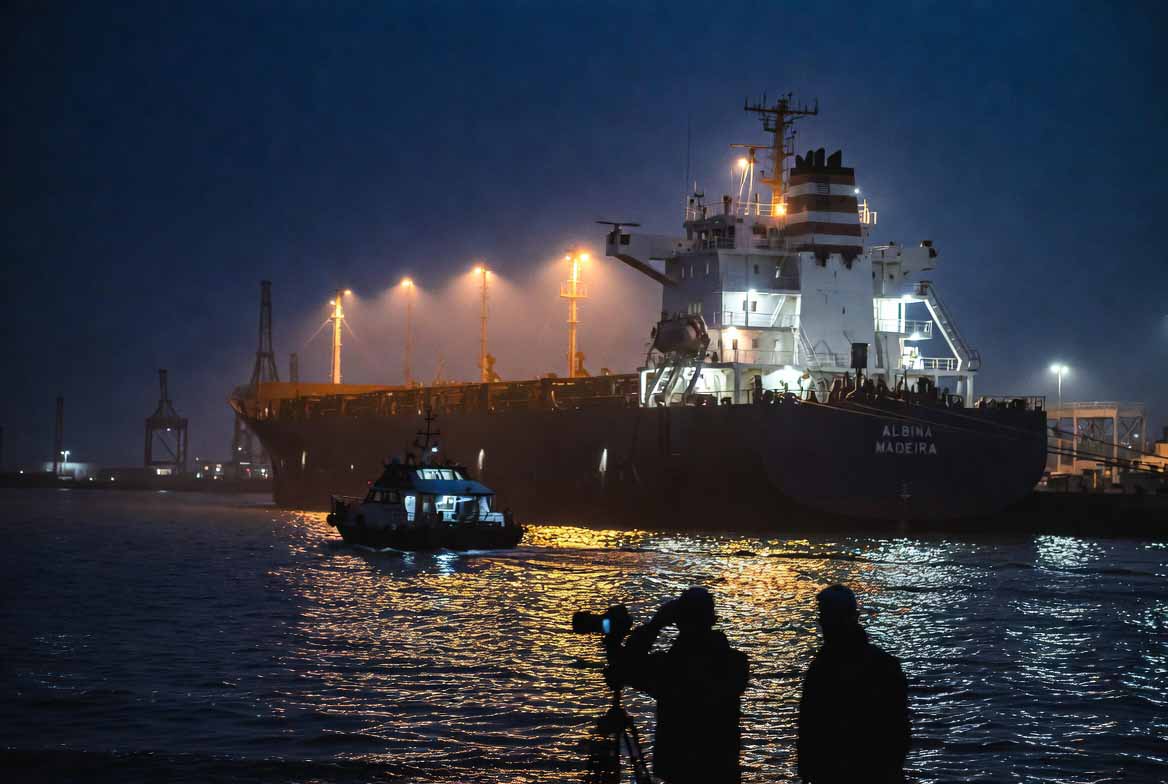
The Associated Press news agency is reporting that the US is enforcing the blockade of Iranian ports by intercepting traffic in the Gulf of Oman.
It cited an unnamed US official as saying that the strategy is to observe vessels subject to the blockade leave Iranian facilities and clear the Strait of Hormuz before intercepting them and forcing them to turn around.
The official said that the military relies on more than just the automated tracking beacons that all merchant ships are required to carry, called AIS, to determine that merchant ships were coming from a port in Iran. However, the official wouldn’t go into more detail, citing the need for operational security.
__________________________________________________________________________

https://whatsapp.com/channel/0029VaAtNxX8fewmiFmN7N22
__________________________________________________________________________
US Navy has forced 8 Iran-linked oil tankers to turn back since Monday
The Wall Street Journal (WSJ) is reporting that US naval forces have forced eight vessels departing and entering Iranian ports to stop and turn back.
Citing officials, the WSJ reported that, in every instance, US forces contacted the crews via radio and instructed them to reverse course.
All the tankers complied with the orders, and no boardings were necessary, it added.
US making a gamble with naval blockade on Iran
US Central Command has said that not a single ship has got through.
We were hearing differently yesterday – that one ship might have got through the blockade – but it seems that it only got through the Strait of Hormuz itself and is now stuck on the other side of it, in front of the blockade.
CENTCOM said they sent six vessels back the way they came, and that these ships went when they were ordered to.
The US has gathered a huge naval force to try and enforce this blockade, including more than a dozen warships, dozens of aircraft, and more than 10,000 personnel there, whether they be Marines or soldiers or airmen, who are all working together to keep this blockade going. That’s obviously quite an expense.
And it’s also a diplomatic expense.
A lot of Iranian oil, for example, goes towards China. That’s Iran’s biggest customer, and about a third of China’s domestic oil needs are met from Iran. So the longer this goes on, the more those needs aren’t going to be met.
Will that then make China put pressure on Iran to negotiate with the United States, or just anger that country? We don’t know yet.
So there is a gamble here. And there is also a sense that the longer that this blockade goes on, the more it makes things economically worse for the global energy market – but also for the United States.
Russia says it can ‘compensate for shortfall’ in China’s resources
Russia’s foreign minister, Sergey Lavrov, says that Moscow could help make up energy shortages in China amid the ongoing US blockade on Iranian ports.
“Russia can undoubtedly make up for the resource deficit that has emerged, both for the People’s Republic of China and for all countries willing to work with us in a fair and mutually beneficial manner,” Lavrov told reporters in Beijing, after meeting China’s President Xi Jinping.
Lavrov said relations between Russia and China “remain unshakeable in the face of all storms” and the ties between Russian President Vladimir Putin and Xi contribute to their countries’ “high degree of resilience in the face of the shocks that have shaken the world”.
China is the biggest buyer of Iran’s oil, and the US has said that Beijing will not be able to buy Iranian oil amid the continuing blockade.
IMF warns war on Iran could push world economy to brink of recession
The International Monetary Fund has warned that a further escalation in the war on Iran and a continued disruption to oil markets could push the world to the brink of recession.
The organisation said its worst case scenario would be repeated shocks to the energy market that would slow global economic growth to 2 percent from the current 3.1 percent.
Under this outlook, oil prices could average $110 a barrel in 2026 and $125 in 2027.
The group’s most benign scenario assumes a short-lived conflict and oil prices normalising in the second half of 2026, with an $82 per-barrel average for the year.
The middle path envisions a longer conflict that keeps oil prices at about $100 per barrel this year and $75 in 2027, with global growth falling to 2.5 percent this year from 3.4 percent in 2025.
IMF chief economist Pierre-Olivier Gourinchas told reporters that with continued energy disruptions and no clear path to end the conflict, the middle path or “adverse scenario” looks increasingly likely.
No sign of a change in Iranian policy on Strait of Hormuz
Abas Aslani, an analyst in Tehran said that Iran “has not been shifting its posture” and that its “adoption of new protocols in the Strait of Hormuz predates the naval blockade by the US”.
Iran believes these protocols can be implemented, given the war that has been launched against it, he said.
“The US wants to pressure Iran to somehow revise its policies in this regard,” Aslani added. “But we have seen no sign or signal from the Iranian side exhibiting that they are going to change their policy.”
SOURCE: INDEPENDENT PRESS AND NEWS AGENCIES
__________________________________________________________________________
FOLLOW INDEPENDENT PRESS:
WhatsApp CHANNEL
https://whatsapp.com/channel/0029VaAtNxX8fewmiFmN7N22

TWITTER (CLICK HERE)
https://twitter.com/IpIndependent

FACEBOOK (CLICK HERE)
https://web.facebook.com/ipindependent

YOUTUBE (CLICK HERE)
https://www.youtube.com/@ipindependent

Think your friends would be interested? Share this story!