Mon 13 July 2026:
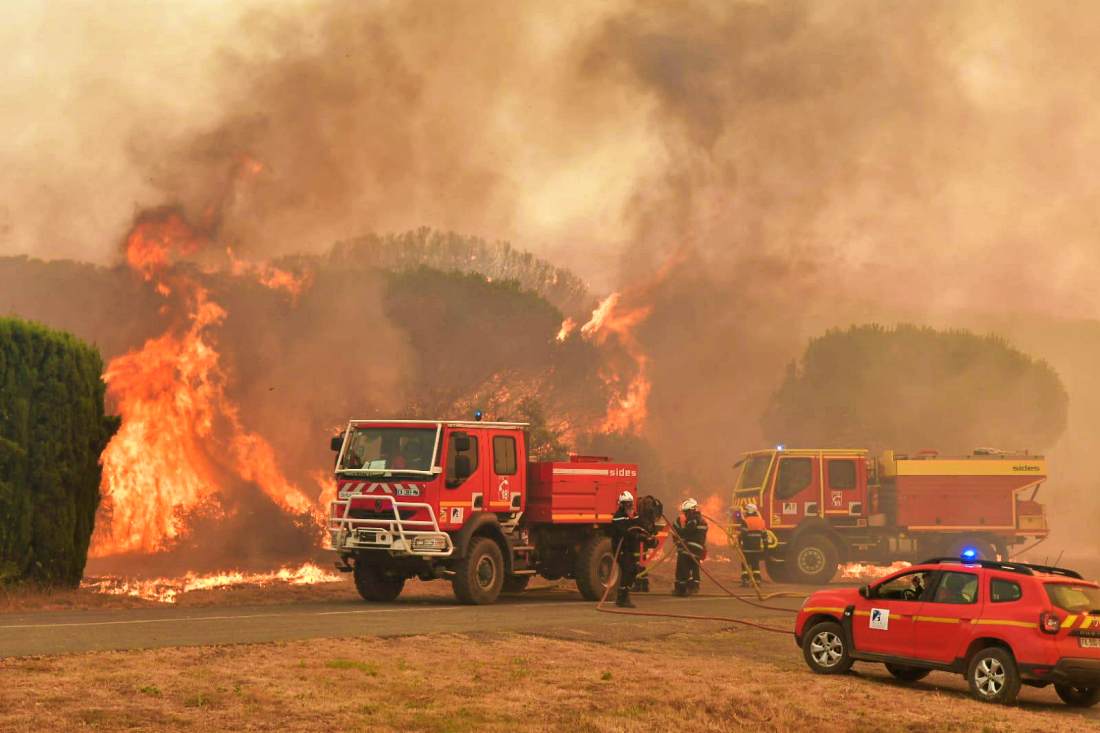
Wildfires burning in France’s Fontainebleau forest have led to home evacuations and caused disruptions to train and motorway traffic, as a heatwave continues to affect Western Europe.
The wildfires broke out near a motorway outside Fontainebleau, located about 60km (42 miles) southeast of Paris and home to one of France’s best-known royal palaces.
By Monday morning, the flames had scorched more than 800 hectares (1,980 acres), fanned by hot winds.
The fires disrupted train lines and forced the partial closure of the A6 motorway, which connects the north and south of France. Fifteen homes had to be evacuated in the nearby village of Vaudoue.
About 400 firefighters mobilised to contain the fires across several towns in the area, and authorities sent two waterbombing planes on Monday to tackle the blazes.
Officials described the fires as “very virulent” and of “exceptional scale”.
Eric Brocardi, of France’s national federation of firemen, said this was the first time fire-bombing planes had to be sent from the hotter and drier south of France to extinguish fires in the Paris region.
Brocardi added that two firefighting helicopters and an observation aircraft were also sent to contain the fire.
__________________________________________________________________________

https://whatsapp.com/channel/0029VaAtNxX8fewmiFmN7N22
__________________________________________________________________________
The Paris region is currently experiencing a heatwave, which increases the risk of fires. Scientists from the World Weather Attribution group say that recent heatwaves would have been “virtually impossible” without climate change.
The ongoing heatwave in France has forced officials to shut down three nuclear power stations.
Interior Minister Laurent Nunez said that forest fires had already consumed 17,000 hectares (42,008 acres) of land this year, “twice as much as the same period” in 2025, he added.
Government spokesperson Maud Bregeon told RTL that the Fontainebleau wildfire was “an exceptional situation,” saying a blaze of such magnitude in northern France was unprecedented.
“Exceptional situation, exceptional resources,” she said, adding that the government had deployed Canadair water bombers and Dash aircraft to support firefighting operations.
Two Canadair aircraft arrived in the area on Monday and began water-dropping operations after collecting water from the Seine River.
The wildfire came as 37 departments remained under France’s highest red heat-wave alert, with extreme temperatures and dry conditions increasing the risk of fires across the country, according to the broadcaster.
Bregeon said about 2,000 cooling centers opened over the weekend under the government’s recently introduced Extreme Heat ORSEC emergency plan to protect vulnerable people.
She added that France’s hospital system remained under pressure but continued to cope with the surge in heat-related demand.
The government also defended the cancellation of some Bastille Day celebrations, saying the measures were intended to avoid overstretching emergency services and reduce the risk of fireworks triggering new fires.
Elsewhere, firefighters brought a wildfire at Cap Frehel in the northwestern Cotes-d’Armor department under control, although emergency crews remained at the scene to prevent flare-ups.
Deputy Defense Minister Alice Rufo told broadcaster TF1 that the government hoped to deploy the military’s A400M transport aircraft for firefighting missions “in the coming weeks” after completing pilot training and other preparations.
SOURCE: INDEPENDENT PRESS AND NEWS AGENCIES
__________________________________________________________________________
FOLLOW INDEPENDENT PRESS:
WhatsApp CHANNEL
https://whatsapp.com/channel/0029VaAtNxX8fewmiFmN7N22

TWITTER (CLICK HERE)
https://twitter.com/IpIndependent

FACEBOOK (CLICK HERE)
https://web.facebook.com/ipindependent

YOUTUBE (CLICK HERE)
https://www.youtube.com/@ipindependent

Think your friends would be interested? Share this story!