Wed 13 May 2026:
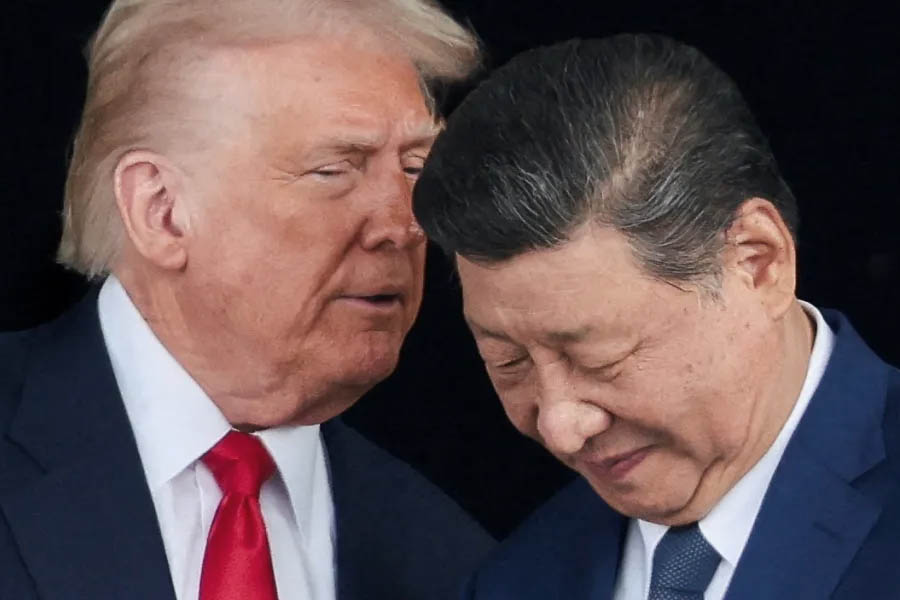
US President Donald Trump is on his way to Beijing to meet China’s President Xi Jinping and says he’ll have a “long talk” about Iran but trade will be the main focus.
United States President Donald Trump has departed for Beijing ahead of a high-stakes summit with Chinese President Xi Jinping, after weeks of unsuccessful US efforts to persuade China to help bring Iran back to negotiations and ease tensions around the Strait of Hormuz.
The leaders of the world’s two largest economies are due to meet on Thursday and Friday during Trump’s first visit to China since 2017, with talks expected to focus on trade, Taiwan, artificial intelligence and the war involving Iran.
__________________________________________________________________________

https://whatsapp.com/channel/0029VaAtNxX8fewmiFmN7N22
__________________________________________________________________________
Why does the Trump-Xi summit matter?
The Trump-Xi summit is a high-level meeting between Trump and Xi Jinping taking place in Beijing as the world’s two largest economies face growing tensions over trade, technology, Taiwan and the Iran war.
The summit is particularly significant because Trump will be the first US leader to visit China in nearly a decade, while the talks also come at a time of heightened geopolitical and economic uncertainty. Originally expected earlier this year, the meeting was delayed by the war on Iran.
Before departing for Beijing, Trump said he and Xi would have a “long talk” about Iran, although he stressed that trade would remain the central focus of the visit.
“Trade remains politically powerful, especially for Trump, because it gives rivalry a language that voters can easily understand,” said Salvador Santino Regilme, associate professor and programme chair of international relations at Leiden University. “Yet the deeper conflict concerns hierarchy, legitimacy and the future architecture of global order.”
Regilme added that both countries remain locked in a relationship shaped by strategic rivalry and deep economic dependence.
“The United States still relies heavily on China’s manufacturing capacity and low-cost production, while China depends on access to US consumers, technology, capital markets and the wider stability of the dollar-centred global economy.”
“This is the paradox of US-China rivalry: each side wants greater autonomy, yet both remain tied to a structure of mutual dependence that neither can easily dismantle without hurting itself,” Regilme added.
Iran war and the Strait of Hormuz
The Iran war is expected to be one of the most closely watched issues at the summit.
Analysts expect Washington to press Beijing to use its influence over Tehran, particularly because China remains the largest buyer of Iranian oil — by far — purchasing more than 80 percent of Iran’s shipped crude exports. US officials have also urged China to support efforts to reopen and secure the Strait of Hormuz, a vital route for global energy supplies.
The conflict has also increased pressure on China’s economy and energy security. About half of China’s crude oil imports come from the Middle East, while disruptions in the Gulf have left commercial shipping vulnerable to attacks and delays.
“I have no doubt that Trump is going to at least try to enlist Xi Jinping to assert some pressure for the Iranians to come back to the table and agree to a settlement,” said Dan Grazier, a senior fellow and director of the National Security Reform programme at the Stimson Center.
Experts say Iran may be one of the few areas where US and Chinese interests overlap, as both countries benefit from stable energy flows through the Gulf.
“Both sides would like to see the strait opened,” said Gregory Poling, director and senior fellow at the Center for Strategic and International Studies (CSIS), but he noted Beijing is unlikely to align itself too closely with Washington’s approach towards Tehran.
While China wants shipping through the Strait of Hormuz restored, Poling argued the diplomatic and strategic pressure created by the disruption is falling far more heavily on Washington.
“It is not China being humiliated in the strait … It’s the US.”
Oil prices dip as markets monitor fragile Iran ceasefire, Trump’s China summit
Crude oil prices dipped on Wednesday, snapping a three-day rise as the markets watched for news on the shaky ceasefire in the US-Israel war on Iran.
By 00:51 GMT, Brent crude futures had dropped 82 cents (0.76 percent) to $106.95 per barrel. Meanwhile, US West Texas Intermediate (WTI) crude fell 66 cents (0.65 percent) to reach $101.52.
Investors are now focused on Trump’s trip to China for talks with Xi Jinping, and what those discussions will mean for the war on Iran and the wider global economy.
Trump should not expect much as China will not ‘jeopardise relationship with Iran’
Mohamad Elmasry, media studies professor at the Doha Institute for Graduate Studies, says Washington understands it will not get much help on ending its war with Iran from China, which wants to keep strong ties with Tehran.
“I think China, while they are being hurt to some extent, is in a much better position than many other global players,” Elmasry told Al Jazeera, adding that Beijing has been able to find “workarounds” to the disruptions in the Strait of Hormuz.
“More importantly, I don’t think the Chinese are willing to jeopardise the relationship that they have with Iran,” he said.
“They’re not allies per se, but it is a kind of strategic partnership,” he added.
“They see it is an important counterbalance to US hegemony in the region. And I don’t think they are willing to surrender the region to the US and Israel.”
SOURCE: INDEPENDENT PRESS AND NEWS AGENCIES
__________________________________________________________________________
FOLLOW INDEPENDENT PRESS:
WhatsApp CHANNEL
https://whatsapp.com/channel/0029VaAtNxX8fewmiFmN7N22

TWITTER (CLICK HERE)
https://twitter.com/IpIndependent

FACEBOOK (CLICK HERE)
https://web.facebook.com/ipindependent

YOUTUBE (CLICK HERE)
https://www.youtube.com/@ipindependent

Think your friends would be interested? Share this story!