Sun 14 June 2026:
Let me paint you a picture.
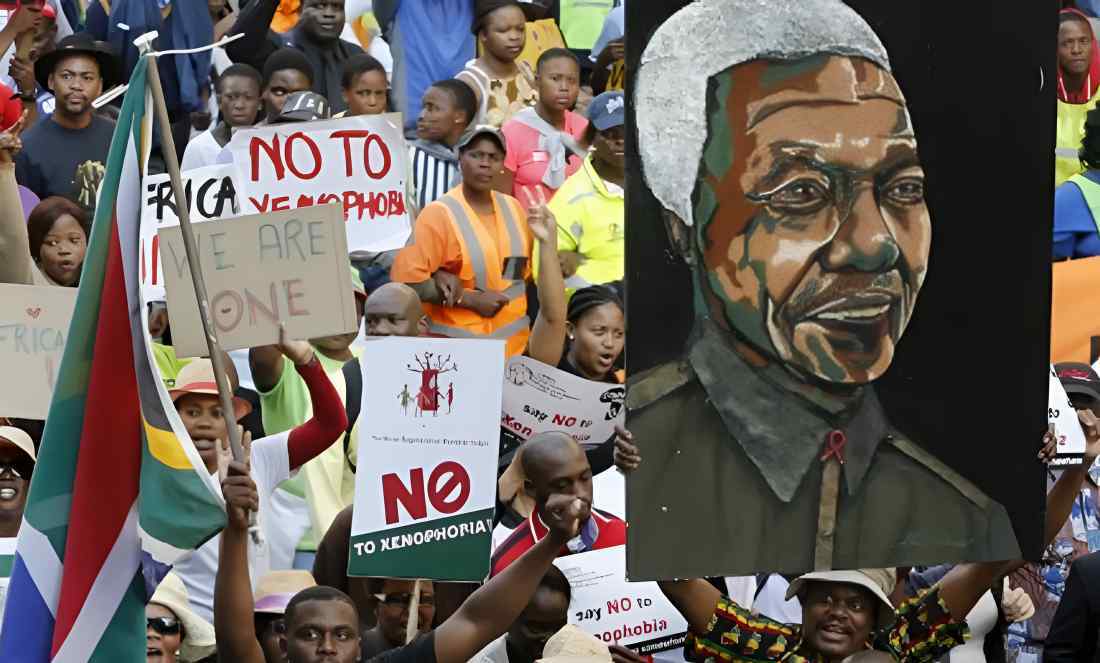
A Zimbabwean man sells vegetables outside a taxi rank in Durban. He has been doing it for three years. He pays his rent. He sends money home. He minds his business. One afternoon, a crowd gathers. His stall is destroyed. He is lucky to escape with his life.
Meanwhile, across town, a South African dual national boards a return flight from Tel Aviv. He has spent the past several months serving in the Israeli Defence Forces in Gaza. He lands at OR Tambo. He walks through customs. He goes home.
No one stops him.
These two stories — one Black African migrant brutalised for existing, one citizen who served in a military that the International Court of Justice has ordered to prevent acts of genocide in Gaza, passing through unchallenged — tell you everything you need to know about how South Africa’s borders actually work. Not in law. In practice.
__________________________________________________________________________

https://whatsapp.com/channel/0029VaAtNxX8fewmiFmN7N22
__________________________________________________________________________
The Aesthetics of Solidarity
We are, in this country, very good at the performance of liberation. We sing the right songs. We carry the right flags. We file the right cases at The Hague. And then we go home to arrangements of power that have not fundamentally shifted since 1994.
The anger directed at African migrants is not new. It is a recurring symptom of a political project that has consistently chosen to redirect legitimate frustration downward rather than upward. When the electricity fails, when the housing queue stretches into decades, when unemployment swallows an entire generation — do not look at who owns the land. Look at the Mozambican running the corner shop.
This is not solidarity. It is its opposite. And it is enabled, consciously or not, by a liberation movement that made its peace with white capital long ago and has spent thirty years hoping nobody would notice.
The land question tells the story plainly. Nearly 26 million hectares of privately owned land — roughly three-quarters of the total — remain in white hands. White South Africans are 8% of the population. Black South Africans are nearly 80%, and own 4% of privately held land. On the JSE, direct black ownership of the top sixty listed companies sits at 1.5% of market capitalisation. Thirty years of BEE. 1.5%.
Not one undocumented migrant caused that. Not one foreign-owned spaza shop.
Who Crosses the Border, and How
The Regulation of Foreign Military Assistance Act is unambiguous. South African nationals are prohibited from providing military assistance to foreign states without explicit government authorisation. No such authorisations were granted to South Africans who served in the IDF in Gaza. The then-Foreign Minister Naledi Pandor said it publicly: “When you come home, we are going to arrest you.”
They came home. The arrests, for the most part, did not follow.
This is not merely a legal technicality. In January 2024, the ICJ — the same court before which South Africa argued its genocide case — ordered Israel to take all measures within its power to prevent acts of genocide against Palestinians in Gaza. South African nationals were, during this period, serving in the very army subject to that order. They returned home to silence.
Human rights defenders were eventually forced to launch a High Court application to compel the government to act — describing, in their papers, “the stark failure by our authorities to deter crime, coupled with frugal resources and weak law enforcement mechanisms.”
Compare this to the global picture. IDF reservists have been taking holidays in Brazil, Cyprus, Sri Lanka, Nepal — posting sunsets on social media, tagging their locations. The Brussels-based Hind Rajab Foundation has compiled evidence against approximately one thousand such soldiers and has been filing criminal complaints with each country they visit. A Brazilian court opened an investigation. The soldier fled to Argentina.
South Africa — the country that took Israel to The Hague for genocide — cannot track its own dual nationals who served in that same military during those very proceedings. The Malawian vendor at the roadblock is documented, profiled, and potentially deported. The soldier who served in an army the ICJ has told to halt genocidal acts walks through OR Tambo without incident.
This is not a bureaucratic failure. It is a political choice. And it exposes the hollowness at the heart of our proclaimed solidarity — with Palestine, with Africa, with ourselves. Those of us who work within peace-building spaces, including through Wage Peace, understand that solidarity without accountability is just theatre. Peace built on selective justice is no peace at all.
Cape Town: Progress for Whom?
The Western Cape presents itself as proof that South Africa can be governed well. Perhaps. But well for whom is a question the province consistently avoids.
Cape Town is in a housing crisis that is not accidental. The City Bowl and Atlantic Seaboard continue to attract luxury property investment — sales above R50 million, some beyond R100 million, have become ordinary transactions. Over 2023 and 2024, every one of the twenty-two suburbs with the highest concentration of foreign buyers was in the Western Cape. Wealth is concentrating. Access is shrinking.
And the City of Cape Town’s affordable housing policy? Delayed for over two years. Consultation “ongoing.” It has been noted — publicly, on record — that some of the DA’s major funders operate in the property development sector.
The people being displaced are not wealthy. They are overwhelmingly Black and Coloured residents, pushed further from economic opportunity by the spatial logic of a city that has never truly confronted its apartheid geography. The mountain and the ocean are beautiful. The Cape Flats are where you go when you cannot afford the view.
What Afrophobia Actually Does
Afrophobia does not fix the electricity. It does not build the houses. It does not transfer the land. It does not produce a single arrest warrant for a citizen who served in a foreign military operation — one the world’s highest court has found plausible grounds to describe as genocidal.
What it does is provide a release valve. It transforms structural anger — anger that, if properly directed, would demand accountability from those who hold power — into communal violence against people who hold none.
This is not a new trick. It has been used against Black people in this country and across the world for centuries. What is new, and what should disturb us, is that thirty years into democracy, we are still falling for it.
The Foundation Beneath the Rainbow
The Rainbow Nation was always more comfortable for some than others. Perhaps the rainbow has faded. Perhaps what we are left with is pebbles — harder, less pretty, but real.
Real foundations are built from honest reckoning. From asking not just where are you from but who owns this country, who serves in whose army, whose housing crisis gets deferred, and whose displacement gets called a crime.
Our liberation story is unfinished. It will remain so as long as we keep burning the wrong things down.
The statements, views and opinions expressed in this column are solely those of the author and do not necessarily represent those of Independent Press.
Author:

Mariam Jooma Çarıkçı
Mariam Jooma Çarıkçı is an independent analyst and writer focused on the politics of Africa, Zionism in Africa, and Türkiye’s evolving role in the Middle East and Africa. She is the author of ‘Kurdistan: Achievable Reality or Political Mirage?’ (2013).
__________________________________________________________________________
FOLLOW INDEPENDENT PRESS:
WhatsApp CHANNEL
https://whatsapp.com/channel/0029VaAtNxX8fewmiFmN7N22

TWITTER (CLICK HERE)
https://twitter.com/IpIndependent

FACEBOOK (CLICK HERE)
https://web.facebook.com/ipindependent

YOUTUBE (CLICK HERE)
https://www.youtube.com/@ipindependent

Think your friends would be interested? Share this story!