Sun 14 June 2026:
The roar of the crowd echoes through a massive, circular arena. Thousands of spectators lean forward in their seats, their hearts pounding in sync with the action below. In the center of the stadium, elite physical specimens push their bodies to the absolute limit, fighting for glory, pride, and survival.
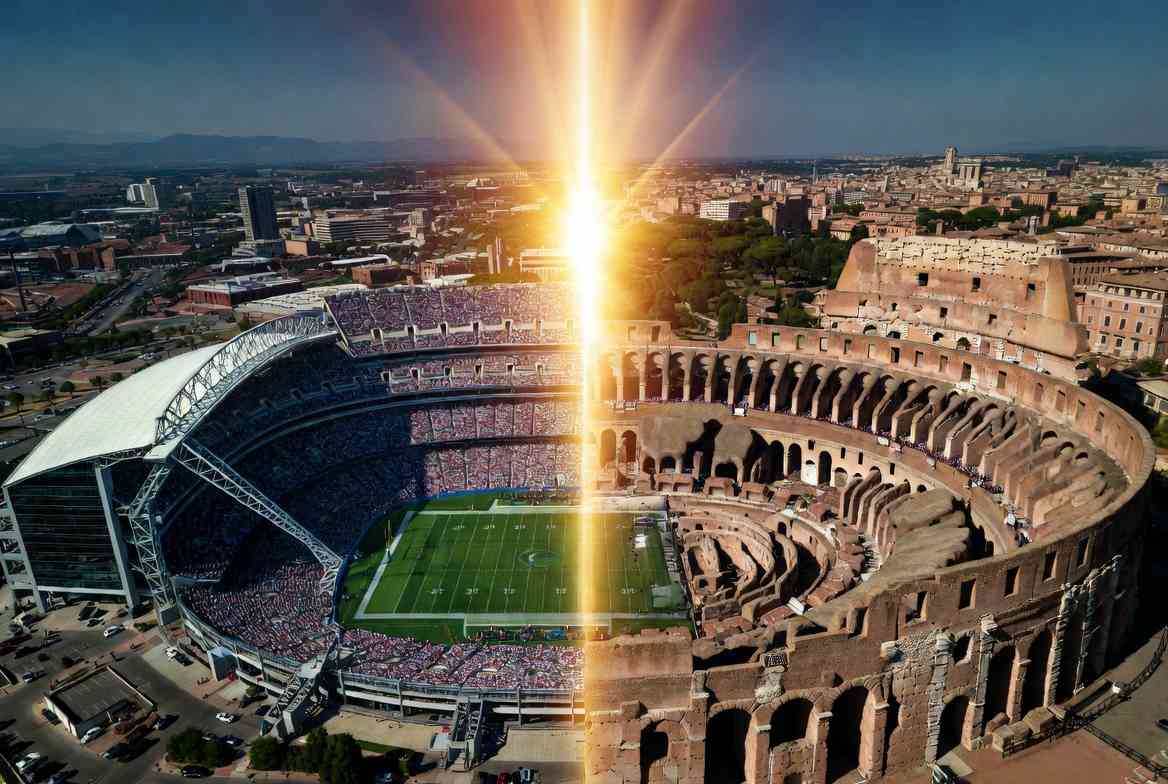
This scene is intimately familiar. But are we looking at the Roman Colosseum in 80 CE, or a modern stadium hosting the Super Bowl, the World Cup, or the Premier League today?
While modern sports like basketball, football, and soccer appear to be clean, civilized entertainment, a deeper look reveals they are a direct continuation and reformation of Roman gladiatorial combat. The blood may have been cleaned up, but the underlying social, political, and economic architecture remains remarkably unchanged.
__________________________________________________________________________

https://whatsapp.com/channel/0029VaAtNxX8fewmiFmN7N22
__________________________________________________________________________
The Architecture of Distraction: Then and Now
Visually and structurally, the modern soccer field or basketball arena is a direct descendant of the ancient amphitheater. Both are designed to centralize attention, turning athletic prowess into a grand spectacle. However, the connection runs far deeper than just blueprints and stadium seating.
In ancient Rome, the emperor used gladiatorial games as a tool for political stabilization. Today, mega-sports events serve as a modern proxy for a nation’s strength, acting as a powerful vehicle for exporting culture and fostering national identity.
Ancient Rome Panem et Circenses: Control through free food/combat
Modern Society Corporate Sports Machine: Control through consumerism/HD entertainment
For most, the history of ancient sports is primarily focused on classical antiquity, mainly due to the countless sources on Greek and Roman sports. Sports, however, were also popular among their Mediterranean predecessors, including in Egypt.
Wrestling was particularly popular with the ancient Egyptians. The sport appeared frequently in Egyptian art, including expansive scenes as far back as the Old Kingdom tomb of Ptahhotep (2300 BC). However, arguably the most significant of the scenes was discovered at the temple of Ramses III at Medinet Habu, where a detailed scene from a wrestling match from the days of Ramses II gave us arguably the earliest example of the political nature of sports, as well as the role it can play in elevating empires.
DEDICATED ROMAN GLADIATOR SUPERFANS WERE THE FOOTBALL HOOLIGANS OF THEIR DAY
The match depicted was between an Egyptian and a Nubian, with Ramses’ international court as the audience. Those in attendance included Nubian diplomats, who watched as their ethnic compatriots are defeated by the mighty Egyptians — a symbolic display of Egypt’s dominance over its neighbors in the region. The final segment in the Medinet Habu frieze depicted a victorious Egyptian wrestler standing over his defeated Nubian foe. The victor is celebrated, while the defeated opponent is forced to acknowledge his loss by kissing the ground before the Pharaoh.
The Medinet Habu frieze shed light on wrestling’s role in political affairs, particularly as a symbol of Pharaoh’s strength and its regional supremacy over neighboring Nubia, even as the latter gained influence.
This practice endured thousands of years later in Ancient Greece. The Olympic Games, for instance, were more than just a religious celebration that incorporated athletic competitions. It was an opportunity for city-states to display power and strength without resorting to warfare. Victors at the Games were imbued with an aura of invincibility that reflected their city-state.
Beyond the opportunity to assert dominance over rivals, city-states also used the Games to discuss political issues, form political and military alliances, and occasionally thaw relations between warring states, if only temporarily.
Following Greece’s assimilation into the Roman Empire in 146 BC, the Olympic Games underwent a drastic decline. In 67 AD, Roman Emperor Nero decided to participate in the 211th Olympiad. He took part in the chariot races and introduced contests in music, poetry and acting — all areas that reflected his personal interests. He was subsequently declared the winner in every event he participated in, including the ten-horse chariot race in which he fell off during the contest.
Following Nero’s death, his victories were declared void by Olympic authorities.
The Romans also engaged in their own form of sportswashing, a practice known as bread and circuses. The phrase, which appeared in a poem by the Roman author Juvenal, describes the process of Roman rulers distracting their population with free food and violent entertainment, the latter of which took the form of sporting events at the Colosseum. The most popular events at the time were the gladiator games.
The “Politics of Diversion” and Sportswashing
The Roman satirist Juvenal famously coined the phrase panem et circenses—bread and circuses—to describe how the emperors kept the populace pacified. By providing free food and violent entertainment, the regime successfully distracted citizens from political corruption, systemic poverty, and the loss of civic freedom.
Today, the corporate-sponsored sports machine performs the exact same function. Modern soccer stars have become the new gladiators—larger-than-life celebrities idolized for their physical gifts.
Across the annals of history, the echoes of sportswashing resonate from the ancient Egyptian displays of power to the prestigious contests of the ancient Greek Olympics and the grand spectacles of bread and circuses in Rome. The common thread linking these ancient practices to their modern counterparts.
Whether in ancient amphitheaters or contemporary arenas, sportswashing remains a potent tool for diverting attention, projecting a positive image, and consolidating power.
When we watch sports, we experience a profound emotional mirror. We gasp when a boxer hits the canvas; we cry when a player executes a flawless maneuver; we are deeply moved by an athlete’s resilience. In these moments, we aren’t just spectators—we see our own hopes, fears, and desire for triumph reflected in the competitors. It is this exact emotional vulnerability that makes the spectacle such a potent tool for societal control.
The dual nature of modern spectacle
THE DARK SIDE
* Politics of diversion
* Sportswashing by regimes
Displacing civic outrage
THE LIGHT SIDE
• Deep community mobilization
• Shared human inspiration
* Tapping into a need for story
Critics argue that the billions of dollars funneled into leagues like the UEFA Champions League or the NFL act as a massive “politics of diversion.” It channels public energy and tribal loyalty away from pressing socioeconomic issues like inflation and inequality. Furthermore, authoritarian regimes frequently utilize “sportswashing”—hosting mega-events like the FIFA World Cup to mask internal human rights crises and project a manufactured image of unity and prestige to the world.
The Invisible Costs of the Spectacle
The financial and human toll of modern sports rivals the excess of the Roman Empire:
The Financial Burden: The Tokyo 2020 Olympics cost taxpayers an estimated $13 billion. Qatar famously spent a staggering $200 billion on the 2022 World Cup, constructing climate-controlled stadiums in the middle of a desert. Economists consistently show that these mega-events rarely deliver lasting economic returns, leaving cities saddled with mounting debts and “white elephant” stadiums that sit empty for years.
The Human Toll: In ancient Rome, slaves and wild animals paid for the spectacle with their lives. Today, the costs are more obscured, but no less tragic. Thousands of migrant workers reportedly lost their lives building the infrastructure for the Qatar World Cup, while thousands of impoverished citizens were displaced in Brazil and China to clear land for Olympic stadiums.
Beyond the physical infrastructure, society pays an emotional and social price through toxic tribalism, manufactured nationalism, and the booming rise of sports betting addiction.
US JUDGE REFUSES TO BLOCK TRUMP’S BIRTHDAY WHITE HOUSE UFC FIGHT AMID LEGAL CHALLENGE
Questioning the Empire
Despite these systemic flaws, our love for the game remains unbroken. We scream for goals, we revere athletes like deities, and we willingly lose ourselves in the drama. This is because sports tap into something fundamentally human: our ancient need for story, belonging, and shared hope.
The circus hasn’t disappeared; it has simply evolved. Today, the bread is popcorn and the arena is broadcast in high definition.
This parallel is not a cynical mandate to abandon sports. Athletic competition has an unparalleled power to heal, inspire, and unite divided communities. However, as consumers of the modern spectacle, we bear a responsibility. We can continue to love the game, but we must stop blindly worshipping the gladiator without questioning the empire.
As the veteran gladiator Proximo famously noted in the film Gladiator:
”I wasn’t the best because I killed quickly. I was the best because the crowd loved me.”
Thousands of years later, it seems the crowd hasn’t changed at all.
Author:

Abu Mus’ab
__________________________________________________________________________
FOLLOW INDEPENDENT PRESS:
WhatsApp CHANNEL
https://whatsapp.com/channel/0029VaAtNxX8fewmiFmN7N22

TWITTER (CLICK HERE)
https://twitter.com/IpIndependent

FACEBOOK (CLICK HERE)
https://web.facebook.com/ipindependent

YOUTUBE (CLICK HERE)
https://www.youtube.com/@ipindependent

Think your friends would be interested? Share this story!