Tue 19 May 2026:
It is impossible to understand the logic of America’s exorbitant military expenditures and successive wars in various countries – from Vietnam, Iraq to Venezuela and Iran – without understanding the international monetary system. By designing a global mechanism, the United States has been able to shift the “costs of war” onto other countries and continue endless military interventions without suffering major chronic inflation or crippling budget deficits. This structural framework is a prerequisite for analysing many ambitious wars the United States has waged – including the recent invasion of Iran.
The starting point of the dollar’s dominance over the global economy was the Bretton Woods Conference at the end of World War II. According to the final agreement, the value of world currencies was tied to the dollar, and the US government pledged to make an ounce of gold equal to $35.
With this agreement, the dollar became the main monetary haven for global trade and assets, and countries kept their main reserves in dollars instead of gold. For two decades, after the world accepted the dollar as the base currency, the United States was able to lend to various countries by printing money, receive its exports in the same dollars, and pay its foreign expenses without leaving gold. Thus, the world became dependent on the dollar, and the United States practically financed the global economy with its printed money.
__________________________________________________________________________

https://whatsapp.com/channel/0029VaAtNxX8fewmiFmN7N22
__________________________________________________________________________
In the 1960s, due to the high circulation volume of US dollar around the world as well as the high costs of the Vietnam War, increased welfare spending, and the widespread printing of dollars to meet the global needs, various countries realized that the United States had printed more dollars than its gold reserves. France, led by Charles de Gaulle, Great Britain, Switzerland, Belgium, the Netherlands, and several other countries gradually converted their dollars into gold—a move that drastically reduced the U.S. gold reserves.
By early 1971, US gold reserves had fallen from 20,000 tons in 1949 to about 10,000 tons, while the volume of dollars in circulation outside the United States had reached more than $50 billion. There was no longer any correlation between gold and foreign dollars.
On 15th August 1971, Richard Nixon announced in a sudden televised speech (later known as the “Nixon Shock”) that the United States would no longer convert the dollar into gold in fixed rate. Thus, the dollar-gold relationship was severed, and exchange rates were allowed to float. After then, Washington had to seek a new anchor for the dollar and its architect was Henry Kissinger, the then US Secretary of State.
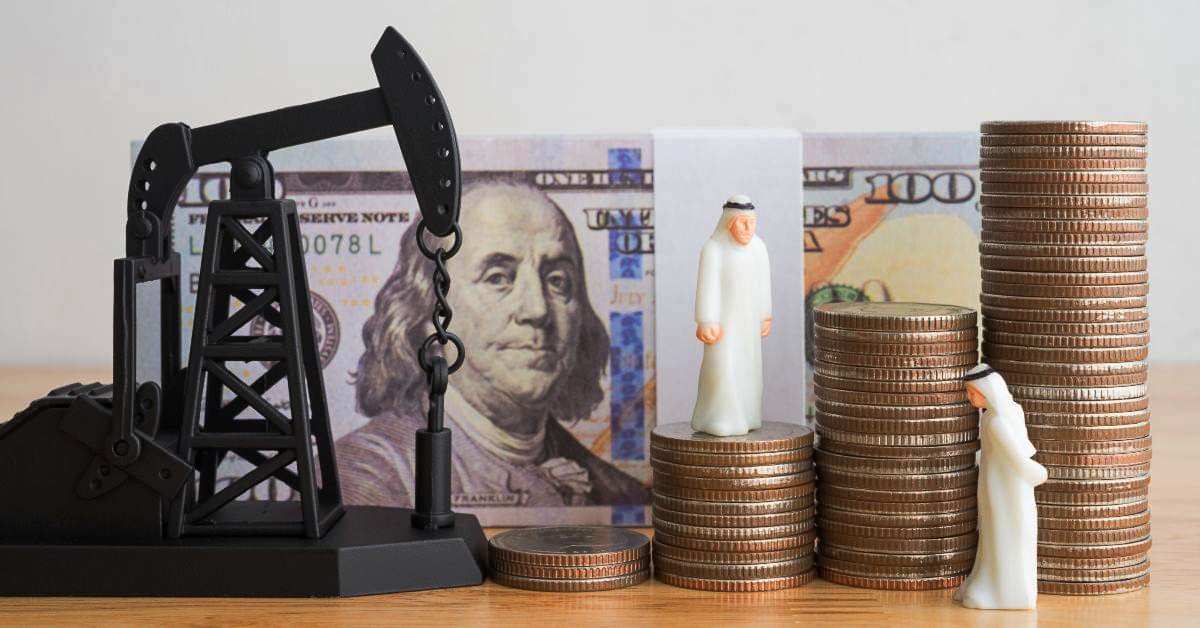
According to several sources, a secret agreement was signed between Washington and Riyadh in June 1974. Saudi Arabia pledged to sell its oil exclusively in dollars and invest the dollar income it received in US Treasury bonds.
In return, Washington provided security guarantees and military aid to the Saudi ruling family. This also applies to other littoral countries on the southern edge of the Persian Gulf. This agreement was the birth of a system that economists call the “petrodollar”. Other OPEC member countries gradually followed Saudi Arabia, thus creating a huge global demand for the dollar.
This financial architecture set up a simple but deadly cycle that still forms the backbone of the global economy.
Because oil—the lifeblood of the modern economy—was priced and sold exclusively in dollars, every country in the world that needed oil had to first acquire dollars.
To earn those dollars, countries had to export real goods and services to the US market. Meanwhile, it cost the Federal Reserve only about 17 cents to print a $100 bill. Now in digital form, it is cheaper. Simply put, workers and companies in Asia and Europe produced real goods and received paper printed or digital dollar published by the Federal Reserve in return. The United States bought $100 worth of real goods from other countries for 17 cents.
But the story doesn’t end there. Oil-exporting countries and other countries with surplus dollars invested that money in US Treasury bonds instead of spending it all on American goods. Foreign investors currently hold a total of $9.1 trillion in US government bonds, equivalent to 32 percent of the total federal debt.
This steady flow of foreign capital into the US Treasury allows the federal government to finance its chronic budget deficit, a deficit that is largely due to massive military spending that is projected to reach $1 trillion in 2026 alone and has now pushed the federal government’s gross debt past $39 trillion.
The dollar’s status as the world’s dominant trade and store of value gives the United States a “huge advantage.” In effect, the United States buys goods from the world by printing or digital dollars, while the world lends the same dollars to the United States by buying US debt. This means that Americans benefit from cheaper imports, lower borrowing costs, and higher living standards than their productivity alone would justify them. Furthermore, when the United States expands its money supply (quantitative easing), inflation is partly exported abroad as dollar-holding countries see their purchasing power decline.
The United States also faces no currency mismatch risk—it borrows in its own currency—unlike developing countries, which are vulnerable to dollar fluctuations. Thus, the world effectively subsidises US consumption and military spending, while the United States imposes a costly dollar dependency on everyone else.
The end result of this cycle is perhaps the most bitter truth of the modern global economy: the world buys oil, hoards dollars, and by buying US bonds, pays for the bombs that Washington drops on its enemies that challenge its bullying or turns into sanctions bludgeons. If the world stops trading oil in US dollars, the dollar’s position as the world’s main trading and reserve currency will face a serious challenge. As a result, the dollar’s value will decline against other major currencies.
US borrowing costs will rise because foreign demand for Treasury bonds (which come from petrodollar recycling) will fall. As imports become more expensive, inflation could accelerate, and the United States would lose its “exorbitant privilege” to run large trade deficits without immediate currency pressure. Financial markets could become more volatile, and countries could turn to the euro, yuan, or gold.
Currently, the “petrodollar” system creates a constant international demand for dollars: countries need dollars to buy oil, and oil-exporting countries often reinvest their surplus dollars in US assets.
This ties global energy security directly to dollar dominance. Any major country that tries to sell oil in another currency—as Iraq, Libya, Venezuela, and Iran have done or are trying to do—directly threatens that dominance. The US would therefore use military force or regime change to prevent petrodollar competition.
The aggression against Venezuela and, more recently, Iran illustrates this logic. The United States secures its economic supremacy by controlling oil-producing regions and enforcing dollar pricing. These military actions are often presented as spreading democracy or countering terrorism, and in the case of Iran, have been carried out under the pretext of combating nuclear weapons, but the underlying motivation is clear: without the petrodollar, US borrowing costs would increase, inflation would rise, and the global power bloc would shift. Thus, the system structurally rewards “warmongering.” The presence of dozens of military bases, battle ships, aircraft carriers, frigates and proxy wars in the Middle East act as de facto guardians of the dollar monopoly- among other reasons- and any country that tries to break away from it will be punished.
Author:

__________________________________________________________________________
FOLLOW INDEPENDENT PRESS:
WhatsApp CHANNEL
https://whatsapp.com/channel/0029VaAtNxX8fewmiFmN7N22

TWITTER (CLICK HERE)
https://twitter.com/IpIndependent

FACEBOOK (CLICK HERE)
https://web.facebook.com/ipindependent

YOUTUBE (CLICK HERE)
https://www.youtube.com/@ipindependent

Think your friends would be interested? Share this story!