

Sun 18 October 2026:
Demonstrations in France, Belgium, Italy and Portugal turn violent as anger grows over housing, wages and economic pressures
Hundreds of thousands of people have taken to the streets across several European countries to protest against the rising cost of living, exposing growing public frustration with economic conditions and putting pressure on governments across the European Union.
Demonstrations in Belgium, France, Italy and Portugal on Saturday unfolded separately, without a coordinated campaign, but reflected widespread concerns over inflation, housing affordability, low wages and the future prospects of young people.
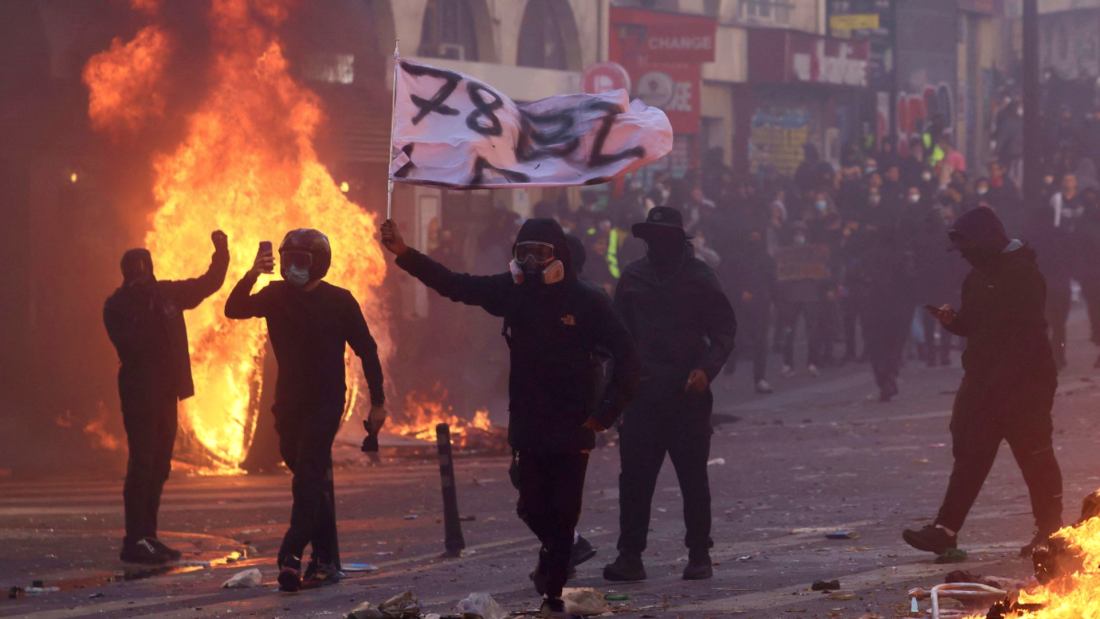
France witnessed some of its most turbulent protests in decades, with more than 550,000 people participating in demonstrations, according to the Interior Ministry. Clashes between police and protesters were reported in several parts of the country.
🇫🇷 Crowd smashing windows and entering Galeries Lafayette, a flagship Paris luxury department store, amid nighttime chaos with shattered glass and people grabbing goods.
The incident is part of widespread looting and clashes during nationwide protests on October 17, 2026, against France’s cost-of-living crisis, involving hundreds of thousands marching with sidelined violence in cities like Paris, Marseille, and Bordeaux.
News reports confirm attempts to breach Galeries Lafayette in Paris around 8 PM, alongside successful break-ins at similar stores and other retailers elsewhere in France, prompting Macron to vow prosecutions for vandalism and theft.
— INDEPENDENT PRESS (@IpIndependent) October 17, 2026
The demonstrations followed weeks of student-led protests but escalated into violence when groups of masked and other fringe protesters targeted public buildings, luxury shops and supermarkets. Police vehicles and officers were also attacked, while incidents of looting and arson were reported.
French Prime Minister Sebastien Lecornu said 1,200 people had been arrested and 150 police officers injured.
“It’s a miracle the toll wasn’t higher,” he said while visiting officers deployed in central Paris.
According to French news agency AFP, shops were looted in Paris, Marseille, Nice, Nantes, Bordeaux, Limoges, Lille, Toulouse and Strasbourg.
Paris Mayor Emmanuel Gregoire said entire streets in the capital “have been devastated”.
🇫🇷 Video show Limoges City Hall’s bell tower collapsing after a fire broke out during violent unrest in France on October 17, 2026, destroying much of the 1883 historic building.
The incident occurred in the margins of a national cost-of-living protest mobilization, where masked individuals broke windows, entered the town hall, and set it ablaze while also burning police cars nearby.
French officials call it a “patrimonial catastrophe” with the structure largely lost, though the mayor stressed continuity of public services remains intact despite the symbolic damage.
— INDEPENDENT PRESS (@IpIndependent) October 17, 2026
In Limoges, a fire started by masked protesters largely destroyed the town hall, a historic building more than 140 years old. Municipal buildings in Marseille and Lille were also broken into and vandalised, while protesters set fire to Lyon’s tourist office.
President Emmanuel Macron vowed to hold those responsible accountable, writing on X that they would be “prosecuted and punished”.
Belgium: Police use tear gas and water cannon
In Brussels, Belgium’s capital, police deployed tear gas and water cannon to disperse protesters, accusing demonstrators of throwing projectiles at officers and starting fires.
The latest unrest follows weeks of student protests against university registration fees, adding to pressure on authorities over education costs and broader economic concerns.
Police also used water cannon to break up demonstrations in Liege, east of Brussels. Authorities did not provide an estimate of the number of people who took part.
__________________________________________________________________________

https://whatsapp.com/channel/0029VaAtNxX8fewmiFmN7N22
__________________________________________________________________________
Portugal: Housing costs and low wages fuel anger
In Lisbon, tens of thousands of people reportedly marched against rising living costs, low salaries and the growing difficulty of securing housing in major cities.
Portugal has faced mounting pressure over housing affordability, with house prices more than doubling since 2017 and rents for new leases rising almost as sharply.
The housing crisis has become a major concern for younger people and lower-income households, particularly in urban areas where property costs have increasingly outpaced earnings.
Portuguese Parliamentary Affairs Minister Carlos Abreu Amorim said on Friday that the “government will not yield to shouts from the street”.
Protesters, however, accused political leaders of being “out of touch” with the difficulties facing ordinary citizens.
Italy: Clashes erupt in Milan and Bologna
In Milan, demonstrations against war and rising living costs escalated into clashes between protesters and police. Shops were looted and property set alight in the city centre, forcing crowds away from Piazza del Duomo and a luxury shopping arcade normally packed with visitors.
The march initially proceeded peacefully before masked demonstrators began throwing stones, paving blocks and other objects at riot police. Protesters also set fire to barricades constructed from bar tables.
Police responded with tear gas and water cannon to disperse the crowds.
🇮🇹 Large-scale protests have begun in Italy’s Milan
Video shows chaos in Piazza del Duomo with fires, smoke, police vehicles, debris, and barricades near the cathedral.
The footage captures clashes during the “Italia in Piazza” march, which drew over 5,000 participants protesting high living costs, fuel prices, taxes, low wages, and public service issues.
Peaceful elements turned violent as some masked youths threw stones, fireworks, and objects at police, prompting tear gas, water cannons, charges, injuries on both sides, and dozens of arrests, with PM Meloni condemning the escalation.
— INDEPENDENT PRESS (@IpIndependent) October 17, 2026
Italian news agency LaPresse reported that at least two police officers were injured and approximately 50 demonstrators were detained, many of them minors.
Prime Minister Giorgia Meloni condemned the violence, drawing a distinction between the right to protest and attacks on public property.
“Demonstrating is a right. Setting our cities ablaze is not,” she wrote on X, blaming “hooligans who exploit demonstrations to sow chaos”.
Milan’s centre-left mayor, Giuseppe Sala, acknowledged the concerns behind the demonstrations but criticised the destruction.
“the reasons for the protests were understandable. The violence against law enforcement and serious damage to the city are not justifiable.”
In Bologna, police also reported clashes with demonstrators who threw stones, although peaceful rallies took place alongside the unrest.
France emerges as the centre of a wider wave of discontent
Although demonstrations in Belgium, Italy and Portugal were smaller than those in France, the protests could indicate that public dissatisfaction is spreading across Europe, according to Alberto Alemanno, a professor of EU law and policy at HEC Paris Business School.
“France is the epicentre of this movement … and there are signs now that this is spreading beyond France,” Alemanno told Al Jazeera.
He warned that Saturday’s demonstrations might not be the last, suggesting that further protests could emerge in other countries.
Greece, Germany and Austria are already showing the “early stages” of a movement, with further mobilisation expected “in the coming week”, he said.
🇫🇷 Riots across France today
Nationwide protests on October 17, 2026, began as demonstrations by students, unions, Yellow Vests, and others against rising living costs, fuel prices, and declining school conditions but turned violent on the fringes with looting of shops, arson, and attacks on police/firefighters.
French authorities reported hundreds of arrests, tear gas and water cannon use by police, while unions claimed up to 800,000 participants overall, with officials attributing much of the destruction to hooded rioters and ultra-left elements.
— INDEPENDENT PRESS (@IpIndependent) October 17, 2026
Alemanno stressed that the demonstrations do not represent one unified movement. Instead, they comprise several protests driven by overlapping concerns, including underfunded education systems, rising living expenses and uncertainty about employment opportunities after graduation.
For students and young workers, these pressures are compounded by difficulties finding affordable accommodation and building financial security.
Economic frustration could reshape Europe’s political debate
The demonstrations come at a politically sensitive moment for Europe, as governments confront economic pressures alongside growing public demands for action on living standards.
Alemanno said the continent was approaching an “unprecedented super-cycle of national elections” over the next 12 months, with elections scheduled in Spain, France, Italy and Poland.
The protests could therefore become a significant issue in political campaigns, forcing candidates and governing parties to address concerns about wages, housing, education and economic inequality.
“Inevitably, all these protests, all these mobilisations, are going to be at the centre of the political conversation,” Alemanno said.
While the demonstrations have taken different forms across national borders, their common themes point to a broader challenge for European governments: responding to public frustration over the cost of everyday life while preventing isolated unrest from developing into a more sustained wave of political discontent.
SOURCE: INDEPENDENT PRESS AND NEWS AGENCIES
__________________________________________________________________________
FOLLOW INDEPENDENT PRESS:
WhatsApp CHANNEL
https://whatsapp.com/channel/0029VaAtNxX8fewmiFmN7N22

TWITTER (CLICK HERE)
https://twitter.com/IpIndependent

FACEBOOK (CLICK HERE)
https://web.facebook.com/ipindependent

YOUTUBE (CLICK HERE)
https://www.youtube.com/@ipindependent

Think your friends would be interested? Share this story!


