Sat 24 October 2026:
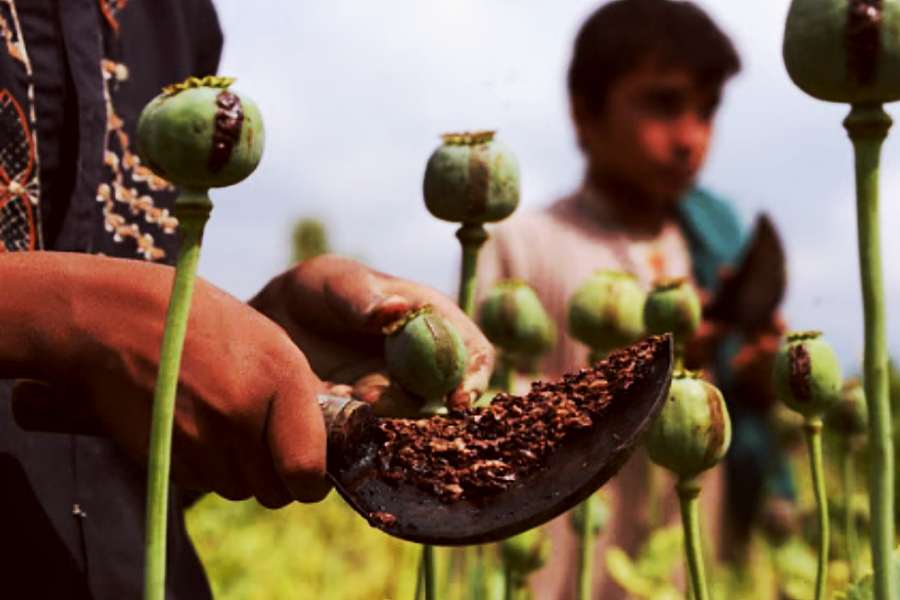
Opium poppy cultivation has expanded into several Iranian provinces, with Afghan farmers crossing the border to grow the crop after the Taliban banned drug production in 2022, according to findings reported by RFE/RL.
Reports of poppy cultivation have emerged from Khorasan Razavi in northeastern Iran, Kermanshah and Lorestan in the west, and the southern province of Fars. Sistan and Baluchestan, in southeastern Iran along the Afghan and Pakistani borders, remains the country’s main documented center of opium poppy production.
Satellite imagery and interviews with local farmers indicate that cultivation expanded in border regions of Iran and Pakistan following the Taliban ban, with some Afghan farmers renting land or entering crop-sharing arrangements with local landowners.
The findings describe large poppy fields that use drip irrigation, suggesting growing investment in opium production.
The report said the Islamic Republic, engaged in a war with the United States and Israel since February, is “unable or unwilling” to destroy poppy fields, giving farmers greater confidence that they can continue cultivating the crop.
__________________________________________________________________________

https://whatsapp.com/channel/0029VaAtNxX8fewmiFmN7N22
__________________________________________________________________________
Cultivation has been expanding for 10 years, but in recent times of war and international crises, the growth has been even more pronounced, fuelled – as academics and agronomists point out – by drought, falling agricultural incomes and a lack of alternatives to poppies.
Even experts from the United Nations (UNDP) stress that combating poppy cultivation will be difficult without creating sustainable economic alternatives, given that its value has been rising: in April, according to Iranian media reports, the retail price per gramme was around 250,000 tomans, approximately $1.60.
According to UN data on drugs and crime, poppy fields in climates similar to Iran’s typically yield between 20 and 30 kilograms of pure opium per hectare. In some regions, the figure exceeds 50 kilograms. A comparison between the income from poppies and that from wheat – one of the main agricultural crops in western Iran – helps to explain farmers’ choices: the value of a one-hectare wheat field is just over $1,000, whilst poppies can generate between $31,000 and $47,000 based on the reported retail price.
And in high-yield areas, where production can exceed 50 kilograms per hectare, the value could rise to around 12.5 billion tomans, equivalent to 78,000 dollars. This means that the estimated value of opium from one hectare could be between 29 and 72 times higher than that of wheat grown on the same area.
According to Mohammad Jamalian, a member of the Parliament’s (Majles) Health and Medicine Committee, the area under opium poppy cultivation in Iran has reached around 32,000 hectares, a figure more than three times higher than in previous years. It is difficult to estimate the total area accurately, as many fields are set up in remote areas and out of public view. However, a review of reports published in recent years shows that the names of the Zagros provinces appear more frequently than others, and these are areas increasingly grappling with drought, unemployment and a crisis in livelihoods.
Among the consequences of the Israeli-US conflict and Western sanctions is the rise in child labour in Iran, which goes hand in hand with increasingly widespread poverty, coupled with sexual exploitation, violence and malnutrition. The alarm has been raised by Hassan Mousavi Chalak, head of the Iranian Association of Social Workers, who argues that worsening economic conditions are forcing more and more families to rely on their children’s income to meet basic needs. “We must accept the fact that poverty in Iran has worsened,” said Mousavi. “The more difficult economic conditions become,” he added, “the more the labour of children is used to cover household expenses.”
Criticising what he described as political efforts to downplay the issue, Mousavi said that child labour has spread far beyond the children visible on city streets. He went on to highlight the use of children in slaughterhouses, livestock farms, underground workshops, orchards, farms and industrial settings, warning that many remain hidden from public view whilst facing “dangerous and harmful” working conditions. To date, “there are no reliable statistics” on the number of child labourers in Iran, but it is clear that “the phenomenon is more widespread in major cities and in pilgrimage and tourist destinations”.
SOURCE: INDEPENDENT PRESS AND NEWS AGENCIES
__________________________________________________________________________
FOLLOW INDEPENDENT PRESS:
WhatsApp CHANNEL
https://whatsapp.com/channel/0029VaAtNxX8fewmiFmN7N22

TWITTER (CLICK HERE)
https://twitter.com/IpIndependent

FACEBOOK (CLICK HERE)
https://web.facebook.com/ipindependent

YOUTUBE (CLICK HERE)
https://www.youtube.com/@ipindependent

Think your friends would be interested? Share this story!