Thu 27 August 2026:
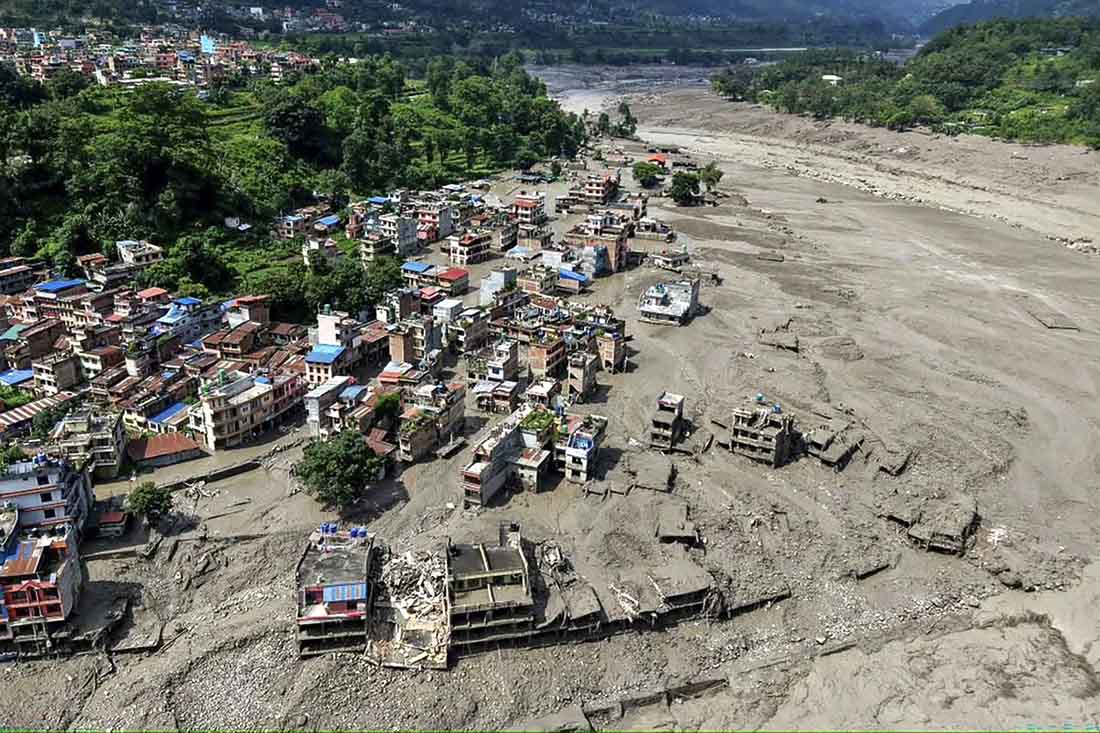
At least 160 people have been killed and hundreds remain missing after a devastating flash flood swept through northern Nepal, destroying villages, roads, bridges and power infrastructure near the border with Tibet.
Nepal Police said late on Wednesday that 157 bodies had been recovered, while emergency teams continued searching for survivors and moving residents away from areas considered at risk. Authorities warned that the death toll could rise as hundreds of people remained unaccounted for.
The country’s tourism ministry said 403 tourists, including 341 foreign nationals, were missing after the disaster. Among them were 142 Indian citizens, as well as visitors from Australia, the United Kingdom, Malaysia, the Netherlands, Portugal, South Africa, South Korea and the United States.
Floods in Nepal wreak havoc, sweeping away several villages and leaving over 1,000 people missing. Bridges and power plants destroyed. Army deployed. pic.twitter.com/4XaxIfZvnQ
— INDEPENDENT PRESS (@IpIndependent) August 26, 2026
Police spokesperson Abi Narayan Kafle said 28 police officers were also among the missing.
The disaster extended across the border into Tibet, where Chinese authorities reported at least three deaths and 265 people missing in Gyirong County. State broadcaster CCTV said rescue teams were still working to verify the full number of casualties.
Nepalese Prime Minister Balendra Shah called for national unity as the scale of the disaster became clearer. He said the government would take responsibility for rescue operations, medical care, food and shelter for those affected.
“Please be patient,” Shah said in a message shared on social media. “In times of such a disaster, we all need to stand together.”
The flash flood struck the mountainous Rasuwa district, affecting areas including Syapru Besi and Timure, where helicopters were unable to land because of dangerously high water levels. The district has a population of around 50,000 people.
Authorities urged residents living along the banks of the Bhote Koshi River to move to higher ground after reports that entire villages and infrastructure project sites had been washed away.
Nepal has also appealed to neighbouring India and China for assistance with rescue efforts.
Terrifying Scenes of Flood in Nepal!
A sudden devastating flood in the Bhote Koshi River in Nepal’s Rasuwa district has caused massive destruction. Videos that have surfaced clearly show the river’s furious form and the chaos all around.
Reports indicate that several markets,… pic.twitter.com/BOGtxZhI7o
— INDEPENDENT PRESS (@IpIndependent) August 26, 2026
Across the border, a mudslide struck the Gyirong port, a key land crossing between China and Nepal, cutting roads, communications and electricity supplies in parts of the Shigatse region. Chinese President Xi Jinping ordered an all-out search for missing people and called for stronger monitoring and early-warning systems to prevent further disasters.
Videos released by Nepal Police and shared widely on social media showed torrents of muddy water tearing through narrow mountain valleys, sweeping away homes and buildings.
Residents were reportedly caught off guard because there had been no significant rainfall immediately before the flooding. Local journalists said many people were inside their homes when the sudden surge of water hit.
The government has since convened emergency meetings involving disaster management authorities, medical teams, scouts and the Red Cross. The Nepal Army has deployed helicopters and disaster-response personnel, although difficult terrain and severe weather conditions are complicating rescue operations.
At least 160 killed, hundreds missing, as flash flood hits Nepal and Tibet
Across the border, Tibet reported ‘major casualties’ with people missing in the neighbouring county of Gyirong.
Nepal’s tourism ministry said some 403 tourists – 341 of them foreigners – were unaccounted… pic.twitter.com/3mm58gfu6S
— INDEPENDENT PRESS (@IpIndependent) August 27, 2026
The country’s electricity authority said about 430 megawatts of power generation capacity, including hydropower and solar facilities, had been damaged. Production, transmission and distribution infrastructure was affected, leading to electricity disruptions.
Foreign workers have also been caught up in the disaster. South Korea said eight of its nationals working at a hydropower plant were missing, while another 10 were stranded. The workers were employed by Korea Energy and Doosan Enerbility. Seoul has established a government task force and plans to send a rapid-response team to Nepal as soon as possible.
The exact cause of the flash flood is still being investigated. However, climate experts believe an avalanche from a glacier may have triggered the disaster.
__________________________________________________________________________

https://whatsapp.com/channel/0029VaAtNxX8fewmiFmN7N22
__________________________________________________________________________
Researchers from the International Centre for Integrated Mountain Development said the Lhende Khola River, a tributary of the Bhote Koshi, experienced the most severe flooding. Experts believe an ice-and-rock avalanche blocked the river before releasing a sudden and destructive surge of water downstream.
The same river has flooded twice in the past 14 months, highlighting the growing risks facing communities in the Himalayas.
Climate activists and researchers say stronger early-warning systems are urgently needed as climate change increases the danger of extreme events in the region. They warned that while such disasters may not be prevented entirely, better monitoring and faster warnings could help protect vulnerable communities.
The Bhote Koshi River originates in Tibet before flowing through Nepal and eventually into India as part of the Gandak River system. A previous flood last year killed nine people, left 24 others missing and washed away the Friendship Bridge linking Nepal and China.
Monsoon rains between June and September frequently trigger deadly floods and landslides across South Asia. Scientists say rising global temperatures are making extreme weather events more frequent and more intense, leaving mountain communities increasingly exposed to sudden and destructive disasters.
SOURCE: INDEPENDENT PRESS AND NEWS AGENCIES
__________________________________________________________________________
FOLLOW INDEPENDENT PRESS:
WhatsApp CHANNEL
https://whatsapp.com/channel/0029VaAtNxX8fewmiFmN7N22

TWITTER (CLICK HERE)
https://twitter.com/IpIndependent

FACEBOOK (CLICK HERE)
https://web.facebook.com/ipindependent

YOUTUBE (CLICK HERE)
https://www.youtube.com/@ipindependent

Think your friends would be interested? Share this story!