Sat 17 October 2026:
Ceramic Jars Dating to Early Bronze Age Recovered off Kekova Island
Turkey’s Culture Minister Mehmet Nuri Ersoy has announced that the country has unearthed ancient treasures from what he described as “the world’s oldest shipwreck.”
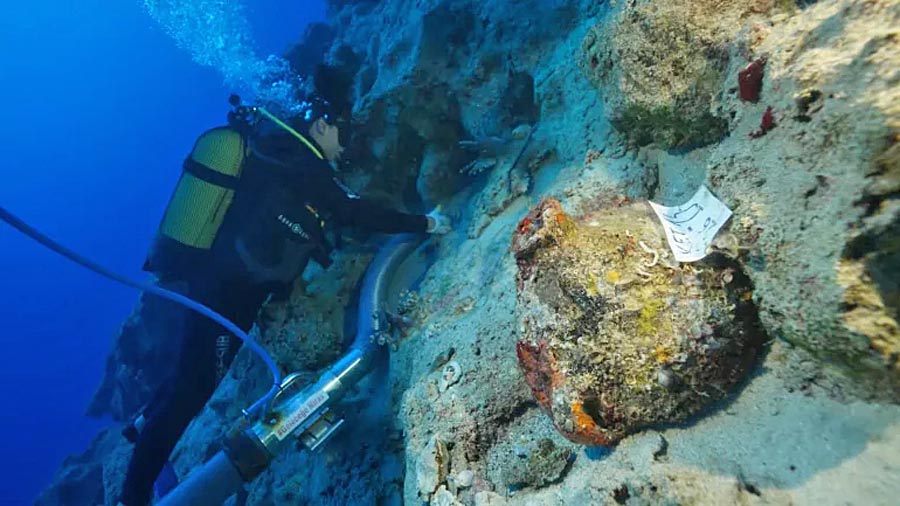
Underwater excavations near Kekova Island in southern Antalya province have yielded ceramic storage jars dating back 4,700 years to the Early Bronze Age, Ersoy said in a post on X on Wednesday. Although the vessel’s wooden hull did not survive, archaeologists recovered the jars during a project launched earlier this year.


A diver handles a container during underwater archaeological excavations near Kekova Island in Antalya, Turkiye, on October 14, 2026 [Turkiye’s Ministry of Culture and Tourism via Anadolu Agency]
Evidence of Early Mediterranean Trade
The jars, believed to have carried olive oil or wine, offer concrete evidence of early maritime trade and cultural exchange across the eastern Mediterranean, the ministry said. Clay analysis showed the containers were produced in workshops in the Jordan Valley and match similar styles previously found in Egypt, Turkey, and Greece, pointing to extensive Bronze Age sea routes.
Early Bronze Age jars rise from a merchant ship that sank off southern Türkiye around the time the Great Pyramid was built.
Thirty meters down off Kekova Island, divers are raising amphorae from a small merchant ship that sank 4,400 to 4,700 years ago. The wood is long gone. More than thirty jars and three stone anchors remain.
Clay analysis points to workshops in the Jordan Valley. The ship likely sailed west from the Levant toward Troy or Crete. Some jars still hold a glossy residue, perhaps oil, wine or resin.
One jar carries nine marks and two pierced holes. It may have been a churn, a sign that the crew kept goats aboard and made butter or cheese at sea.
The team calls Kekova the oldest shipwreck yet found, ahead of Greece’s Dokos wreck. The finds are headed for Antalya’s new Mediterranean Underwater Archaeology Museum.
— INDEPENDENT PRESS (@IpIndependent) October 17, 2026
One vessel stood out for its unusual design, featuring nine markings and two holes that suggest it may have been used to churn butter or cheese. Researchers believe the ship was traveling from the Levantine coast toward modern-day Hisarlik in Turkey or the island of Crete when it capsized and sank.
__________________________________________________________________________

https://whatsapp.com/channel/0029VaAtNxX8fewmiFmN7N22
__________________________________________________________________________
Archaeologist Describes Moment of Discovery
The excavation was directed by Hakan Oniz, an associate professor of archaeology at Akdeniz University. Speaking to the BBC, Oniz said that when his team first located the wreck four years ago, the jars appeared to be only a century or two old.

“However, we later became excited when we saw the same amphora forms in a publication on Egyptian archaeology and returned to the site,” he said. “Indeed, they were similar to those found at the Giza pyramids in Egypt. We were incredibly excited.”
The discovery has “shed light on the deep-rooted history of maritime trade along the Anatolian coasts,” Ersoy added.
SOURCE: INDEPENDENT PRESS AND NEWS AGENCIES
__________________________________________________________________________
FOLLOW INDEPENDENT PRESS:
WhatsApp CHANNEL
https://whatsapp.com/channel/0029VaAtNxX8fewmiFmN7N22

TWITTER (CLICK HERE)
https://twitter.com/IpIndependent

FACEBOOK (CLICK HERE)
https://web.facebook.com/ipindependent

YOUTUBE (CLICK HERE)
https://www.youtube.com/@ipindependent

Think your friends would be interested? Share this story!