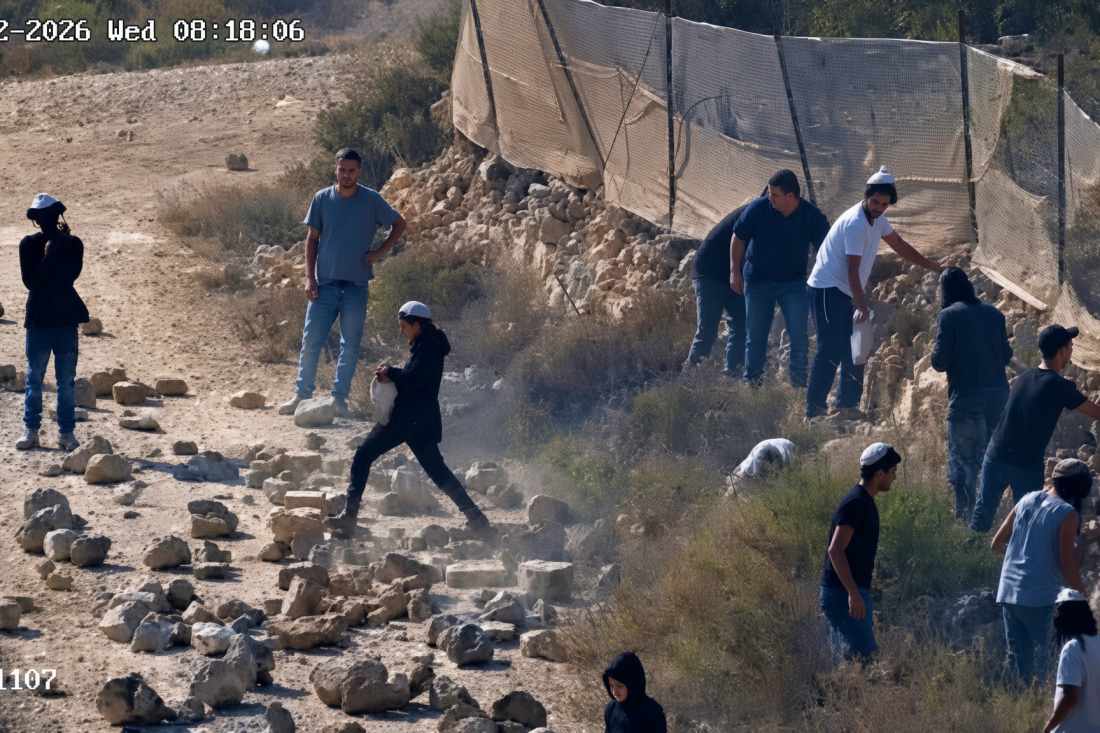
 CCTV footage shows Israeli settlers throwing rocks on the road in Qusra in the Israeli-occupied West Bank.
Mon 24 August 2026:
UN Special Rapporteur Francesca Albanese called Sunday for an “international protection presence” in the occupied West Bank, East Jerusalem and Gaza, saying such a deployment was “absolutely urgent.”
“Third states have an obligation, per the ICJ, to act to end Israel’s unlawful occupation,” Albanese wrote on the US social media platform X, referring to a July 2024 advisory opinion by the International Court of Justice that deemed Israel’s occupation of Palestinian territory unlawful and said states must not assist in maintaining it.
Albanese also questioned whether UN Secretary-General Antonio Guterres’ diplomatic efforts and the General Assembly’s “Uniting for Peace” mechanism could overcome the Security Council’s deadlock on the conflict.
The mechanism allows the General Assembly to consider international peace and security issues when the Security Council cannot act because of a lack of unanimity among its permanent members. The council has repeatedly been unable to take action on Gaza and the West Bank amid vetoes by the US.

Israeli forces also continued their operations against the town of Qusra, south of Nablus for the 11th consecutive day. They have imposed a complete siege on the Ras al-Ain area, west of the town, for nine days, cutting them off from basic supplies and emergency services.
Israeli settlers have besieged and attacked the area for a longer period. They have burned tents and property, uprooted trees, and stolen equipment and timber.
Qusra Mayor Abdul Azim Wadi told The New Arab,“The settlers’ siege imposed on the Ras al-Ain area is entering its third week, while the army’s siege has continued for nine days.”
Wadi said Israeli forces withdrew early Sunday from a home belonging to a Palestinian family after occupying it since the beginning of the siege, but left the house badly damaged.
He said the Israeli forces removed the home’s contents and damaged furniture, windows and balconies. Wadi added that the extent of the damage indicates that it will take a long time to restore the house to its previous condition.
Wadi said that Israeli forces remain around the besieged homes and that an army tent they established there is still in place. Settlers also continue to arrive in the area.
Settlers used the same tactic just last month to force the al-Tubassi family from their home in Jalud. This time, however, with one of the besieged Qusra homes belonging to a Palestinian-American, the siege has become front-page news.
On August 13, Israeli forces ordered the families to evacuate, saying the homes would be seized “to protect” them, and converted 16 homes in the town into military barracks. Soldiers entered Qusra that day. Israeli forces briefly detained one Israeli suspect during a later overnight operation dismantling nearby outpost structures, but no other arrests of settlers have been reported. Amnesty International’s Erika Guevara Rosas said the siege reflected “an accelerating and well-documented pattern of coordinated and strategic settler terror, enabled, backed and funded by the State of Israel”.
For a second week, 15 Palestinians, including two children, remain trapped in their homes. Soldiers spent two days dismantling the settlers’ tent, only to put up their own in the same spot, effectively continuing the closure. Municipal crews eventually restored electricity and water, but the families say they have been told they can’t leave their homes. Speaking to Al Jazeera the same day, UN Special Rapporteur Francesca Albanese called Qusra the “climax” of Israel’s “decades-long rule of impunity”, saying Israeli officials “appear to be collaborating with settlers rather than restraining them”.
For years, the legal architecture of West Bank dispossession – including firing-zone designations, “state land” declarations and a permit regime that effectively criminalises Palestinian construction – has operated overwhelmingly in Area C, the area of the West Bank under full Israeli control. It has fallen hardest on Bedouin and herding communities who have experienced massive forcible displacement as a result.
Beit Imrin has none of that legal exposure. But as the Qusra siege leads settlers to widen such tactics, the week’s developments suggest that where the traditional legal toolkit of the occupation doesn’t reach – like the areas of the West Bank under nominal Palestinian control – the pattern is becoming clear: settlers establish a tent adjacent to homes and are not removed; Palestinians’ homes are besieged, with water, power, supplies and medical services cut off; and soldiers arrive not to remove the settlers, but increasingly to remove the family – through arrest or ostensibly for their “protection”.
__________________________________________________________________________

https://whatsapp.com/channel/0029VaAtNxX8fewmiFmN7N22
__________________________________________________________________________
Gaza’s trajectory hangs in the balance
A Board of Peace official told Al Jazeera on Monday that the body had agreed with Israeli Prime Minister Benjamin Netanyahu that Israel did not need to withdraw its forces from Gaza until Hamas disarms – including both light and heavy weapons, and the dismantling of its tunnel network.
That comes after Netanyahu had publicly rejected the disarmament agreement announced by US President Donald Trump last month. The deal had initially envisaged a phased withdrawal occurring alongside a phased disarmament.
At the same time, in a podcast with former Israeli captive Rom Braslavski, National Security Minister Itamar Ben-Gvir said Israeli forces should kill “30 or 40” people in Gaza every night, going beyond those who pose an immediate threat. The far-right minister said he opposed Netanyahu’s decision to scale back strikes under the current truce, called for encouraging Palestinians to leave Gaza permanently alongside new Israeli settlement of the Strip, and offered to help arrange for Braslavski to personally execute prisoners under Israel’s newly enacted death-penalty law for Palestinians. Ben-Gvir holds no formal authority to order military strikes but sits on Israel’s security cabinet.
SOURCE: INDEPENDENT PRESS AND NEWS AGENCIES
__________________________________________________________________________
FOLLOW INDEPENDENT PRESS:
WhatsApp CHANNEL
https://whatsapp.com/channel/0029VaAtNxX8fewmiFmN7N22

TWITTER (CLICK HERE)
https://twitter.com/IpIndependent

FACEBOOK (CLICK HERE)
https://web.facebook.com/ipindependent

YOUTUBE (CLICK HERE)
https://www.youtube.com/@ipindependent

Think your friends would be interested? Share this story!