Fri 28 August 2026:
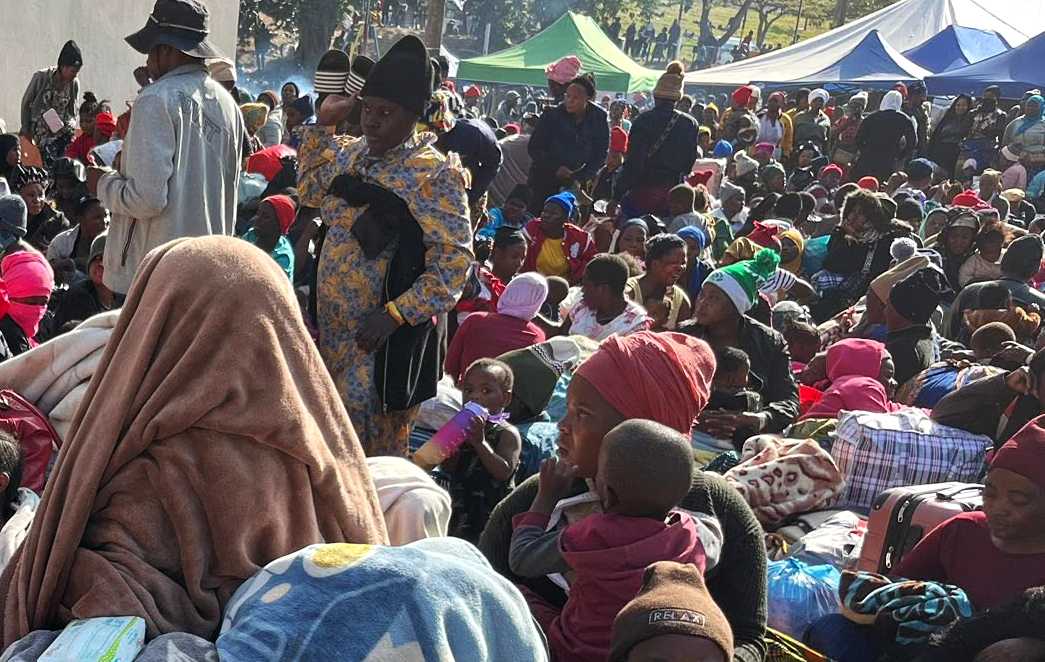
When the unilaterally imposed June 30th deadline for the evacuation or return of illegal migrants triggered an exodus of both legal and illegal migrants the organisers used the real economic grievances of ordinary south africans as the movement’s raison detre. Leader of the movement, Jacintha Ngobese Zuma claimed that their aim was to address the “severe economic and social costs, such as job losses and increased crime.’’ While many critics saw the group’s protest as scapegoating an already vulnerable migrant population, regardless of their legal status, others like journalist Gillian Schutte, wrote strongly against critics.
In her piece, Majoritariat Phobia and the Rumour Machine Around March and March (5 July 2026), Schutte argues that focusing on Ngobese Zuma’s family ties to Jacob Zuma “removes Black South Africans from the centre of their own revolt. It protects the liberal class from the possibility that the anger may be real, widespread and rooted in material life.” Her argument is intended as a sobering wake-up call to those who view March and March as xenophobic. Instead, she frames the movement as an indigenous protest against state failure that the NGO class cannot stomach. In her view, dismissing the grievances behind the marches as manufactured hysteria is itself a form of patronisation.
__________________________________________________________________________

https://whatsapp.com/channel/0029VaAtNxX8fewmiFmN7N22
__________________________________________________________________________
The gap between what the movement says and what is actually produces is the subject of this piece. Schutte identifies the real and lived experiences of South African’s exhausted by the consequences of a failing state. Her argument is made in good faith and indeed many aspects correctly diagnose the problems facing South Africa’s underserved majority. The description of how civic life often must align with donor incentives is a serious point and deserves its own interrogation. However, these arguments lose their gravity when we look at what the MaM leadership actually says and does. Once you look at these aspects closely enough you cannot unsee three major inconsistencies. Firstly, the legal distinction Schutte relies on isn’t the one operating on the ground. Second, the underlying claim to who South Africa “really” belongs to is built on a historical fallacy most importantly the question this movement ultimately poses isn’t about immigration policy at all. It’s about who we’ve decided we are.
Starting with the constitution, which is uncontested, the Bill of Rights states that South Africa “enshrines the rights of all people in our country and affirms the democratic values of human dignity, equality and freedom.” There is no trace of the word ‘citizen’, but rather affords the rights enshrined it to all except for a handful of rights like political participation. The Constitutional Court settled this decisively in Lawyers for Human Rights v Minister of Home Affairs (2004 and again in 2017), striking down provisions that allowed arbitrary detention of undocumented foreigners precisely because dignity, freedom, and access to courts do not carry a passport requirement. Section 16(2)(c) goes further still: it removes advocacy of hatred based on race, ethnicity, or religion from free-speech protection altogether, not because such speech loses an argument but because our Constitution decided in advance that it isn’t a legitimate contender.
From the legal perspective, MaM and its ideological cousin; Operation Dudula, those involved would actually be committing a crime by doing random civilian led ‘papers check’. It has no legal authority to do so and in November 2025, the Johannesburg High Court judged that only Immigration officials and police officers may do such checks under the Immigration Act. The same judgement importantly viewed Operation Dudula’s actions as incitement that led to blockaded clinics that forced women to give birth at home, the gruesome murder of Elvis Nyathi in Diepsloot and traders forcibly evicted from their stall. President Ramaphosa and Police leadership said the same regarding MaM’s own organiers in June of this year. The fact that an estimated 15 million South Africans live with incomplete or backlogged documentation and cannot always produce an ID on demand should ring alarm bells around their ‘dompass’ strategy.
This is a severe fracture in the argument that assumes that MaM are simply aiming for illegal migrants when in fact it relies on who looks, speaks or acts like a foreigner, That is an ethnic based argument clothed in legalese.
The fallacy of indigeneity
Hiding behind this ‘documented’ vs ‘undocumented’ argument is the assumption that South Africa belongs to its indigenous communities, and everyone else is almost negotiable and revocable. The evidence for this is clear in Ngobese Zuma’s viral facebook post about Police Commissioner Firoz Cachalia’s visit to Laudium. She asked why the Minister was not visiting areas affected by drugs, crime and unemployment (the Laudium community is not immune to those social ills). The post racked up some 2000 responses many of which derided Muslim South Africans and framed them as outsider/illegal /foreign to South Africa. The rewriting of social history based on ethnicity is not a new phenomenon in South Africa.
Anthony D. Smith, a scholar of nationalism spent much of his career cataloguing what he called, chosen people’ nationalism, the idea that specific people were destined for an exclusive homeland. He found patterns of this everywhere including in Afrikaner nationalism in South Africa. Paul Kruger described the Great Trek explicitly as an Exodus to Promised land, and the victory at Blood River was seen as a sacred claim to the land. Ultimately this ethnic ‘destiny’ became the theological justification for Apartheid.
It was precisely this exclusionary claim that propelled the liberation movement to explicitly reject ethnic essentialism. Rather the Congress of the People adopted the Freedom Charter with the deliberate nonracial declaration that South Africa belongs to all who live it it, signaling that it is the will of its people not ethnic entitlement that will guide its policies. The fracture within the ANC between those who rejected non racialism led to the creation of the Pan Africanist Congress (PAC) in 1959 on the premise that the struggle and the land belonged to indigenous Africans alone. But it was the vision of a shared inheritance that established that a shared life and not ethnic affiliation would determine our belonging to this country. A movement that claims to speak for people apartheid disposed cannot borrow Apartheid’s own logic of belonging without becoming institutionally if not intentionally its mirror image.
When we consider how many documented and undocumented migrants have been forced out, how many lives have been disrupted, and how many schoolchildren have been removed from classrooms midway through the academic year, the question becomes what MaM has actually achieved? It can be argued that the MaM movement has done little of substance to address the structural poverty and crime caused by misgovernance, not migration.
If there was an irony to this rather uncomplicated scenario it would be that more than any gains that MaM could claim to have made through their ‘go home’ campaign it is the selfless work of slain whistle blower, Babita Deokaran, whose voice still reverberates through the Madlanga Commission of enquiry . Deokaran was a South African of Indian heritage from Phoenix, Durban, who worked her way up from an accounting clerk to Acting Chief Director of Financial Accounting at the Gauteng Department of Health. In August 2021, in that role, she halted roughly R850 million in suspicious payments flowing out of Tembisa Hospital to a network of more than two hundred companies. This scheme extracted public health money meant for the poorest patients in the province, at the height of a pandemic. She warned her supervisor, in writing, that her life could be in danger for doing it. Three weeks later, on 23 August 2021, she was shot dead outside her home in Winchester Hills, Johannesburg. Six men have since been convicted of carrying out her murder.
But Babita’s death did not end the investigation, it launched it. The Special Investigating Unit confirmed her findings were accurate. Just last month, in July 2026, the NPA’s Asset Forfeiture Unit seized R326 million in assets — four Lamborghinis, a Bentley, luxury properties — from one of the businessmen implicated in the scheme she uncovered. Five years on, her disclosures are still producing convictions and seizures, in what one investigative journalist has called, without exaggeration, “Babita’s revenge.”
Set that against the movement’s own account of who protects South Africans and who threatens them. No spaza-shop boycott, no unlawful “papers check,” no march has clawed back R326 million stolen from a health system serving the province’s poorest patients. A woman from the very community considered as ‘foreign’ and untrustworthy did more, at the cost of her life, to defend the material conditions of ordinary South Africans than anything March and March has yet achieved. If the question really is who is failing this country and who is defending it, the honest answer runs in the opposite direction from what Ngobese Zuma would have you believe.
Digital Nomads
Where MaM have protested in township areas, focusing on the most vulnerable, they have been remarkably silent on the substantial negative impact that ‘digital nomads’ are having on local economies. The numbers in Cape Town are worthy of serious interrogation. Housing activists describe long-term rental stock being converted wholesale into tourist and nomad accommodation, “pushing out locals from neighbourhoods where they can no longer afford to live. Airbnb listings in Cape Town’s City Bowl and Atlantic Seaboard rose 190% between 2022 and 2024, a figure independently corroborated by BusinessTech (Sept 2024), Berman Bros’ market analysis, and the Cape Town Housing Data Portal.
Independent listings-counter Ian du Plessis recorded 23,564 active Airbnb listings citywide as of mid-2024. This puts Cape Town at the eighth-highest count of any city in the world, ahead of Lisbon, Berlin and Barcelona reported consistently across GroundUp, News24 and CapeTownEtc.
These stats belie the logic of MaM on its own terms. If the organizing principle is truly about documentation status and accountability to South Africa, digital nomads would be the quintessential case. A digital nomad is basically transient by design, largely untaxed and contributes nothing to local employment while at the same time drives up the cost of living for the poorest South Africans in the country’s most unequal city. The difference is not documentation, they are arguably specifically here on immigration law designed for them – what is different is that their wealth and passports make them unaccountable in a way that poverty never does. It is visibility not legality, that organizes and decides who gets treated as a threat.
Jacintha and Kallie
MaM’s ethno nationalism found an unlikely partner last week when Ngobese Zuma met with Afriforum CEO Kallie Kriel to create a ‘collaborative working group’ that includes border control, safety, mother-tongue educations and what they both call ‘peaceful coexistence’. The collaboration runs in one direction as Ngobese Zuma was clear that she wanted MaM to become ‘like Afriforum’ and that they could learn much from the Afrikaner group.
If we look at what Afriforum is as the institutional heir of the Afrikaner Nationalist ‘chosen people’ variety, best known for lobbying foreign governments on ‘white genocide’ and Afrikaner victimhood, MaM has chosen an odd ally. If solidarity with landless and disposed indigenous South Africans is the aim it makes no sense at all. However, if the aim is to police who belongs and who doesn’t – regardless of who is doing the excluding then the alliance makes perfect sense. It becomes clear that the ‘indigenous vs foreign’ framework is only useful when levelled at African, Indian descent migrants. Indeed, Ngobese Zuma was herself a recipient of the 2023 US’s International Visitor Leadership Experience (IVLP), a program specifically created to advance US national security interests through rising youth leaders from around the world. More explicit than her affiliation with the US thinktank is Ngobese Zuma’s history of deriding Muslim South Africans. In a tweet that took aim at a Muslim school that adopted a justice-based syllabus focusing on the Palestinian cause, she opined, ‘Imagine if a Christian country went and rolled out a Christian curriculum in a Muslim country? What would Muslims do?’. Not only did this demonstrate her clear bias but also highlighted her ignorance of the fact that the birthplace of Christianity is currently under occupation and that the call for justice for Palestine includes justice for Palestinian Christians oppressed by the Zionist Israeli regime.
While Ngobese Zuma’s has denied allegations that her movement may be funded by Israel calling those suggestions ‘offensive and unfounded’, she has voiced her support for Action SA, one of the many opposition political parties funded by South African born Zionist, Martin Moshal. Moshal’s links to the Israeli establishment currently under investigation for committing genocide in Gaza are not casual. He is a trustee on the board of Keren Hayesod, a state institution that funds international recruits to the Israeli Defense Force (IDF). The same military that is being investigated for genocide. And where has Moshal’s fortune which contributed roughly R110 million to opposition parties including the DA and Afriforum come from?
AmaBhungane/Daily Maverick (12 June 2026) reports that Moshal “is the beneficiary of a number of trusts that together own 45% of Super Group,” NYSE-listed parent company of the gambling giant Betway. Hardly, a socially responsible industry. In contrast, the National Gambling Board’s statistics show that R76 billion is siphoned from the economy through gambling sites including Betway and Hollywood Bets. The two gambling sites combined receive 60 million visits monthly, while Betway’s annual advertising spend alone is R342 million. This is where Stats SA says distressed households spend up to 55 percent of their gross income, with 57 percent of gamblers cutting food/rent/transport to keep betting.
Gambling linked suicide trends have also roughly tripled according to mental health professionals interviewed by the Daily Maverick. If there was an industry more damaging to the social, economic and physical health of ‘ordinary South Africans’ whom Ngobese Zuma often cites as their main constituents, it would be the gambling industry – and Martin Moshal, the Australian based bank roller, who would have done more harm than any township spaza shop owner could possibly do.
The Moral Question
Beneath the questions of legality and history is a question that should concern us regardless of where our views on immigration policy. What does it say about us a nation if we have reached a point where citizens are performing unlawful ‘papers check’ on their neighbours, blocking pregnant women from accessing clinics, and using social media to incite panic about a centuries old community that is part of the fabric of this country?
The grievances driving people into the streets are real. Unemployment, failing clinics, overcrowded schools are all symptoms of a state that has not delivered what it promised. Nothing here disputes that, and nothing about a constitutional or historical rebuttal should be read as telling angry, struggling people that their anger is illegitimate. But a country doesn’t solve unemployment by demanding a Zulu grandmother’s ID at a taxi rank, and it doesn’t fix a health system by locking pregnant women out of clinics. What those acts actually do is answer a different question entirely, not “how do we build a functioning state,” but “who among us is disposable enough to blame.”
The statements, views and opinions expressed in this column are solely those of the author and do not necessarily represent those of Independent Press.

By Mariam Jooma Çarikci
Mariam Jooma Çarikci is an Independent researcher, focused on the politics of Africa, Zionism in Africa, and Türkiye’s evolving role in the Middle East and Africa.
__________________________________________________________________________
FOLLOW INDEPENDENT PRESS:
WhatsApp CHANNEL
https://whatsapp.com/channel/0029VaAtNxX8fewmiFmN7N22

TWITTER (CLICK HERE)
https://twitter.com/IpIndependent

FACEBOOK (CLICK HERE)
https://web.facebook.com/ipindependent

YOUTUBE (CLICK HERE)
https://www.youtube.com/@ipindependent

Think your friends would be interested? Share this story!