Mon 24 August 2026:
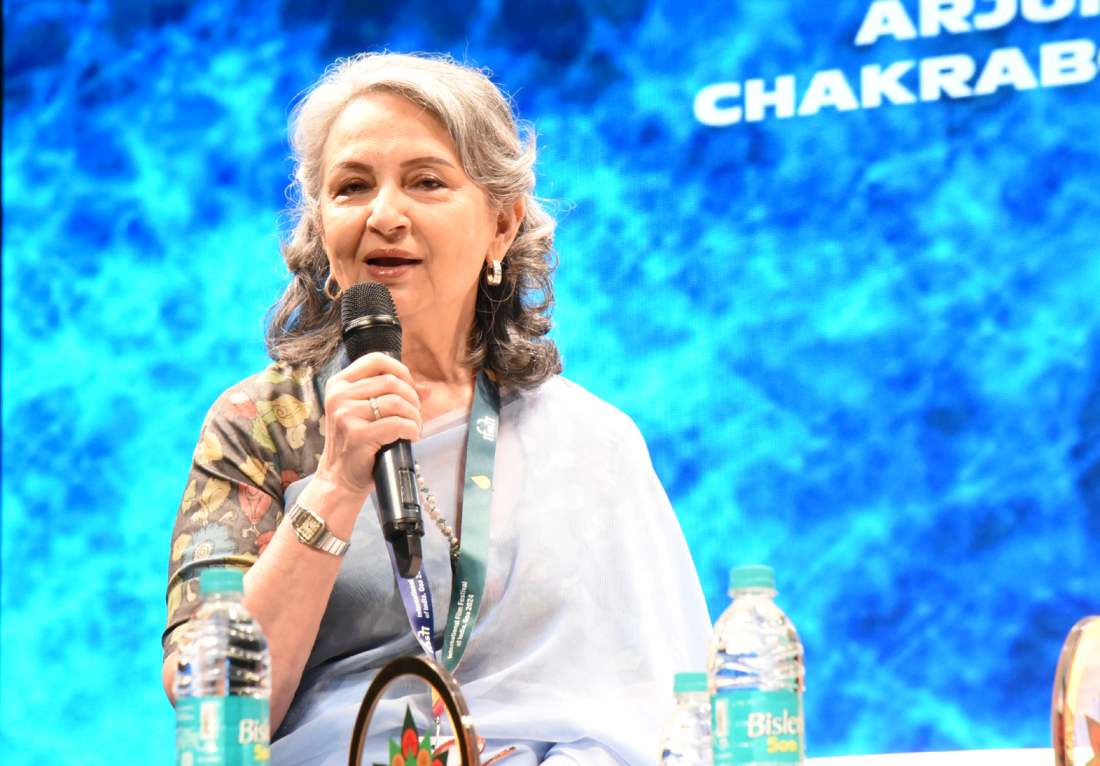
Veteran actress Sharmila Tagore has said that the nation should stick to only the first two stanzas of the national song ‘Vande Mataram’.
The actress spoke with IANS on Thursday, and said that the entire song may not comply with the religious beliefs of many communities in India as they are monotheistic in nature.
She told IANS, “My point of view is that there are many religious people who believe in one single God, not many Gods. In ‘Vande Mataram’, there is a stanza which says that many Gods are mentioned in ‘Vande Mataram'”.
“It is difficult for those who believe in one religion to say, ‘Vande Kali, Vande Durga’. Therefore, if we take all the religious people in India together, the first two stanzas are very good”, she added.
Her argument, therefore, was not against Vande Mataram in its entirety. She was specifically making a case for retaining the first two stanzas while leaving out the later verses that contain references to Hindu deities.
She told IANS, “My point of view is that there are many religious people who believe in one single God, not many Gods. In ‘Vande Mataram’, there is a stanza which says that many Gods are mentioned in ‘Vande Mataram'”.
“It is difficult for those who believe in one religion to… pic.twitter.com/5RPGhsmviu
— INDEPENDENT PRESS (@IpIndependent) August 24, 2026
Veteran actor’s remarks on Vande Mataram have triggered a strong response from actor and BJP MP Kangana Ranaut.
Her comments came amid a wider political debate over the rendition of Vande Mataram, with the BJP and Congress taking opposing positions on which portions of the song should be sung at public and party events.
__________________________________________________________________________

https://whatsapp.com/channel/0029VaAtNxX8fewmiFmN7N22
__________________________________________________________________________
Why did Kangana Ranaut object?
Kangana Ranaut strongly disagreed with Sharmila’s interpretation of the song. Sharing a video of Sharmila’s interview on her Instagram Stories, Kangana said she respected the veteran actor’s right to express her reservations but questioned her understanding of the song as an artist.
Kangana argued that poetry and art often use metaphors and imagery and should not necessarily be interpreted as literal religious texts.
She said Vande Mataram represents the spirit of India’s freedom struggle and that Bankim Chandra Chatterjee’s use of the idea of Shakti should be understood as a call for strength and awakening. Kangana wrote that she was “shocked as an artist” by what she described as a limiting interpretation of art and poetry. She argued that reducing Vande Mataram to a matter of religious practice overlooked the larger symbolism of the composition.
What is the controversy around the first two stanzas?
The debate over the first two stanzas of Vande Mataram is not new. The song, written by Bankim Chandra Chatterjee, was first published in the literary journal Bangadarshan on November 7, 1875. It was later incorporated into his 1882 novel Anandamath. While the original composition had two stanzas, the version that appeared in the novel contained additional verses.
The song became an important part of India’s freedom movement and was first sung at a Congress session in 1896 by Rabindranath Tagore. However, concerns were raised over some of its imagery and its association with Anandamath. Some Muslim leaders and sections of the Muslim community objected to references to Hindu deities and the portrayal of the motherland in a form resembling a goddess.
The issue became particularly contentious within the Congress in the 1930s. There were concerns that using the complete song could alienate Muslims at a time when the freedom movement was trying to maintain unity.
In 1937, Congress leaders eventually decided to use only the first two stanzas at political gatherings. Rabindranath Tagore, who had himself sung Vande Mataram at the 1896 Congress session, was consulted during the debate and supported the use of the first two stanzas.
This historical decision is also at the centre of the Congress’s present-day position.
Why is the issue back in the news?
The controversy intensified after the 80th Independence Day celebrations, when the full version of Vande Mataram was performed at the Red Fort on August 15. This renewed the debate over which parts of the song should be sung at official and political events.
The Congress Working Committee has maintained its position of using only the first two stanzas of the song during party programmes, saying this follows the position adopted by the party in 1937. The BJP, however, has accused the Congress of disrespecting the national song. Congress president Mallikarjun Kharge has defended his party’s position.
Sharmila Tagore’s connection to Rabindranath Tagore
Sharmila Tagore is also related to Rabindranath Tagore. On her mother’s side, her maternal grandmother Latika Tagore was the granddaughter of Dwijendranath Tagore, Rabindranath Tagore’s eldest brother. She is also related to the Tagore family through her father’s side.
This connection is particularly interesting, given Rabindranath Tagore’s own association with Vande Mataram. He composed the tune and also sang the song at the 1896 Congress session and later advised that only its first two stanzas be used amid concerns over its religious imagery.
Saif’s sister Saba reveals Sharmila Tagore converted to Islam
During a conversation with the YouTube channel Big Bollywood Buffs, Saif Ali Khan’s sister Saba Pataudi shared that she identifies as a Muslim and feels deeply connected to her faith.
“For me, I would say my religion is Islam, and I do connect with it. And I’m spiritual because, if I were to think of a God, I would probably say Allah,” she said.
Saba clarified that following one faith does not mean disrespecting other religions. She then spoke about her parents’ interfaith marriage and said Sharmila converted to Islam after marrying legendary cricketer Mansoor Ali Khan Pataudi.
“When Amma and Abba got married, Amma, in fact, did convert to Islam and did guide us in Islam, perhaps so that we wouldn’t be confused and would have some sort of grounding,” Saba revealed.
She further claimed that Hinduism was not actively practised in their household while the siblings were growing up. “There was no temple, there was no Hindu religion that we practised,” she added.
Saba Pataudi, sister of Saif Ali Khan and daughter of Sharmila Tagore, says her religion is Islam and that she feels spiritually connected to it.
She also says her mother converted to Islam and guided them in Islam.
She says there was no temple and that there was no Hindu… pic.twitter.com/7F1NcTUzo2
— Amit Kumar Sindhi (@AMIT_GUJJU) August 15, 2026
Sharmila Tagore married Mansoor Ali Khan Pataudi in 1968. The couple welcomed three children, Saif Ali Khan, Saba Pataudi and Soha Ali Khan. While Saif and Soha entered the entertainment industry, Saba largely stayed away from films and pursued jewellery designing.
Saba’s revelation has now grabbed attention online, offering a rare glimpse into the faith and upbringing of one of Bollywood’s most prominent families.
Cultural Majoritarianism: Hindutva proponents seek to redefine Indian identity from a pluralist, multi-religious republic into a distinct Hindu civilizational state. Pushing the complete poem—which explicitly invokes Hindu deities like Durga in its later stanzas—asserts Hindu sacred symbols as default national standards.
Diversion from Governance: Political analysts often view these symbolic campaigns as strategic maneuvers used to consolidate majoritarian support and shift public focus away from pressing socio-economic challenges, governance issues, and systemic grievances.
SOURCE: INDEPENDENT PRESS AND NEWS AGENCIES
__________________________________________________________________________
FOLLOW INDEPENDENT PRESS:
WhatsApp CHANNEL
https://whatsapp.com/channel/0029VaAtNxX8fewmiFmN7N22

TWITTER (CLICK HERE)
https://twitter.com/IpIndependent

FACEBOOK (CLICK HERE)
https://web.facebook.com/ipindependent

YOUTUBE (CLICK HERE)
https://www.youtube.com/@ipindependent

Think your friends would be interested? Share this story!